Facts
M/s. Geojit Financial Services Ltd., a company incorporated under the Companies Act, allotted shares to its employees under an Employees Stock Option Plan (ESOP).
Source reference: paras. 1–2The assessee claimed the discount arising on the allotment of ESOP shares as revenue expenditure deductible under Section 37(1) of the Income Tax Act, 1961. The Assessing Officer disallowed the claim, but the Commissioner of Income Tax (Appeals) allowed it.
Source reference: paras. 1–2The Income Tax Appellate Tribunal, Cochin Bench, affirmed the appellate order and dismissed the Revenue’s appeal. The Principal Commissioner of Income Tax challenged the Tribunal’s decision before the Kerala High Court.
Source reference: paras. 1–2Issues
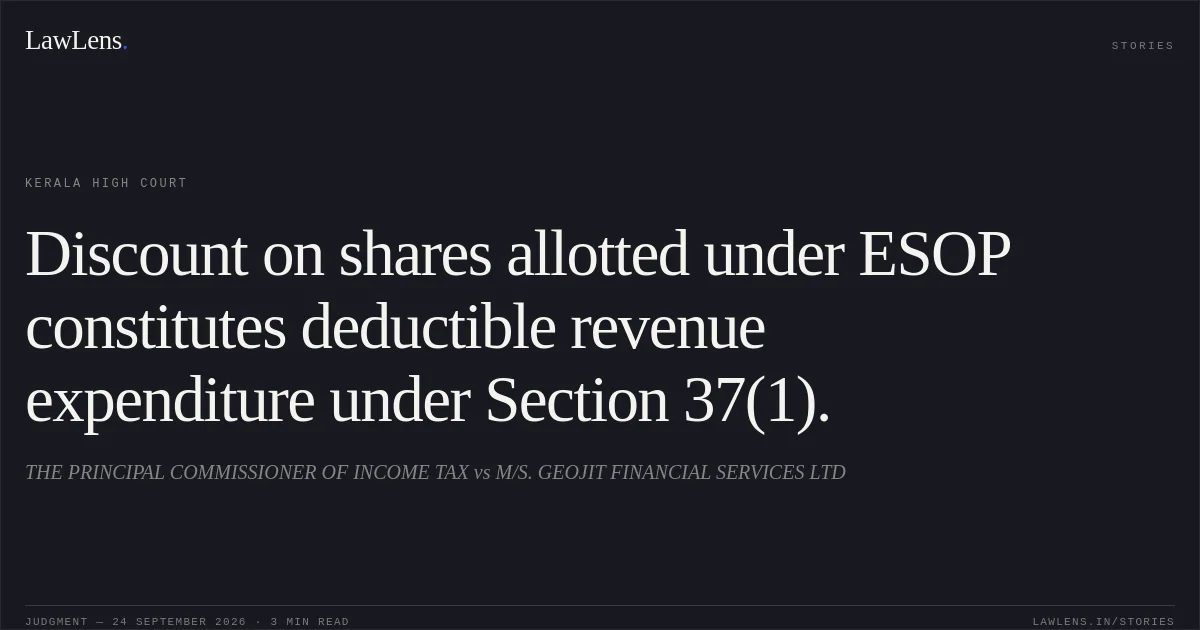
Whether the discount allowed on shares allotted under an ESOP constitutes revenue expenditure allowable as a deduction under Section 37(1) of the Income Tax Act, 1961?
Source reference: para. 3(i)Whether, on the facts and circumstances of the case, the Tribunal was correct in affirming the order allowing the assessee’s claim for deduction of the ESOP discount under Section 37(1) of the Income Tax Act?
Source reference: para. 3(ii)Law Applied
Section 37(1) of the Income Tax Act permits deduction of expenditure incurred wholly and exclusively for business purposes, and the expression “expenditure” may include a loss.
Source reference: para. 8The Court relied on CIT v. Lemon Tree Hotels (P) Ltd., 2018 SCC OnLine Del 13684, which held that ESOP expenditure is not merely notional merely because the employer issues or allots its own shares rather than purchasing shares from a third party.
Source reference: para. 8It also followed CIT (LTU) v. Biocon Ltd., (2021) 430 ITR 151 (Karnataka), which held that ESOP discount is an ascertained business liability accruing over the vesting period; its later quantification upon exercise of the option does not make it contingent.
Source reference: para. 9The Karnataka High Court further held that the discount represents expenditure incurred to secure employee services and incentives, rather than a short receipt of capital.
Source reference: para. 9The principles in Bharat Movers and Rotork Controls India (P) Ltd. were applied regarding accrued business liabilities, while CIT v. Infosys Technologies Ltd., (2008) 297 ITR 167 (SC) was distinguished as a tax-deduction-at-source case involving different statutory provisions and issues.
Source reference: para. 9Reasoning
The Court held that allotting shares to employees at a price below their market value results in the assessee absorbing the difference between the market value and the issue price.
Source reference: para. 10That difference constitutes an economic loss or expenditure incurred for the business purpose of attracting, retaining, and incentivising employees, and therefore falls within Section 37(1).
Source reference: para. 10The liability arises over the vesting period and is not rendered contingent merely because the precise amount may be determined when the employee exercises the option.
Source reference: para. 9The Revenue’s contention that no deductible expenditure arises in the absence of a purchase of shares from a third party was rejected, since such an approach would ignore the commercial reality of ESOP arrangements and incorrectly characterise the discount as a notional loss.
Source reference: para. 8The Court also found that the ESOP discount was not a diminution or short receipt of capital, but an expenditure incurred in the course of earning business profits.
Source reference: para. 10Holding
The Kerala High Court answered both substantial questions of law in favour of the assessee.
It held that the discount on shares allotted under the ESOP is revenue expenditure allowable under Section 37(1) of the Income Tax Act, subject to the applicable statutory requirements.
Source reference: para. 11The Court affirmed the order of the Income Tax Appellate Tribunal and dismissed the Revenue’s appeal.
Source reference: paras. 11; pp. 14–15Acts & Sections Cited
5 provisions across 1 statute referred to in this judgment. Linked provisions open on LawLens.
Companies Act, 19565
Original Court PDF
THE PRINCIPAL COMMISSIONER OF INCOME TAXvsM/S. GEOJIT FINANCIAL SERVICES LTD
Click to open original judgment
Original judgment, available to read, download and summarize on LawLens.in
![Subsequent criminal proceedings do not warrant review absent an error apparent on the record.. M/o Finance vs R C BAKSHI. CAT - ['Delhi']. LawLens](/stories/thumbnails/subsequent-criminal-proceedings-do-not-warrant-review-absent-an-error-apparent-on-the-reco-1686b1e451684d1590db13b17e36a8d2.webp)
![Transfer-policy tenure guidelines create no indefeasible right; interference requires statutory violation or established mala fides.. PRIYADARSHI PARIMAL AROHI vs BSNL. CAT - ['Patna']. LawLens](/stories/thumbnails/transfer-policy-tenure-guidelines-create-no-indefeasible-right-interference-requires-statu-110afbbb489a444f8a39741589297e68.webp)
![Recovery of excess pay from a retired employee is impermissible absent fraud or misrepresentation.. RAVI KANT vs Bharat Sanchar Nigam Ltd. CAT - ['Patna']. LawLens](/stories/thumbnails/recovery-of-excess-pay-from-a-retired-employee-is-impermissible-absent-fraud-or-misreprese-074b3b610aa14d1799eeaee490035275.webp)