01Facts
The prosecution alleged that on August 8, 2014, while the informant (PW-1) and the deceased (Raju Yadav) were laying a foundation for a house, the six appellants arrived armed with firearms.
p. 8It was alleged that Babloo Dubey exhorted the others, leading Govind and Suresh Yadav to shoot the deceased in the head at close range, while Babloo allegedly snatched the deceased's licensed pistol before the group fled.
pp. 8-9The trial court convicted the appellants under Sections 147, 148, 302/149, 307/149, and 504 of the IPC, and specifically convicted Govind and Suresh under Section 3/25 of the Arms Act.
p. 3The appellants challenged this on grounds of medical contradictions, alibi, and discrepancies in the place of occurrence.
pp. 17-2002Issues
i.1. Whether the ocular testimony of PW-1 and PW-2 was reliable given the material contradictions regarding the place of occurrence and the medical evidence.
pp. 54-56ii.2. Whether the recovery of weapons under Section 27 of the Evidence Act was legally sustainable in the absence of a recorded disclosure statement.
p. 55iii.3. Whether the failure to conduct a dock identification of an unnamed accused (Rajan Yadav) vitiates the conviction.
p. 56iv.4. Whether the plea of alibi raised by Babloo Dubey was sufficiently established to discard the prosecution version.
p. 5703Law Applied
The Court applied Section 302 (Murder) and Section 149 (Unlawful Assembly) of the IPC.
p. 3It relied on the principle from Subramanya v. State of Karnataka (2023), which mandates that a disclosure statement must be recorded before recovery under Section 27 of the Evidence Act.
p. 55Regarding identification, it followed Tukesh Singh v. State of Chattisgarh (2025), holding dock identification essential for unnamed accused.
p. 20, 56It also considered Section 157 CrPC regarding the delay in forwarding the FIR to the Magistrate.
p. 17, 44Provisions in the judgment · 14 · Linked ones open on LawLens
Indian Penal Code, 1860 Section 147Section 148Section 149Section 302Section 307Section 396Section 504
Arms Act, 1959 Section 3Section 25
Code of Criminal Procedure, 1973 Section 157Section 161Section 162Section 164Section 313
04Reasoning
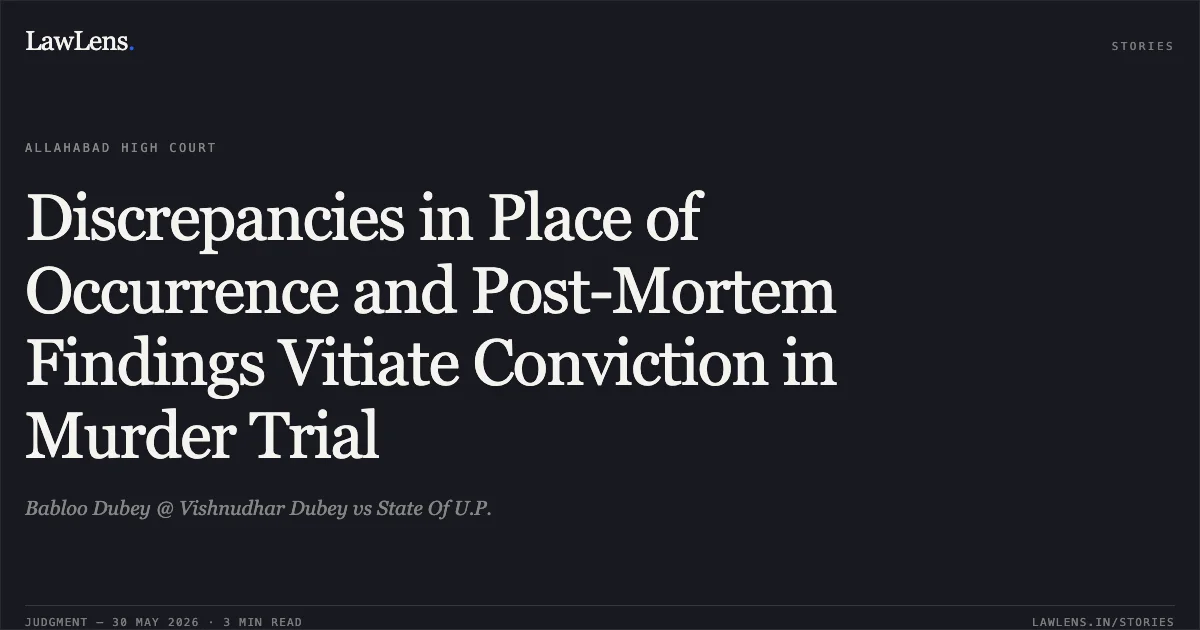
The court found the prosecution's case fundamentally flawed due to shifting versions of the "situs of assault": PW-1 claimed the murder happened inside the boundary wall, while PW-2 and the site plan placed it outside.
pp. 54-55Medically, the presence of faecal matter in the large intestine contradicted PW-1’s claim that the deceased had not eaten, suggesting the time of death was inconsistent with the prosecution's timeline.
pp. 55-56Critically, Forensic Science Laboratory (FSL) reports confirmed that the recovered firearms did not match the bullets or empty cartridges found at the scene.
p. 55The court also noted that the recovery of weapons was procedurally void as no disclosure statements were recorded.
p. 55Regarding Babloo Dubey, the court accepted the defense evidence (DW-1 to DW-3) proving he was attending a religious function (Akhand Ramayan Path) elsewhere, rendering the initial FIR version a "bundle of lies".
p. 57Finally, the absence of dock identification for Rajan Yadav was held to be a fatal trial error.
p. 5605Holding
The Court concluded that the prosecution failed to prove the guilt of the appellants beyond a reasonable doubt.
p. 57The High Court allowed the appeals, setting aside the judgment and order dated February 13/17, 2023, and the appellants were honorably acquitted of all charges.
pp. 57-58The court held that the procedural lapses in recovery, the medical contradictions regarding the time of death, and the established alibi of the main accused created an "irresistible conclusion" that the prosecution story was concocted.
p. 57Original Court PDF
Babloo Dubey @ Vishnudhar DubeyvsState Of U.P.
Click to open original judgment
Original judgment, available to read, download and summarize on LawLens.in