Facts
The Corporate Debtor (CD), an SPV incorporated to execute a road project for the Maharashtra PWD, availed a term loan from a consortium of lenders, including Canara Bank (Respondent).
Source reference: para. 2(ii), (iv)Due to the PWD’s failure to issue completion certificates and a subsequent takeover by NHAI in 2016, the CD defaulted and its account was declared an NPA on July 30, 2017.
Source reference: para. 2(vi)The CD secured an arbitral award against the PWD on June 21, 2022, for ₹318.94 crores plus interest, which is currently under challenge in the High Court.
Source reference: para. 2(v)Canara Bank filed a Section 7 application under the IBC on November 29, 2024, claiming a default of ₹346.83 crores.
Source reference: para. 2(vii)The Adjudicating Authority (NCLT) admitted the application, ruling it was within the limitation period due to acknowledgments in balance sheets.
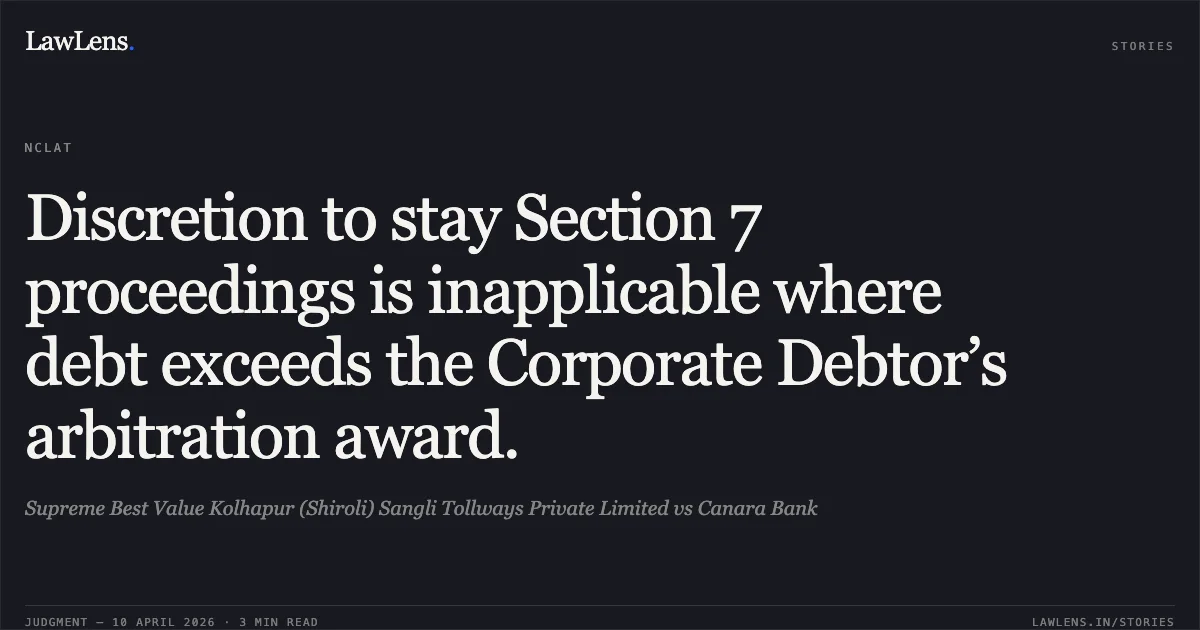
Source reference: para. 2(ix)The Appellant challenged the admission, arguing that under the Vidarbha Industries doctrine, the NCLT should have stayed the proceedings as the CD’s arbitral award (valued at ₹561.23 crores in execution) exceeded the debt claimed by the Financial Creditor.
Source reference: para. 4, 9Issues
1. Whether the Adjudicating Authority erred in admitting the Section 7 application despite the existence of an arbitral award in favor of the Corporate Debtor that allegedly exceeded the debt claimed.
Source reference: para. 9, 162. Whether the discretionary power of the Adjudicating Authority, as established in Vidarbha Industries Power Ltd. v. Axis Bank Ltd., was applicable to stay the CIRP in the present circumstances.
Source reference: para. 10, 17Law Applied
The court primarily applied Section 7(5)(a) of the Insolvency and Bankruptcy Code (IBC), which states that the Adjudicating Authority "may" admit an application upon satisfaction of debt and default.
Source reference: para. 11It relied extensively on the precedent in Vidarbha Industries Power Ltd. v. Axis Bank Ltd. (2022), which established that Section 7(5)(a) is discretionary rather than mandatory, requiring the NCLT to consider the overall financial health and viability of the CD.
Source reference: para. 10-13The court also referenced M/s Innoventive Industries Ltd. v. ICICI Bank and M. Suresh Kumar Reddy v. Canara Bank, which emphasize that the NCLT must admit an application once debt and default are established, unless there are exceptional reasons not to do so.
Source reference: para. 15Reasoning
The Appellate Tribunal distinguished the present case from the Vidarbha Industries precedent on two grounds.
Source reference: no citationFirst, it noted that while the CD’s execution claim was ₹561.23 crores, the total debt owed to the consortium of lenders (of which the Respondent is a member) was ₹1,113 crores.
Source reference: para. 17(I)Thus, the debt significantly exceeded the awarded amount, negating the Vidarbha principle which applies when the award exceeds the debt.
Source reference: para. 17(I)Second, the court evaluated the "viability and financial health" of the CD as mandated by Vidarbha.
Source reference: no citationIt found that the CD was an SPV with no independent business, no assets, and no source of income following the NHAI takeover in 2016.
Source reference: para. 17(II)Consequently, the CD was neither financially sound nor commercially viable, making CIRP the appropriate mechanism for resolution.
Source reference: para. 17(II), 18Holding
The NCLAT held that the Vidarbha Industries judgment did not aid the Appellant because the total consortium debt far exceeded the value of the arbitral award and the CD lacked commercial viability.
The Tribunal affirmed the Adjudicating Authority’s decision, finding no grounds to exercise discretion to keep the Section 7 proceedings in abeyance.
Source reference: para. 19The appeal was dismissed, and the initiation of the Corporate Insolvency Resolution Process (CIRP) was upheld.
Source reference: para. 19Acts & Sections Cited
3 provisions across 2 statutes referred to in this judgment. Each provision opens on LawLens.
Arbitration and Conciliation Act, 19961
Original Court PDF
Supreme Best Value Kolhapur (Shiroli) Sangli Tollways Private LimitedvsCanara Bank
Click to open original judgment
Original judgment, available to read, download and summarize on LawLens.in