Facts
The petitioner, a Senior Auditor, was deputed for an audit at Sadar Hospital, Daltonganj from June 10–17, 2010. During a surprise inspection on June 17, the Deputy Accountant General (DAG) found the petitioner absent since June 12
Source reference: p. 1-2The petitioner claimed he left due to a medical emergency involving his daughters and had verbally informed a colleague
Source reference: p. 4A departmental inquiry was initiated under Rule 14 of the CCS (CCA) Rules. The Inquiry Officer (IO) found the lapse occurred but recommended leniency due to the stated emergency
Source reference: p. 3, 6The Disciplinary Authority disagreed with the leniency and imposed a penalty of withholding one pay increment for one year without cumulative effect
Source reference: p. 3After his appeal and revision were rejected, the petitioner challenged the orders before the Central Administrative Tribunal (CAT), which dismissed his application on July 6, 2017
Source reference: p. 3-4Issues
1. Whether the Disciplinary Authority was required to record tentative reasons for disagreement under the principles of Punjab National Bank v. Kunj Behari Misra when the Inquiry Officer recommended leniency rather than exoneration
Source reference: p. 5, 122. Whether the non-issuance of a second show-cause notice regarding the proposed punishment vitiated the inquiry proceedings
Source reference: p. 14-163. Whether the High Court can interfere with a minor penalty under the limited scope of judicial review under Article 226
Source reference: p. 10-11Law Applied
The court relied on the "Doctrine of Prejudice" established in ECIL v. B. Karunakar, which mandates that an order is not vitiated by procedural lapses (like non-supply of reports) unless the employee proves actual prejudice
Source reference: p. 15Regarding the scope of judicial review, it applied L. Chandra Kumar v. Union of India, limiting interference to errors apparent on the face of the record or perversity
Source reference: p. 10It further distinguished Punjab National Bank v. Kunj Behari Misra, noting that the requirement to record reasons for disagreement arises only when the Disciplinary Authority reverses a finding of "not guilty"
Source reference: p. 12-13The court also applied the standard from West Bengal Central School Service Commission v. Abdul Halim regarding the self-evident nature of legal errors
Source reference: p. 11Reasoning
The Court found that the Kunj Behari Misra precedent did not apply because the Inquiry Officer did not exonerate the petitioner; rather, the IO confirmed the "lapse" (unauthorized absence) but merely suggested a lenient view based on Para 3 of the O.O. dated 28.01.2010
Source reference: p. 13Therefore, there was no reversal of a "not guilty" finding requiring a prior disagreement note.
Source reference: p. 13On the issue of natural justice, the Court held that the petitioner failed to demonstrate any "actual prejudice" caused by the non-issuance of a second show-cause notice, especially given that the punishment was "minor"
Source reference: p. 15-16The Court observed that the petitioner's explanations for his absence and his subsequent inconsistent leave applications created reasonable doubt regarding his conduct
Source reference: p. 9The Court concluded that the Tribunal correctly identified that the DAG’s finding of unauthorized absence was substantiated, and the punishment was proportionate
Source reference: p. 14Holding
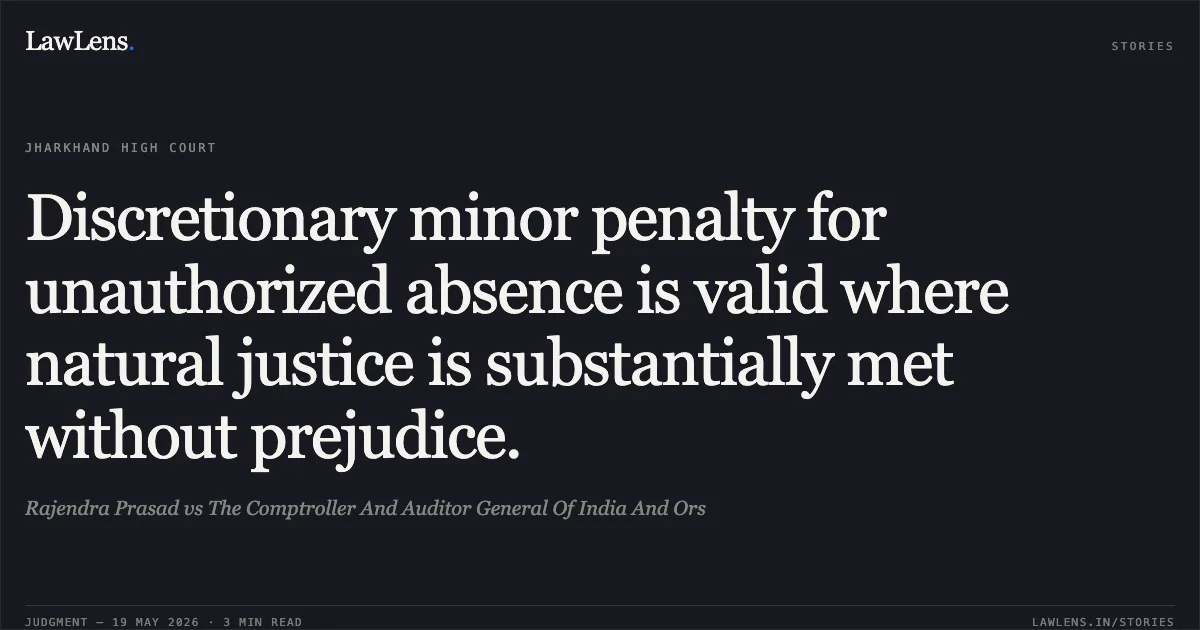
The High Court dismissed the writ petition, upholding the CAT's order
It held that the Disciplinary Authority acted within its jurisdiction and that the minor penalty of withholding one increment for one year without cumulative effect did not warrant interference under the limited powers of judicial review
Source reference: p. 14, 16The Court affirmed that the period of unauthorized absence would be treated as dies non as a natural consequence of the punishment
Source reference: p. 10All pending interlocutory applications were disposed of
Source reference: p. 16Acts & Sections Cited
2 provisions across 1 statute referred to in this judgment. Linked provisions open on LawLens.
the Act (alias, unresolved)2
Original Court PDF
Rajendra PrasadvsThe Comptroller And Auditor General Of India And Ors
Click to open original judgment
Original judgment, available to read, download and summarize on LawLens.in


