Facts
The petitioner, a CRPF Constable, was granted casual leave from 3 November 2004 to 28 November 2004 but failed to report on 29 November 2004 and remained absent until 31 December 2004, a period of 32 days.
Source reference: para. 3–5During his absence, he received three directions dated 4, 16 and 26 December 2004 to report for duty, which he admittedly neither obeyed nor answered by seeking extension of leave.
Source reference: para. 3–5A departmental inquiry was initiated on charges of unauthorised absence, disobedience of the directions to resume duty, and habitual absence based on two earlier punished instances of unauthorised absence.
Source reference: para. 5–6, 14The petitioner participated in the inquiry, cross-examined departmental witnesses and was permitted to lead evidence.
Source reference: para. 6–8After receiving the inquiry report, he was granted time and eight days’ earned leave to collect material for his defence, but he submitted no representation within the stipulated period.
Source reference: para. 6–8, 23–25The disciplinary authority dismissed him from service on 8 April 2005; the order was subsequently modified on 12 May 2005 regarding treatment of certain periods of absence, without altering the dismissal penalty. The appellate authority affirmed the dismissal on 9 September 2005.
Source reference: para. 10–14Issues
Whether the departmental inquiry and disciplinary proceedings were conducted in accordance with the prescribed procedure and principles of natural justice, including whether the petitioner was afforded a reasonable opportunity to defend himself?
Source reference: para. 21–25Whether the findings of unauthorised absence, disobedience of directions and habitual absence were supported by evidence?
Source reference: para. 21, 26–28Whether dismissal from service was so disproportionate to the proved misconduct as to warrant interference under Article 226 of the Constitution?
Source reference: para. 21–22, 29–37Law Applied
The Court applied Section 11(1) of the Central Reserve Police Force Act, 1949 and Rule 27 of the Central Reserve Police Force Rules, 1955, which govern disciplinary action and departmental inquiry against CRPF personnel.
Source reference: para. 18In judicial review under Article 226, the Court does not reappreciate evidence or sit as an appellate authority; interference is justified where procedure or natural justice is violated, findings are based on no evidence or are perverse, or the punishment is shockingly disproportionate.
Source reference: para. 22The Court relied on Union of India v. Giriraj Sharma, 1994 Supp (3) SCC 755, distinguishing cases where dismissal for overstay was excessive because of compelling circumstances and absence of wilful defiance.
Source reference: para. 17, 29The Court relied on Shamsher Bahadur Singh v. State of Uttar Pradesh, 1993 (2) SLR 736, concerning proportionality.
Source reference: para. 17, 30The Court relied on Mithilesh Singh v. Union of India, (2003) 3 SCC 309, holding that an application for leave is not equivalent to permission and that disciplinary punishment may be interfered with only when shockingly disproportionate.
Source reference: para. 31The Court relied on decisions emphasising the heightened discipline applicable to uniformed forces, including Union of India v. P. Gurunathan, (2005) 4 CTC 35 and M. Vallavaraj v. Deputy Inspector General, CISF, (2005) 2 MLJ 152.
Source reference: para. 32–34Reasoning
The Court found that the petitioner had received the charge memorandum, relied-upon documents and witness list, participated in the inquiry, cross-examined witnesses and had an opportunity to produce defence evidence.
Source reference: para. 23The inquiry report was supplied to him, and his request for time to collect material was accommodated by granting earned leave with an express warning that the disciplinary authority would proceed if no representation was filed.
Source reference: para. 24–25Since he submitted no representation and identified no specific evidence or defence that he was prevented from producing, the plea of denial of reasonable opportunity failed.
Source reference: para. 24–25The findings of misconduct were supported by the attendance record, the three written directions and the petitioner’s admission that he had received but ignored them without seeking extension of leave.
Source reference: para. 26His explanation regarding a family dispute was unsupported, while the later medical explanation concerning jaundice could not account for the earlier 32-day absence or the December directions.
Source reference: para. 27The charge of habitual absence was supported by two prior instances involving absences of 48 and 105 days for which punishments had been imposed.
Source reference: para. 28On proportionality, the Court distinguished Giriraj Sharma because the present case involved prolonged absence, repeated disobedience, no contemporaneous request for extension and recurrence despite prior punishments.
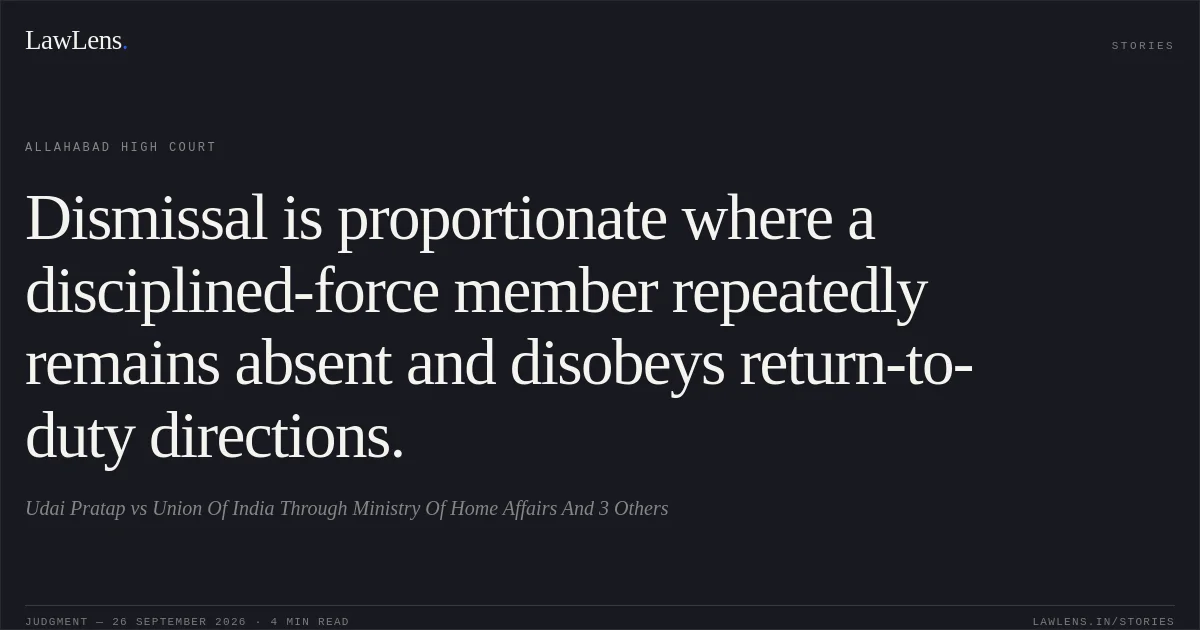
Source reference: para. 29–35Given the stringent discipline required in the CRPF, dismissal was not shockingly disproportionate.
Source reference: para. 29–35The later period treated as dies non was not relied upon as an additional charged misconduct for determining proportionality.
Source reference: para. 36Holding
The Court answered all issues against the petitioner.
It held that the departmental inquiry was procedurally fair, the findings were supported by evidence, and the petitioner’s explanations did not justify his unauthorised absence or disobedience.
Source reference: para. 37Dismissal was not so excessive or disproportionate as to warrant interference under Article 226.
Source reference: para. 37The writ petition was dismissed, and the dismissal order dated 8 April 2005, as modified on 12 May 2005, together with the appellate order dated 9 September 2005, was upheld.
Source reference: para. 38–39There was no order as to costs.
Source reference: para. 38–39Acts & Sections Cited
1 provisions across 1 statute referred to in this judgment. Each provision opens on LawLens.
Central Reserve Police Force Act, 19491
Original Court PDF
Udai PratapvsUnion Of India Through Ministry Of Home Affairs And 3 Others
Click to open original judgment
Original judgment, available to read, download and summarize on LawLens.in