Facts
The Appellants obtained two loans of ₹2,50,000 each from Sangli Bank Ltd. (subsequently merged with ICICI Bank Ltd.) on 30 December 1994, secured by pledged shares and carrying interest at 19.25% per annum.
Source reference: paras. 2–5The loans were not repaid within the stipulated one-year period, and the Appellants did not seek renewal or instruct the Bank to sell the pledged shares.
Source reference: paras. 2–5, 54The Bank subsequently sold certain pledged shares, including shares sold in July 1997 and during the pendency of recovery proceedings, allegedly without reasonable notice under Section 176 of the Indian Contract Act, 1872.
Source reference: paras. 8–10The Bank instituted a recovery suit on 19 December 1997 for ₹2,27,873.50. That suit was dismissed on 22 December 2012 on the grounds that it was premature, that the Bank had concealed material facts, and that certain sales of pledged shares without reasonable notice were void; the Bank did not appeal.
Source reference: paras. 9–11, 37(iv)The Appellants thereafter filed the present suit seeking ₹5,00,000 as damages and compensation for the allegedly false, frivolous and vexatious recovery suit, claiming harassment, humiliation, defamation and mental agony.
Source reference: para. 12The Trial Court treated the claim as one substantially founded on malicious prosecution and dismissed it, holding that the essential ingredients were not established and that the claim was barred by limitation.
Source reference: paras. 21–24Issues
1. Whether the Appellants’ suit was, in substance, a claim for compensation founded on malicious prosecution, notwithstanding the terminology used in the plaint.
Source reference: paras. 38–472. Whether the Appellants established want of reasonable and probable cause, malice, termination in their favour, and resultant damages so as to claim compensation for malicious prosecution.
Source reference: paras. 48–723. Whether the Bank’s failure to lead evidence entitled the Appellants to a decree despite the burden of proof resting upon them.
Source reference: para. 71Law Applied
A claim for malicious prosecution requires proof of: (i) institution or continuation of legal proceedings by the defendant; (ii) want of reasonable and probable cause; (iii) malice; and (iv) termination of the proceedings in favour of the plaintiff.
Source reference: para. 48Malice means an improper motive and is distinct from absence of reasonable and probable cause; neither is established merely because the earlier proceeding failed.
Source reference: paras. 46, 49, 55Under Section 176 of the Indian Contract Act, 1872, a pawnee may sue upon the debt while retaining the pledged goods or sell the pledged goods after reasonable notice; the legal consequences of an improper sale do not, by themselves, establish malicious institution of a recovery suit.
Source reference: paras. 23, 34, 58–60Articles 74 and 55 of the Limitation Act, 1963 prescribe limitation of one year for compensation for malicious prosecution and three years for breach of contract, respectively, while Article 113 is the residuary provision.
Source reference: para. 24Sections 35, 35A and 35B of the Code of Civil Procedure, 1908 provide remedies through costs, compensatory costs and costs for delay in the proceeding in which false or vexatious litigation occurs.
Source reference: paras. 64–65The Court relied on West Bengal State Electricity Board v. Dilip Kumar Ray, (2007) 14 SCC 568, for the meaning of malice, and distinguished H.S. Bedi v. National Highway Authority of India, RFA 784/2010, and S.P. Chengalvaraya Naidu v. Jagannath, (1994) 1 SCC 1.
Source reference: paras. 46, 62–63Reasoning
The Court held that the substance of the plaint, its title, and the allegations of an intentionally false suit instituted to harass and extort money disclosed a claim based on malicious prosecution, regardless of the Appellants’ subsequent denial of that characterization.
Source reference: paras. 40–47Although the Bank’s recovery suit had been dismissed, the Appellants admitted availing the loans, executing the relevant security documents, failing to repay the interest, and not directing the Bank to sell the pledged shares.
Source reference: paras. 51–54These circumstances established that the Bank had a subsisting claim and reasonable grounds to approach the civil court; the mere fact that the suit was ultimately dismissed as premature or for procedural defects did not demonstrate want of reasonable and probable cause.
Source reference: paras. 54–59The findings of concealment and improper sale related principally to the Bank’s conduct during the earlier litigation and did not establish that the suit was maliciously instituted in 1997.
Source reference: paras. 60–61The Appellants also failed to prove malice, causal injury, or the quantum of damages. The alleged heads of damages were not pleaded in the plaint, medical records concerning depression were not properly proved, and no evidence established professional or reputational loss.
Source reference: paras. 66–70The Bank’s failure to lead evidence did not relieve the Appellants of their initial burden to prove their claim.
Source reference: para. 71The Court further observed that any claim for compensatory costs for false or vexatious litigation ought to have been pursued in the original recovery suit under Sections 35, 35A and 35B CPC.
Source reference: paras. 64–65Holding
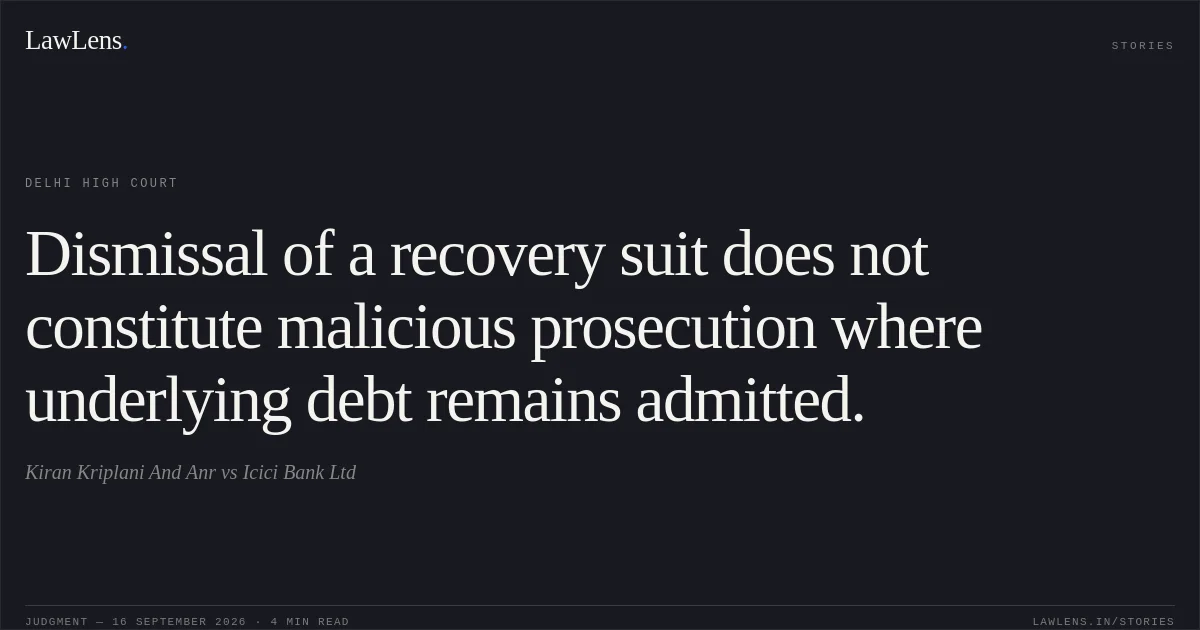
The High Court held that the suit was, in substance, one for compensation for malicious prosecution, but that the Appellants failed to establish want of reasonable and probable cause, malice, or compensable injury.
The dismissal of the Bank’s earlier recovery suit did not make its institution actionable, particularly since the underlying loan liability remained admitted and outstanding.
Source reference: paras. 54–63The appeal was accordingly dismissed, the judgment and decree dated 31 May 2025 were upheld, and all pending applications were disposed of.
Source reference: paras. 72–74Acts & Sections Cited
5 provisions across 3 statutes referred to in this judgment. Each provision opens on LawLens.
Code of Civil Procedure, 19082
Indian Contract Act, 18721
Limitation Act, 19632
Original Court PDF
Kiran Kriplani And AnrvsIcici Bank Ltd
Click to open original judgment
Original judgment, available to read, download and summarize on LawLens.in
![Non-submission of online self-appraisal cannot automatically disqualify an employee from EPP financial upgradation.. Ashok Kumar Sahu vs Bharat Sanchar Nigam Limited. CAT - ['Jabalpur']. LawLens](/stories/thumbnails/non-submission-of-online-self-appraisal-cannot-automatically-disqualify-an-employee-from-e-211b98f9eb684a569412a8a970828971.webp)
![Eligibility creates only a right to consideration, not promotion without completing the prescribed selection process.. O P PAL vs M/o Railways. CAT - ['Jabalpur']. LawLens](/stories/thumbnails/eligibility-creates-only-a-right-to-consideration-not-promotion-without-completing-the-pre-ff5bdfe1718e426aabd12d4bcb4a6177.webp)
![Regular departmental enquiry is not mandatory before imposing minor penalties under Rule 12.. RATAN SINGH THAKUR vs M/o Labour. CAT - ['Jabalpur']. LawLens](/stories/thumbnails/regular-departmental-enquiry-is-not-mandatory-before-imposing-minor-penalties-under-rule-1-84363cece17042c49e8e1700746e4941.webp)