Facts
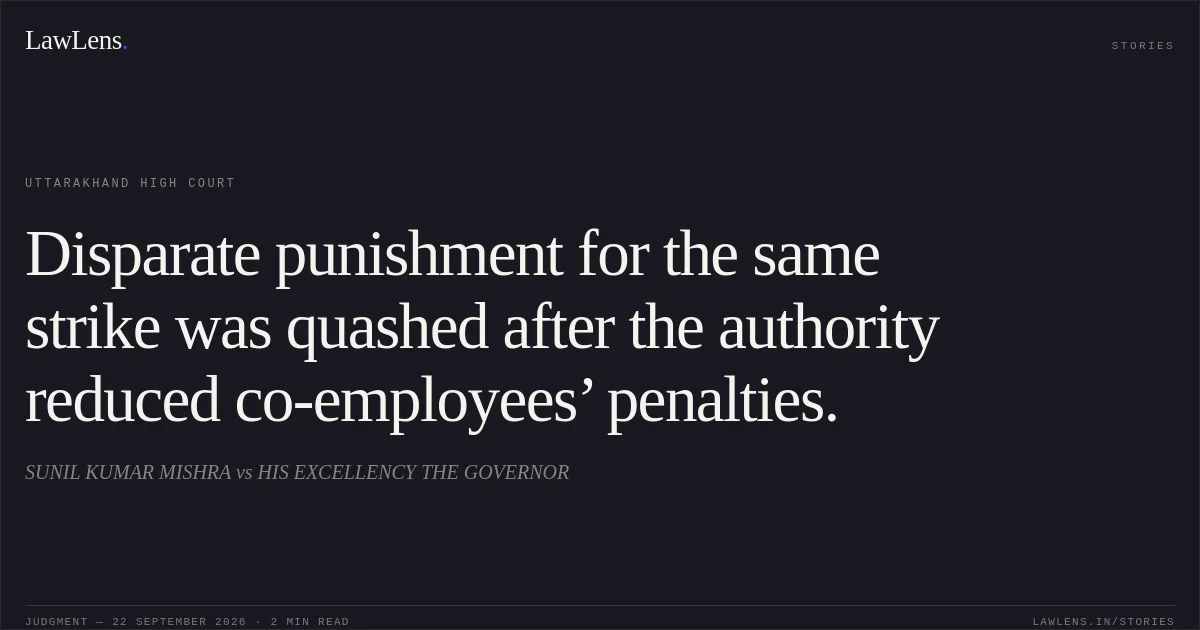
The petitioner, while serving as a Section Officer in the Uttarakhand Public Service Commission, was suspended and charge-sheeted on 21 February 2014 for allegedly instigating employees to participate in a strike from 4 December 2013 to 18 December 2013.
Source reference: para. 2–3; p. 1Other employees and office-bearers proceeded against on the same strike-related allegations were initially punished by stoppage of two increments for two years and an adverse entry for 2013–14; however, on 16 October 2014, the Commission reduced their punishment to a warning and directed that the strike period be treated as leave.
Source reference: para. 4–5; pp. 1–2Despite that decision, the Commission imposed a harsher punishment on the petitioner on 16 December 2014, namely stoppage of three increments and an adverse entry for 2013–14.
Source reference: para. 6; p. 2His departmental appeal was dismissed on 27 July 2016.
Source reference: para. 7; p. 2During the writ proceedings, the punishments imposed on the other employees and office-bearers were quashed by the learned Single Judge on 20 November 2025, and the Commission stated that the judgment had been complied with.
Source reference: para. 8–12; pp. 2–3Issues
Whether the punishment order dated 16 December 2014 imposed on the petitioner could be sustained when the Commission had subsequently reduced the punishment imposed on other employees proceeded against on the same strike-related allegations to a warning and treated the strike period as leave.
Source reference: para. 11–13; pp. 3–4Whether quashing the petitioner’s punishment order would affect any separate or independent disciplinary proceedings, including the vigilance inquiry referred to in that order.
Source reference: para. 13; p. 4Law Applied
No specific statutory provision or judicial precedent was expressly cited in the judgment. The Court applied the principle of consistency and parity in disciplinary action: where employees are proceeded against on substantially identical charges arising from the same incident, the disciplinary authority cannot sustain a materially harsher punishment against one employee after adopting a general decision reducing the punishment for the others, absent a legally sustainable distinction.
Source reference: para. 11–13; pp. 3–4The Court also preserved the independence of separate disciplinary proceedings not arising from the impugned punishment order.
Source reference: para. 11–13; pp. 3–4Reasoning
The petitioner’s charge arose from the same strike for which the other employees and office-bearers had been proceeded against. Although the Commission initially imposed punishments on those employees, it subsequently passed an order dated 16 October 2014 reducing the punishment to a warning and treating the strike period as leave.
Source reference: para. 4–5; pp. 1–2The petitioner’s later and more severe punishment did not take that intervening decision into account.
Source reference: para. 6; p. 2The learned Single Judge had already quashed the corresponding punishment orders in the cases of the other employees, and the Commission’s counsel fairly conceded that the present controversy was covered by that judgment.
Source reference: para. 8–12; pp. 2–3Applying consistency in disciplinary treatment, the Division Bench held that the petitioner’s punishment could not be sustained. It nevertheless clarified that the quashing would not affect other independent disciplinary proceedings, including the vigilance inquiry mentioned in the punishment order.
Source reference: para. 13; p. 4Holding
The writ petition was allowed to the extent that the petitioner’s punishment order dated 16 December 2014 was quashed.
The quashing was limited to that punishment order and did not affect any other disciplinary proceedings, including the stated vigilance inquiry. Any pending application was also disposed of.
Source reference: para. 14; p. 4Original Court PDF
SUNIL KUMAR MISHRAvsHIS EXCELLENCY THE GOVERNOR
Click to open original judgment
Original judgment, available to read, download and summarize on LawLens.in