Facts
The appellant, a former Chief General Manager, Telecom, North-East Task Force, was intercepted at Guwahati Airport on 6 September 1997 while carrying cash of ₹25,31,200 in his baggage.
Source reference: pp. 2–5An additional ₹4,00,000 was recovered from his residence the following day.
Source reference: pp. 2–5The Assam Police initially registered Azara P.S. Case No. 74/1997 under Sections 7 and 13(1)(e) of the Prevention of Corruption Act, alleging that the money represented illegal gratification from contractors.
Source reference: pp. 2–5The CBI subsequently took over the investigation and filed a charge-sheet alleging disproportionate assets of ₹29,31,200 against the appellant and other accused persons.
Source reference: pp. 2–5The other accused were discharged, and the appellant was ultimately tried only under Sections 13(1)(e) and 13(2) of the PC Act.
Source reference: p. 4, para. 5The trial court convicted him under Section 13(1)(e) and sentenced him to three years’ rigorous imprisonment with a fine of ₹50,000.
Source reference: p. 2, para. 1Issues
1. Whether the CBI could investigate the alleged offence in Assam without specific consent of the Assam Government under Section 6 of the Delhi Special Police Establishment Act, 1946.
Source reference: pp. 32–38, paras. 14–212. Whether the sanction for prosecution was validly granted and reflected proper application of mind by the competent authority.
Source reference: pp. 38–41, paras. 22–233. Whether the prosecution proved that the appellant possessed pecuniary resources disproportionate to his known sources of income under Section 13(1)(e) of the PC Act.
Source reference: pp. 41–46, paras. 24–304. Whether the appellant satisfactorily accounted for the seized cash by establishing that it belonged to DW-1 and was held in a fiduciary capacity.
Source reference: pp. 46–52, paras. 31–385. Whether the trial court’s conviction and sentence were sustainable in light of the contradictions concerning recovery, seizure, denomination and identity of the currency notes.
Source reference: pp. 46–52, paras. 31–38Law Applied
The court applied Sections 5 and 6 of the Delhi Special Police Establishment Act, 1946, concerning extension of CBI jurisdiction and State consent, and relied on CBI v. A. Satish Kumar, Fertico Marketing and Investment Pvt. Ltd. v. CBI and Kanwal Tanuj v. State of Bihar for the principle that State consent is not necessary in the circumstances recognised by those decisions, particularly where Central Government employees are investigated for offences under a Central law.
Source reference: pp. 32–38, paras. 14–21On sanction, the court applied Section 19 of the PC Act and held, relying on Dinesh Kumar v. Chairman, Airport Authority of India, Prakash Singh Badal v. State of Punjab and Binod Kumar Garg v. State (NCT of Delhi), that sanction requires consideration of the relevant materials and application of mind, although an error or irregularity is not fatal unless it causes failure of justice.
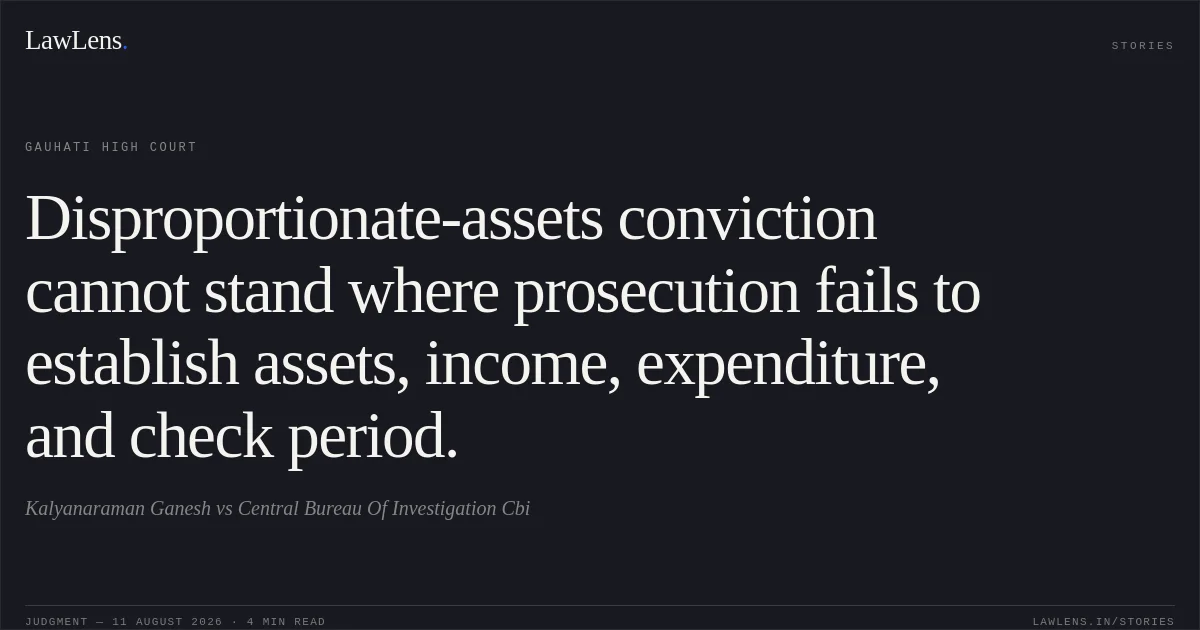
Source reference: pp. 38–41, paras. 22–23For Section 13(1)(e), the court held that the prosecution must establish the assets, income and expenditure during a definite check period and make a proper computation of disproportionate assets; thereafter, the accused bears the evidentiary burden of satisfactorily accounting for the excess, though only on the standard of preponderance of probabilities, with Section 106 of the Evidence Act applying to facts especially within the accused’s knowledge.
Source reference: pp. 41–46, paras. 24–29The court also relied on N. Ramakrishnaiah v. State of Andhra Pradesh regarding the meaning of “known sources of income,” and Munshi Prasad v. State of Bihar for the equal evidentiary status of defence witnesses.
Source reference: pp. 42–44, para. 26; p. 49, para. 35Reasoning
The court rejected the challenge to CBI jurisdiction, holding that the CBI was empowered to investigate the appellant, a Central Government employee, in relation to offences under the PC Act, a Central law.
Source reference: pp. 35–38, paras. 18–21It also upheld the prosecution sanction, finding that the Telecom Minister had considered the relevant materials and approved prosecution, while the sanction order was issued in the name of the President.
Source reference: pp. 38–41, para. 22However, the conviction for disproportionate assets was found unsustainable.
Source reference: no citationThe prosecution failed to undertake the required computation of assets at the beginning and end of the check period, income, expenditure and savings; it also failed to establish any disproportionate asset other than the seized cash.
Source reference: pp. 44–46, para. 29The court further found material contradictions regarding whether the cash was recovered at the airport or police station, whether the appellant made the alleged explanations concerning contractors, and whether the currency produced in court was the same currency seized from him.
Source reference: pp. 46–49, paras. 31–34The appellant’s explanation that DW-1 had entrusted the money for purchase of diamond jewellery was supported by DW-1’s testimony, the alleged receipt and DW-1’s earlier application seeking custody of the seized money.
Source reference: pp. 49–52, paras. 35–38The prosecution’s objections based on DW-1’s financial position and the mismatch in currency denominations were held insufficient, particularly because DW-1 had cleared substantial bank loans, had business interests, and the evidence was recorded fifteen years after the seizure.
Source reference: pp. 49–52, paras. 35–38The resulting doubt was therefore required to operate in favour of the appellant.
Source reference: no citationHolding
The appeal was allowed.
The Gauhati High Court set aside and quashed the trial court’s judgment dated 26 March 2013, along with the appellant’s conviction and sentence under Section 13(1)(e) read with Section 13(2) of the PC Act.
Source reference: p. 52, para. 39The appellant was acquitted of all charges and his bail bonds were discharged.
Source reference: p. 52, paras. 40 and 42Since the seized money had already been confiscated to the State in 2013, the court passed no further order regarding it.
Source reference: p. 52, para. 41Acts & Sections Cited
19 provisions across 4 statutes referred to in this judgment. Each provision opens on LawLens.
Prevention of Corruption Act, 19884
Code of Criminal Procedure, 19736
Indian Penal Code, 18606
Original Court PDF
Kalyanaraman GaneshvsCentral Bureau Of Investigation Cbi
Click to open original judgment
Original judgment, available to read, download and summarize on LawLens.in