Facts
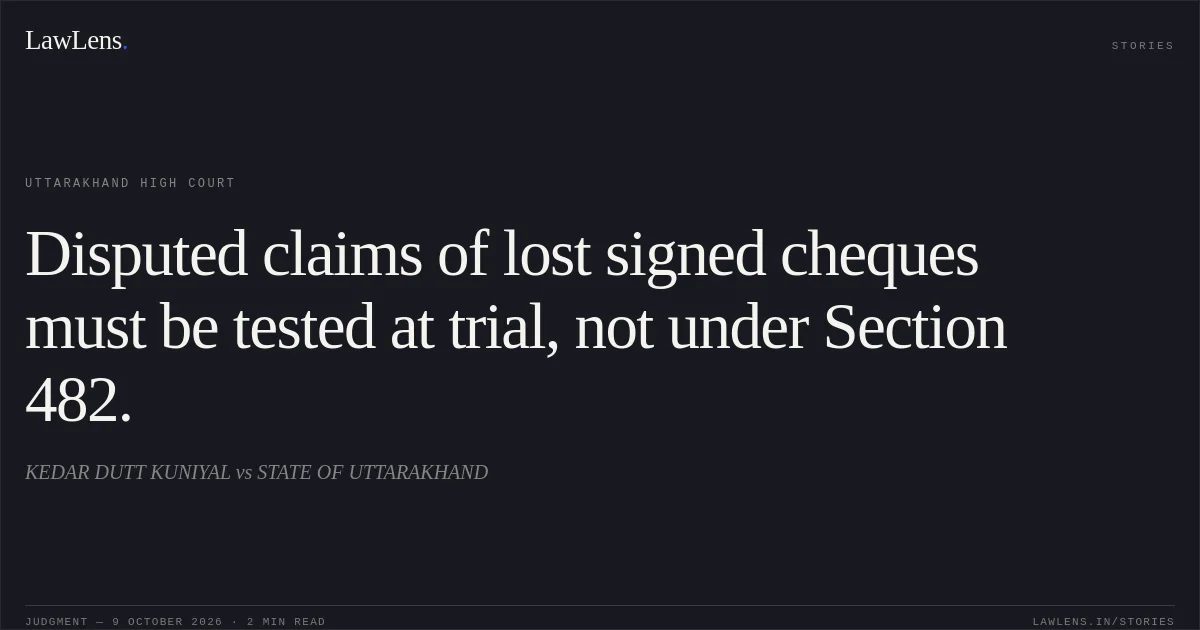
The applicant challenged the Chief Judicial Magistrate’s order summoning him under Section 138 of the Negotiable Instruments Act, 1881 (“NI Act”).
Source reference: para. 2He contended that he had lost three signed, blank cheques, notified the bank on 22 January 2021, and closed his account on 18 February 2021; he also alleged there had been no transaction between him and the complainant.
Source reference: para. 3The complainant alleged that the applicant had issued cheques in connection with a 2019 business loan, which were dishonoured with the remark “account closed,” and that the applicant reported the cheques lost only after receiving notice of dishonour.
Source reference: para. 5The applicant sought quashing of the summoning order under Section 482 of the Code of Criminal Procedure, 1973.
Source reference: paras. 1, 4Issues
Whether the applicant’s claim that he had lost the signed cheques, notified the bank, and closed the account warranted quashing the summoning order under Section 482 Cr.P.C.
Source reference: paras. 3–4, 8Whether Raj Kumar Khurana v. State (NCT of Delhi), (2009) 6 SCC 72, applied where the cheque was dishonoured because the account was closed and the police complaint was made after notice of dishonour.
Source reference: paras. 6–8Law Applied
Section 138 of the NI Act provides the basis for criminal liability for dishonour of a cheque in the circumstances prescribed by that provision.
Source reference: no citationSection 482 Cr.P.C. empowers the High Court to exercise its inherent jurisdiction, but the Court held that it could not enter into the factual arena at this stage where the applicant’s contentions were matters for the trial court.
Source reference: para. 8In Raj Kumar Khurana v. State (NCT of Delhi), (2009) 6 SCC 72, the Supreme Court held that the complaint there did not disclose an offence under Section 138 where the bank returned the cheque with the remark “cheque reported lost by drawer”; the High Court distinguished that decision on its facts.
Source reference: paras. 6–7Reasoning
The Court found Raj Kumar Khurana distinguishable because, in the present case, the cheque was dishonoured on the ground that the account was closed, rather than because it had been reported lost to the bank.
Source reference: para. 7It also noted that the applicant’s police complaint was made only after notice of dishonour had been sent.
Source reference: para. 8The competing accounts of the cheque’s loss, the parties’ dealings, and the timing of the complaint raised factual matters that the applicant could pursue before the trial court; they did not justify interference under Section 482 Cr.P.C. at the summoning stage.
Source reference: para. 8Holding
The High Court dismissed the application and declined to quash the summoning order.
It left the applicant at liberty to raise all his contentions before the trial court and directed that the trial court decide the case on its own merits, uninfluenced by the High Court’s observations.
Source reference: paras. 9–10Acts & Sections Cited
2 provisions across 2 statutes referred to in this judgment. Each provision opens on LawLens.
Code of Criminal Procedure, 19731
Negotiable Instruments Act, 18811
Original Court PDF
KEDAR DUTT KUNIYALvsSTATE OF UTTARAKHAND
Click to open original judgment
Original judgment, available to read, download and summarize on LawLens.in