Facts
The petitioner challenged the order dated 12 January 2023 concerning partition proceedings under Section 178 of the Chhattisgarh Land Revenue Code.
Source reference: paras. 1–5He alleged that he was the legitimate son of late Pawansai and that respondent No. 6, described in the cause title as Pawansai’s illegitimate child, was not entitled to a share in the ancestral property.
Source reference: paras. 1–5He further contended that he had not been afforded a proper opportunity of hearing and that the revenue authorities had failed to consider the disputed questions of title and status.
Source reference: paras. 1–5Respondent No. 6 claimed to be the legitimate child of late Pawansai and asserted her entitlement to a share.
Source reference: paras. 1–5The State defended the concurrent orders passed by the revenue authorities.
Source reference: paras. 1–5Issues
Whether the High Court, exercising writ jurisdiction, could determine the disputed question concerning respondent No. 6’s legitimacy and her entitlement to a share in the ancestral property.
Source reference: paras. 2–6Whether the order of partition passed under Section 178 of the Chhattisgarh Land Revenue Code could be set aside in the writ petition on the ground that the petitioner was not afforded a proper opportunity of hearing and that the revenue authorities overlooked questions of title.
Source reference: paras. 1–2, 6–7Law Applied
Section 178 of the Chhattisgarh Land Revenue Code governs partition proceedings before the revenue authorities.
Source reference: paras. 6–7However, questions involving disputed title, legitimacy, legal status, and entitlement to inherited or ancestral property are disputed questions of fact requiring the recording and appreciation of evidence, and are appropriately adjudicated by a competent Civil Court rather than in writ proceedings.
Source reference: paras. 6–7The High Court may decline to decide such questions in writ jurisdiction and preserve the parties’ remedy before the Civil Court.
Source reference: paras. 6–7Reasoning
The Court found that the petitioner’s challenge depended substantially on resolving the conflicting claims regarding respondent No. 6’s legitimacy and consequent entitlement to a share in the property.
Source reference: paras. 6–7These issues could not be conclusively determined merely on the revenue record and required proper evidence.
Source reference: paras. 6–7Since the dispute involved legal status, title, and succession-related entitlement, the Court held that the competent Civil Court was the appropriate forum.
Source reference: paras. 6–7Accordingly, it declined to enter into the merits of the petitioner’s allegations regarding the partition proceedings or to interfere with the orders passed by the revenue authorities.
Source reference: paras. 6–7Holding
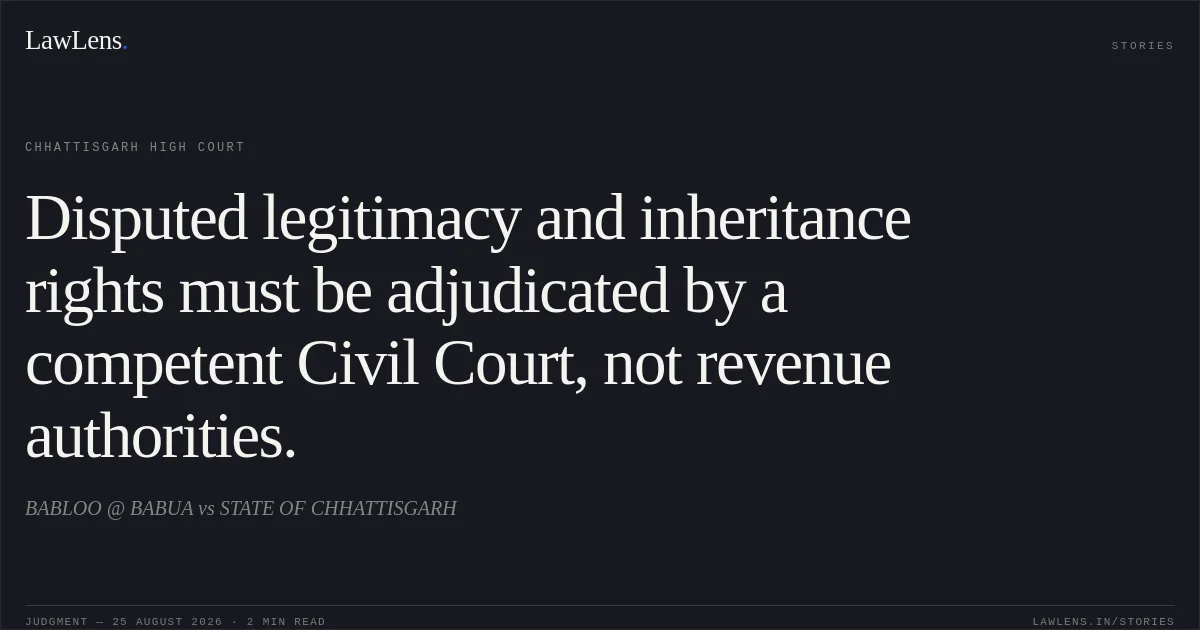
The High Court held that the disputed questions concerning respondent No. 6’s legitimacy and entitlement to the property must be adjudicated by the competent Civil Court.
The writ petition was disposed of without interfering with the orders of the revenue courts, while granting the petitioner liberty to approach the competent Civil Court for appropriate relief, including a challenge to the partition order, in accordance with law.
Source reference: paras. 6–8Acts & Sections Cited
1 provisions across 1 statute referred to in this judgment. Linked provisions open on LawLens.
Chhattisgarh Land Revenue Code1
Original Court PDF
BABLOO @ BABUAvsSTATE OF CHHATTISGARH
Click to open original judgment
Original judgment, available to read, download and summarize on LawLens.in
![Courts will not interfere with transfers absent mala fides or violation of statutory rules.. M Ramya vs EMPLOYEES STATE INSURANCE CORPORATION (ESIC). CAT - ['Chennai']. LawLens](/stories/thumbnails/courts-will-not-interfere-with-transfers-absent-mala-fides-or-violation-of-statutory-rules-a6845e9ca6f548fca284c51c8351957f.webp)
![Courts cannot direct one-time recruitment age relaxation absent authority in the governing rules or advertisement.. UT OF PUDUCHERRY vs M ANDAL. CAT - ['Chennai']. LawLens](/stories/thumbnails/courts-cannot-direct-one-time-recruitment-age-relaxation-absent-authority-in-the-governing-895d78fde47143e2a8ed0207c4b6a44f.webp)
![A review cannot correct an allegedly erroneous decision absent an error apparent on the record.. Ajit Kumar Jha vs RAILWAY BOARD. CAT - ['Delhi']. LawLens](/stories/thumbnails/a-review-cannot-correct-an-allegedly-erroneous-decision-absent-an-error-apparent-on-the-re-8ac952fd4eba470c92f7da20af72a220.webp)