Facts
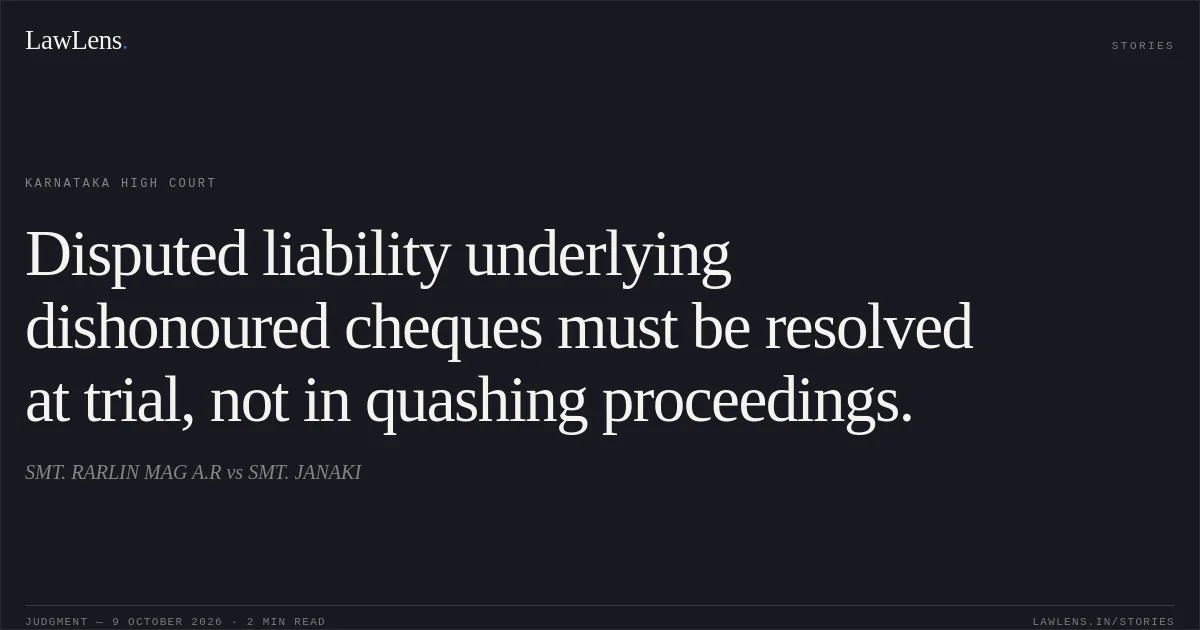
The respondent filed a complaint under Section 200 of the Code of Criminal Procedure, 1973, alleging an offence under Section 138 of the Negotiable Instruments Act, 1881. Cognisance was taken and notice issued to the petitioner
Source reference: p.2, para. 2The petitioner sought to quash the proceedings in C.C. No. 33711/2023, contending that three cheques issued from her account were security for a debt owed by a third party, Mr. Ashok, and that she owed no legally enforceable debt to the respondent
Source reference: pp. 2–3, paras. 3.1–3.4The respondent maintained that the cheques related instead to a separate transaction involving the petitioner and Mr. Arun Leo, for which Rs. 8,50,000 was due
Source reference: p. 4, paras. 4.1–4.3The petitioner brought the quashing petition under Section 482 CrPC, corresponding to Section 528 of the Bharatiya Nagarik Suraksha Sanhita, 2023
Source reference: pp. 1–2, para. 1Issues
Whether the proceedings under Section 138 of the Negotiable Instruments Act could be quashed on the petitioner’s contention that the cheques were issued only as security and were not supported by a legally enforceable debt or liability.
Source reference: pp. 2–5, paras. 3–7Whether the disputed question concerning the underlying liability could be determined in the High Court’s inherent jurisdiction under Section 482 CrPC/Section 528 BNSS, rather than at trial.
Source reference: pp. 4–6, paras. 6–10Law Applied
Section 138 of the Negotiable Instruments Act, 1881, concerns the offence of dishonour of a cheque for insufficiency of funds where the statutory requirements, including the existence of a legally enforceable debt or liability, are met.
Source reference: pp. 2–3, paras. 2–3The High Court’s inherent jurisdiction under Section 482 CrPC, corresponding to Section 528 BNSS, is to be exercised sparingly and with circumspection; disputed factual questions requiring appreciation of evidence ordinarily should not be resolved in quashing proceedings.
Source reference: pp. 4–6, paras. 6, 9–10Reasoning
The Court found that the parties disputed whether the cheques related to the petitioner’s alleged liability of Rs. 8,50,000 or were issued merely as security for Mr. Ashok’s separate debt.
Source reference: pp. 4–5, paras. 7–8Although issuance from the petitioner’s account and dishonour for insufficiency of funds were undisputed, deciding the purpose for which the cheques were issued and whether a legally enforceable liability existed would require assessment of factual and documentary evidence.
Source reference: p. 5, para. 8Those matters were therefore defences for the trial court, and the record did not establish, on its face, that the essential ingredients of Section 138 were wholly absent.
Source reference: pp. 5–6, paras. 9–10Holding
The Court dismissed the criminal petition, finding no ground to quash the proceedings at that stage.
It reserved the petitioner’s liberty to raise any available defences before the trial court and dismissed the pending interlocutory applications as not surviving for consideration.
Source reference: p. 6, para. 11Acts & Sections Cited
4 provisions across 3 statutes referred to in this judgment. Each provision opens on LawLens.
Code of Criminal Procedure, 19732
Bharatiya Nagarik Suraksha Sanhita, 20231
Negotiable Instruments Act, 18811
Original Court PDF
SMT. RARLIN MAG A.RvsSMT. JANAKI
Click to open original judgment
Original judgment, available to read, download and summarize on LawLens.in