Facts
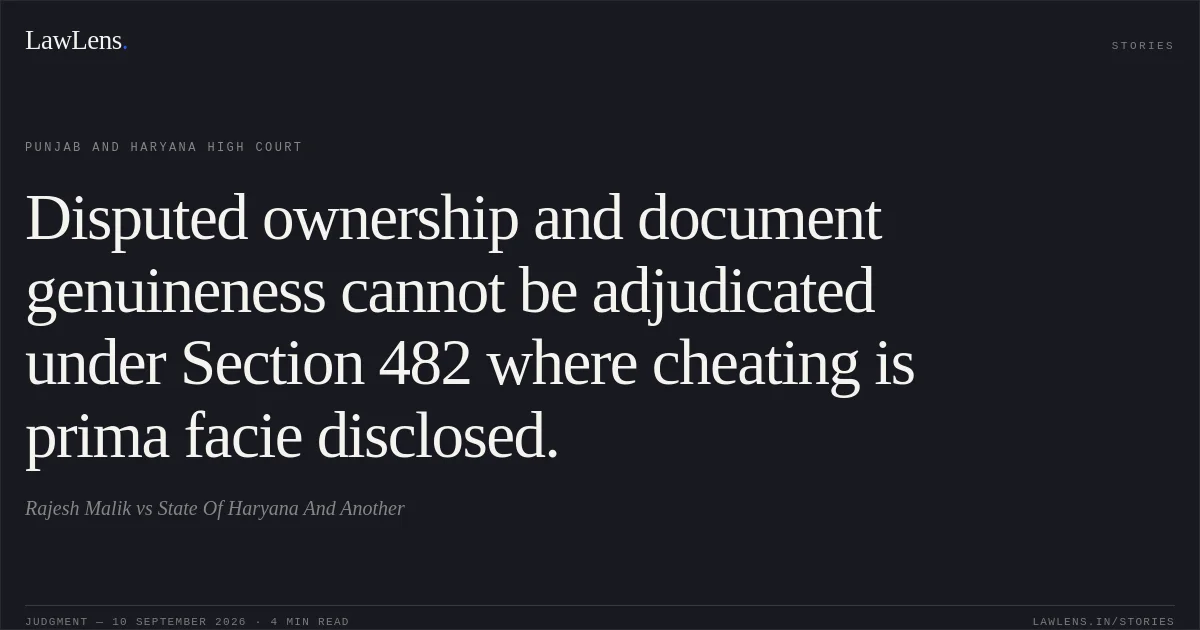
The petitioner sought quashing of FIR No. 203 dated 27.05.2021, registered at Police Station DLF, Phase I, Gurugram, under Sections 406, 420, 467 and 471 IPC.
Source reference: para. 1The complainant alleged that the petitioner represented himself as the sole owner of Plot No. G-3/20, DLF City, Gurugram, relying upon purported relinquishment deeds executed by his sisters, and induced him to enter into an agreement to sell for ₹5,55,11,000 and pay ₹41,00,000.
Source reference: para. 1–2During investigation, Sections 406, 467 and 471 IPC were deleted and the challan was filed only under Section 420 IPC. The trial Court framed charge under Section 420 IPC on 07.03.2026.
Source reference: para. 3The petitioner contended that the dispute was civil in nature, that he was the lawful owner, and that the relinquishment deeds were genuine.
Source reference: para. 4–7Issues
1. Whether the allegations in the FIR, taken at face value, disclosed the commission of an offence under Section 420 IPC warranting continuation of the criminal proceedings
Source reference: para. 15–162. Whether the High Court, in exercise of its inherent jurisdiction under Section 482 Cr.P.C., could determine disputed questions concerning ownership, genuineness of the relinquishment deeds, the parties’ agreement to sell, and the alleged settlement
Source reference: para. 15–173. Whether the FIR and subsequent proceedings constituted an abuse of process of law or fell within the recognised categories for quashing under State of Haryana v. Bhajan Lal
Source reference: para. 9, 15–17Law Applied
The Court applied Section 482 Cr.P.C., which preserves the High Court’s inherent power to prevent abuse of the process of any court and to secure the ends of justice; the provision was noted to be pari materia with Section 528 of the Bharatiya Nagarik Suraksha Sanhita, 2023.
Source reference: para. 9Under State of Haryana v. Bhajan Lal, 1992 Supp (1) SCC 335, quashing may be justified, illustratively, where the allegations do not constitute an offence, disclose no cognizable offence, are inherently improbable, are legally barred, or are manifestly mala fide.
Source reference: para. 9–10Paramjeet Batra v. State of Uttarakhand, (2013) 11 SCC 673, establishes that proceedings may be quashed where the essential ingredients of the alleged offence are absent.
Source reference: para. 10Under Mahendra K.C. v. State of Karnataka, (2022) 2 SCC 129, the Court must examine whether the allegations, without adding or subtracting from them, prima facie establish the offence, but cannot test their truth at the quashing stage.
Source reference: para. 10Priyanka Jaiswal v. State of Jharkhand, 2024 SCC OnLine SC 685, Minakshi Yadav v. State of Uttar Pradesh, 2024 SCC OnLine SC 643, and Neeharika Infrastructure v. State of Maharashtra, 2021 SCC OnLine SC 315, reiterate that the High Court cannot conduct a mini-trial, assess evidentiary reliability, or obstruct investigation where the FIR discloses a cognizable offence.
Source reference: para. 10–13The Court also relied on Gian Singh v. State of Punjab, (2012) 10 SCC 303, and Ajay Malik v. State of Uttarakhand, 2025 SCC OnLine SC 185, concerning the limited and sparing exercise of inherent jurisdiction.
Source reference: para. 12, 14Reasoning
The Court held that the FIR specifically alleged that the petitioner falsely represented himself to be the sole owner, relied on relinquishment deeds allegedly executed by his sisters, and thereby induced the complainant to enter into the transaction and pay ₹41,00,000.
Source reference: para. 15These allegations, if accepted at face value, prima facie disclosed the cognizable offence of cheating under Section 420 IPC.
Source reference: para. 15The petitioner’s assertions regarding lawful ownership, genuineness of the deeds, the complainant’s alleged failure to arrange the balance consideration, and the circumstances surrounding the subsequent settlement were matters of disputed fact and defence.
Source reference: para. 15–17They required appreciation of evidence by the trial Court and could not be adjudicated in a petition under Section 482 Cr.P.C.
Source reference: para. 15–17The deletion of Sections 406, 467 and 471 IPC during investigation did not, by itself, negate the surviving allegation of cheating, particularly since the challan had been filed under Section 420 IPC and charge had been framed.
Source reference: para. 16The Court therefore found no basis to conclude that the proceedings were inherently improbable, legally barred, mala fide, or an abuse of process.
Source reference: para. 15–17Holding
The High Court answered the issues against the petitioner.
It held that the FIR and the material collected during investigation disclosed a prima facie case under Section 420 IPC, and that the disputed issues concerning title, authenticity of the relinquishment deeds, the agreement to sell, and the alleged settlement could not be resolved in inherent jurisdiction.
Source reference: para. 15–17The petition seeking quashing of FIR No. 203 dated 27.05.2021 and all consequential proceedings was dismissed.
Source reference: para. 17The Court clarified that its observations were confined to deciding the quashing petition and would not prejudice the merits of the trial.
Source reference: para. 18Acts & Sections Cited
9 provisions across 3 statutes referred to in this judgment. Each provision opens on LawLens.
Code of Criminal Procedure, 19734
Indian Penal Code, 18604
Bharatiya Nagarik Suraksha Sanhita, 20231
Original Court PDF
Rajesh MalikvsState Of Haryana And Another
Click to open original judgment
Original judgment, available to read, download and summarize on LawLens.in