01Facts
The respondent no. 1 instituted a suit seeking, inter alia, a declaration that it was a monthly tenant in respect of the suit premises and a permanent injunction protecting its possession.
¶ 3, 5, 10The plaint and injunction application described the premises as a commercial office space and the tenancy as a commercial tenancy.
¶ 3, 5, 10The City Civil Court at Calcutta passed an ad-interim injunction on 27 July 2026 in Title Suit No. 1569 of 2026.
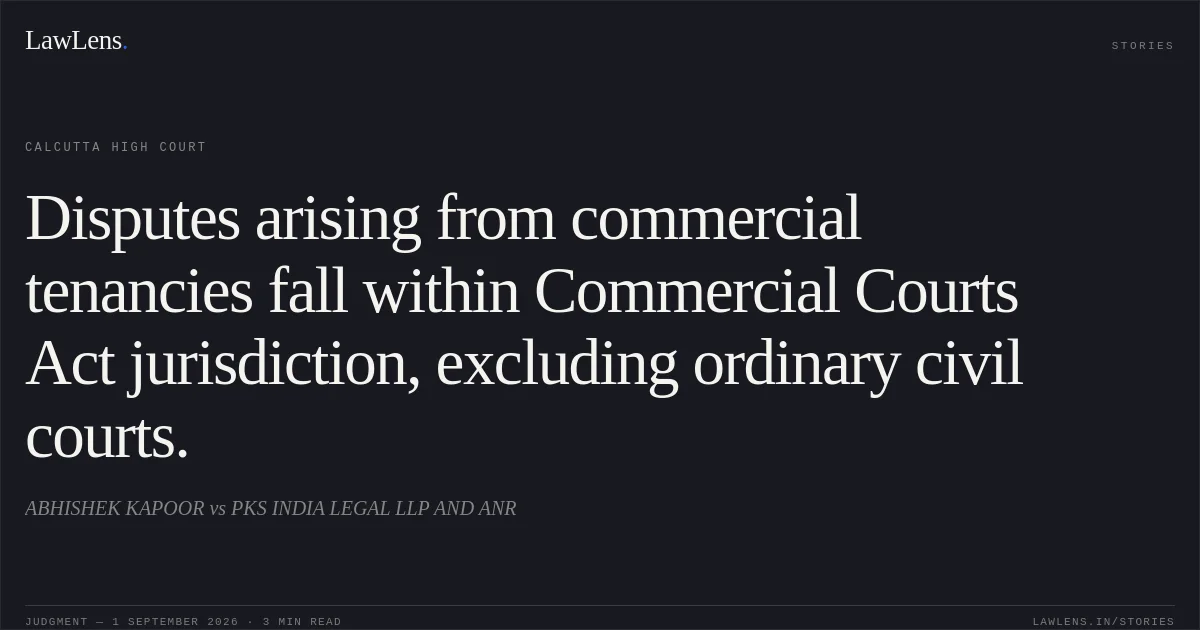
¶ 13The appellant challenged that order, contending that the dispute was a “commercial dispute” under Section 2(1)(c)(vii) of the Commercial Courts Act, 2015, and therefore could not be entertained by an ordinary civil court.
¶ 4–802Issues
i.1. Whether the dispute concerning the alleged tenancy of commercial office premises constitutes a “commercial dispute” under Section 2(1)(c)(vii) of the Commercial Courts Act, 2015.
¶ 4–6, 10ii.2. Whether the ordinary civil court had subject-matter jurisdiction to pass the ad-interim injunction, having regard to the specified-value and allocation-of-jurisdiction provisions applicable to commercial courts.
¶ 6–8, 11–12iii.3. Whether the impugned ad-interim injunction order was liable to be set aside for want of inherent jurisdiction.
¶ 12–1303Law Applied
The Court applied Section 2(1)(c)(vii) of the Commercial Courts Act, 2015, which covers disputes arising out of agreements relating to immovable property used exclusively in trade or commerce.
¶ 10It also applied Section 12 of the 2015 Act concerning determination of the “specified value” of a commercial dispute.
¶ 6–7, 11The Court relied on the Notification dated 20 March 2020 governing the jurisdiction of commercial courts in Calcutta: the City Civil Court has exclusive jurisdiction for specified values from Rs. 3 lakhs up to Rs. 10 lakhs; it has concurrent jurisdiction with the Commercial Division of the High Court for values exceeding Rs. 10 lakhs up to Rs. 1 crore; and the Commercial Division has jurisdiction for values exceeding Rs. 10 lakhs in accordance with the notified allocation.
¶ 6–7, 11An order passed by an ordinary civil court lacking subject-matter or inherent jurisdiction is liable to be set aside.
¶ 12Provisions in the judgment · 2 · Linked ones open on LawLens
Commercial Courts Act, 2015 Section 2Section 12
04Reasoning
The Court treated the pleadings in the plaint and injunction application as determinative for identifying the nature of the dispute at this stage.
¶ 10Since the respondent itself pleaded a tenancy of commercial office premises and characterised it as a commercial tenancy, the dispute fell within Section 2(1)(c)(vii) of the 2015 Act.
¶ 10The Court further noted that the suit property was situated in a prime commercial locality and that the specified value, rather than merely the valuation stated in the suit, governed the allocation of jurisdiction.
¶ 6–7As the suit had been framed as an ordinary civil suit and the impugned order had been passed by an ordinary civil court rather than the competent commercial court or Commercial Division, the Court held that the trial court lacked subject-matter/inherent jurisdiction.
¶ 12The Court clarified, however, that its findings were tentative and would not prevent the competent trial court from deciding the pending injunction application independently and in accordance with law.
¶ 1405Holding
The appeal was allowed on contest against respondent no. 1 and ex parte against pro forma respondent no. 2.
¶ 13The ad-interim injunction order dated 27 July 2026 passed by the Sixth Bench of the City Civil Court at Calcutta in Title Suit No. 1569 of 2026 was set aside on the ground of lack of subject-matter/inherent jurisdiction.
¶ 13CAN 1 of 2026 was consequently disposed of, with no order as to costs.
¶ 15–16Original Court PDF
ABHISHEK KAPOORvsPKS INDIA LEGAL LLP AND ANR
Click to open original judgment
Original judgment, available to read, download and summarize on LawLens.in