Facts
The appellant, defendant no. 2 in CS No. 77 of 2013, challenged the order dated 8 March 2022 by which the learned Single Judge allowed amendment of the plaint to substitute the plaintiff with its liquidator and rejected the application seeking dismissal of the suit on the ground of abatement.
Source reference: para. 1–4The suit concerned the plaintiff’s asserted ownership of specified quantities of imported metallurgical coke acquired through High Sea Sales. The plaintiff sought delivery of the coke, cancellation of an alleged tripartite agreement dated 23 March 2012, injunctions, and damages in the alternative.
Source reference: para. 27–28During the pendency of the suit, insolvency and liquidation proceedings were initiated against the plaintiff. A liquidator was appointed and appeared in several proceedings, but the formal application for substitution and consequential amendment was filed only on 10 January 2022.
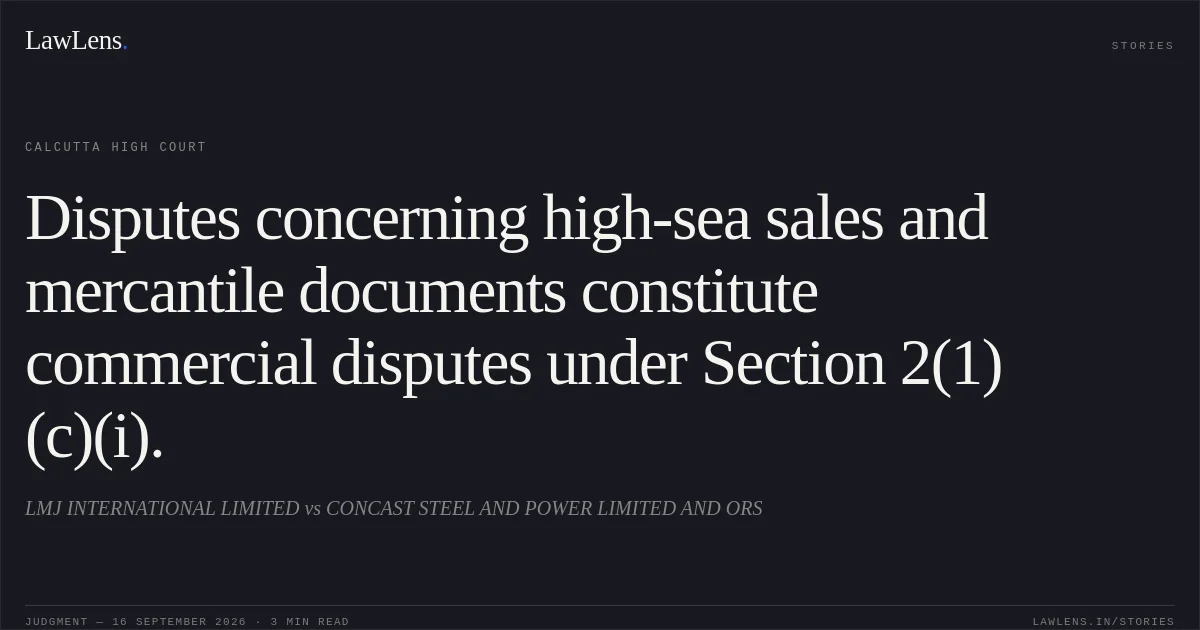
Source reference: para. 34–40In the appeal, the plaintiff contended that the suit involved a commercial dispute under Section 2(1)(c)(i) of the Commercial Courts Act, 2015, whereas the defendants disputed this characterization and contended that the suit was principally founded on title, alleged fraud, fabrication, and wrongful detention of goods.
Source reference: para. 5–24Issues
1. Whether the subject matter of the suit constituted a “commercial dispute” under Section 2(1)(c)(i) of the Commercial Courts Act, 2015?
Source reference: para. 25–262. Whether the learned Single Judge was correct in permitting substitution and amendment of the plaint and in rejecting the application seeking abatement of the suit?
Source reference: para. 25Law Applied
The Court applied Section 2(1)(c)(i) of the Commercial Courts Act, 2015, which covers disputes arising out of ordinary transactions of merchants, bankers, financiers and traders, including disputes relating to mercantile documents and their enforcement or interpretation.
Source reference: para. 57–60The Court held that two requirements must coexist: the dispute must arise from ordinary commercial transactions of merchants or traders, and those transactions must relate to mercantile documents.
Source reference: para. 59–60Under Section 15 of the Act, suits instituted before the Act came into force must be transferred to the Commercial Division if they involve a commercial dispute.
Source reference: para. 29–30, 67The Court relied principally on Ambalal Sarabhai Enterprises Ltd. v. K.S. Infraspace LLP , which requires examination of the plaint’s averments and strict construction of the Act.
Source reference: para. 41, 63It also considered authorities holding that the character of a suit is determined from the substance of the plaint and that fraud does not, by itself, exclude a commercial dispute from the jurisdiction of the Commercial Court.
Source reference: para. 42–58The Court noted, but did not decide, the issues under Order XXII Rules 4 and 8 of the Code of Civil Procedure, 1908 concerning substitution and abatement.
Source reference: para. 7–8, 71Reasoning
The Court examined the plaint as a whole rather than isolating the allegations of fraud, title, or wrongful detention. It found that the parties were business entities and that the dispute concerned metallurgical coke acquired through High Sea Sale transactions, which necessarily involved commercial instruments and mercantile documents relating to the goods and their title.
Source reference: para. 56, 61The alleged tripartite agreement was also a document executed between commercial entities in connection with those transactions; the plaintiff’s prayer for its delivery and cancellation necessarily raised issues concerning the interpretation and legal effect of a mercantile document.
Source reference: para. 56, 64The absence of a direct contractual relationship between every party and the allegations that the agreement was fabricated did not remove the dispute from Section 2(1)(c)(i), particularly since the Act does not exclude adjudication of fraud-related issues arising in a commercial dispute.
Source reference: para. 58, 61–65On that basis, the Court held that the suit was required to be transferred to the Commercial Division. Having reached that conclusion, it declined to adjudicate the substitution and abatement issue in the present appeal.
Source reference: para. 68–71Holding
The Court answered the first issue in the affirmative, holding that the suit involved a commercial dispute within the meaning of Section 2(1)(c)(i) of the Commercial Courts Act, 2015.
It directed that CS No. 77 of 2013 and all connected applications be transferred from the Non-Commercial Division to the Commercial Division and renumbered there.
Source reference: para. 67The appeal, APOT 70 of 2022, and the connected application were likewise directed to be transmitted to and renumbered before the Commercial Appellate Division.
Source reference: para. 69–70The Court expressly refrained from deciding whether substitution was properly allowed or whether the suit had abated, leaving that issue open.
Source reference: para. 71The appeal and connected application were disposed of accordingly.
Source reference: para. 72Acts & Sections Cited
4 provisions across 2 statutes referred to in this judgment. Each provision opens on LawLens.
Commercial Courts Act, 20153
Arbitration and Conciliation Act, 19961
Original Court PDF
LMJ INTERNATIONAL LIMITEDvsCONCAST STEEL AND POWER LIMITED AND ORS
Click to open original judgment
Original judgment, available to read, download and summarize on LawLens.in