Facts
The petitioner applied for a 1 KW domestic electricity connection for his residence at Maqsoodpur, Hajipur.
Source reference: pp. 2–3, paras. 2–4The petitioner claimed that the connection was disconnected on 07.11.1992 after he sold the property and requested disconnection. Despite the alleged disconnection, bills were subsequently issued, including bills in 2000, 2013, 25.03.2022 and 01.11.2022, the last being for Rs. 9,74,562.
Source reference: pp. 1–5, para. 1–3The petitioner had earlier approached the High Court, which directed the electricity authorities to inspect the premises and pass an appropriate order on his representation.
Source reference: p. 4, para. 3In the present proceedings, the respondents stated that, pursuant to the Court’s earlier direction, the bill had been revised to Rs. 81,653.27.
Source reference: pp. 5–6, para. 4Issues
Whether the respondents had complied with the earlier direction of the High Court by revising the petitioner’s electricity bill and passing an appropriate order?
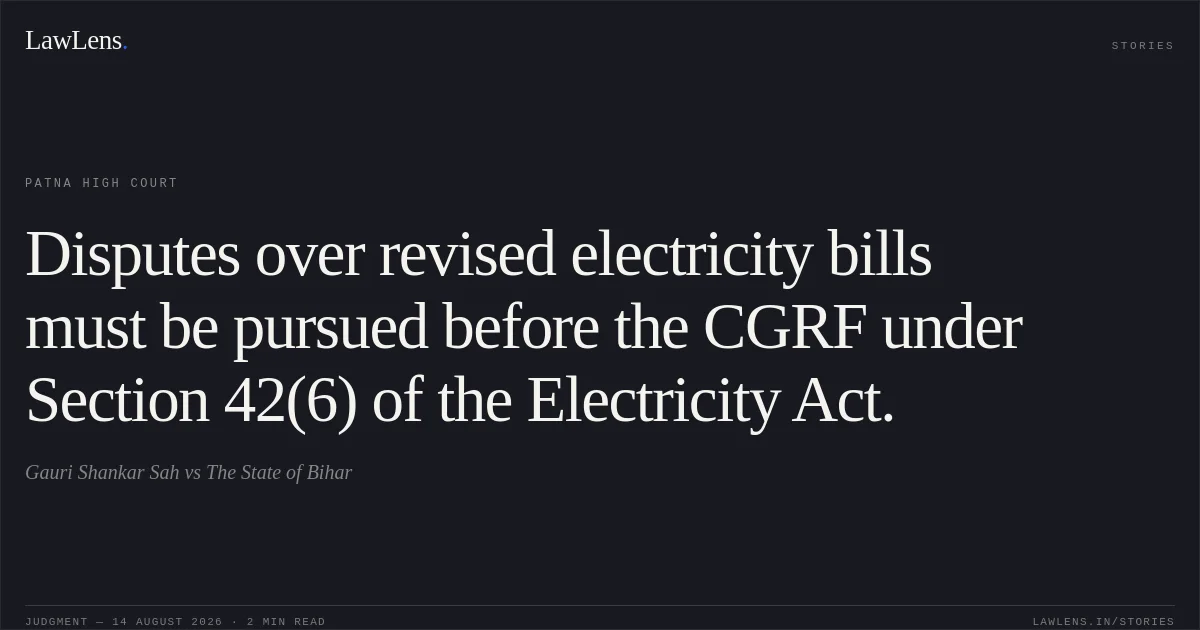
Source reference: pp. 5–6, paras. 6–7Whether the petitioner’s dispute regarding the revised electricity bill should be adjudicated by the High Court or pursued before the Consumer Grievance Redressal Forum under Section 42(6) of the Electricity Act, 2003?
Source reference: p. 6, paras. 7–8Law Applied
The Court applied Section 42(6) of the Electricity Act, 2003, which provides a statutory remedy before the Consumer Grievance Redressal Forum (“CGRF”) for grievances relating to electricity supply and billing.
Source reference: p. 6, para. 7The Court followed the principle that where an efficacious alternative statutory remedy is available, the High Court may decline to adjudicate the disputed merits in writ jurisdiction and direct the aggrieved party to pursue that remedy.
Source reference: p. 6, para. 8Reasoning
The Court noted that the present petition constituted the second round of litigation concerning the petitioner’s disputed electricity dues.
Source reference: p. 6, para. 6The respondents’ counter-affidavit disclosed that, pursuant to the earlier High Court order, the bill had been revised to Rs. 81,653.27. Since the petitioner’s remaining grievance concerned the correctness of the revised bill rather than a complete failure to act, the Court held that the dispute required adjudication by the specialised statutory forum.
Source reference: pp. 5–6, paras. 4, 7Applying Section 42(6) and the alternative-remedy principle, the Court declined to examine the billing dispute on merits in the writ petition and directed the petitioner to approach the CGRF.
Source reference: pp. 6–7, paras. 7–9Holding
The Court held that the respondents had revised the petitioner’s bill to Rs. 81,653.27 in compliance with the earlier direction.
If the petitioner remained aggrieved by the revised bill, he was required to approach the Consumer Grievance Redressal Forum under Section 42(6) of the Electricity Act, 2003.
Source reference: pp. 6–7, paras. 7–10The writ petition was accordingly disposed of with liberty to pursue that statutory remedy; any pending interlocutory application was also disposed of.
Source reference: pp. 6–7, paras. 7–10Acts & Sections Cited
1 provisions across 1 statute referred to in this judgment. Each provision opens on LawLens.
Electricity Act, 20031
Original Court PDF
Gauri Shankar SahvsThe State of Bihar
Click to open original judgment
Original judgment, available to read, download and summarize on LawLens.in