Facts
Respondent No. 2 alleged that, after her marriage to accused No. 1, she was harassed for additional dowry by her husband and in-laws, including the petitioners, who were relatives of her husband.
Source reference: para. 1–2Police filed a charge sheet against eight accused, and the Magistrate took cognizance of offences under Sections 498A, 506, 323 and 114 read with Section 149 of the IPC, and Sections 3 and 4 of the Dowry Prohibition Act.
Source reference: para. 1–2The petitioners, arrayed as accused Nos. 4 to 8, sought to quash the proceedings under Section 482 Cr.P.C., contending that they lived separately and that the allegations against them were general and unsupported by specific instances.
Source reference: para. 1–2, 4Respondent No. 2 did not appear; the State opposed the petition, relying on the charge-sheet materials.
Source reference: para. 5–6Issues
Whether the complaint and charge-sheet disclosed specific allegations sufficient to proceed against the petitioners, who were relatives living separately from the complainant’s matrimonial household.
Source reference: para. 8, 11Whether continuation of the criminal proceedings against the petitioners amounted to abuse of process warranting quashing under Section 482 Cr.P.C.
Source reference: para. 9, 13Law Applied
Section 482 Cr.P.C. empowers the High Court to quash proceedings where their continuation would amount to an abuse of the process of court.
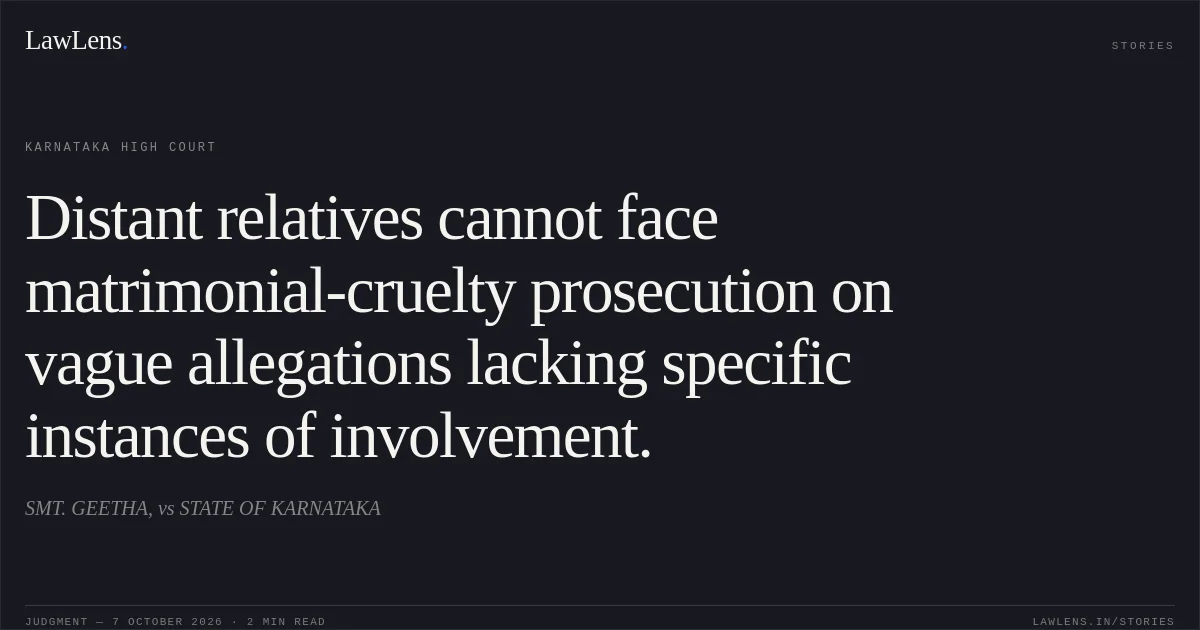
Source reference: no citationThe Court applied the principle in K. Subba Rao v. State of Telangana, 2024 INSC 960, that distant relatives should not be prosecuted in matrimonial and dowry-related cases on the basis of omnibus allegations without specific instances of involvement.
Source reference: para. 8It also relied on Dara Lakshmi Narayan v. State of Telangana, (2025) 3 SCC 735, which cautions against prosecuting family members based only on generalized accusations, particularly where they live separately and no specific allegations establish their active involvement.
Source reference: para. 10Allegations must be scrutinized with care in matrimonial disputes; general assertions of harassment, without particulars, do not by themselves justify criminal prosecution.
Source reference: para. 9, 12Reasoning
The Court noted that the petitioners were relatives of the complainant’s husband and had not resided in the matrimonial home shared by the complainant and accused Nos. 1 to 3.
Source reference: para. 8, 11The complaint alleged that they instigated the principal accused when visiting that home, but neither the complaint nor the charge-sheet statements specified any date, time, place, manner, or particular instance of harassment by the petitioners.
Source reference: para. 8, 11Applying the cited principles, the Court concluded that the allegations were vague and omnibus and did not establish a prima facie case against these petitioners; requiring them to face trial would therefore constitute an abuse of process.
Source reference: para. 11–13Holding
The Court allowed the petition and quashed the proceedings in C.C. No. 2667/2023, arising from Crime No. 10/2023, against accused Nos. 4 to 8 for the offences under the IPC and Dowry Prohibition Act.
It expressly directed that proceedings against accused Nos. 1 to 3 continue.
Source reference: para. 13 and order clauses (i)–(iii)Acts & Sections Cited
7 provisions across 3 statutes referred to in this judgment. Each provision opens on LawLens.
Code of Criminal Procedure, 19731
Indian Penal Code, 18604
Original Court PDF
SMT. GEETHA,vsSTATE OF KARNATAKA
Click to open original judgment
Original judgment, available to read, download and summarize on LawLens.in