Facts
The respondent, Seema Jakhar, was the SHO of Police Station Barloot when two individuals were intercepted with 141 kgs of poppy straw. It was alleged that the respondent accepted a bribe of ₹10,00,000 to manipulate the investigation, release the suspects, and record false entries in the police diary (Rajnamcha).
Source reference: p. 3, para. 7A Co-ordinate Bench of the Rajasthan High Court granted her bail on 20.07.2022, primarily noting that the alleged offence under Section 221 IPC carried a maximum sentence of three years and that the respondent was a woman in custody since 26.06.2022.
Source reference: p. 2-3, para. 5-6The State of Rajasthan filed this application under Section 439(2) of the Cr.P.C. to cancel/revoke the bail, arguing that the court failed to consider the gravity of the offences under Sections 8/15, 29, 27A, and 59 of the NDPS Act.
Source reference: p. 2, para. 2Issues
1. Whether the bail granted to the respondent could be cancelled or revoked on the grounds that the granting court failed to properly consider the gravity of the charges under the NDPS Act.
Source reference: p. 6, para. 122. Whether the State established sufficient "post-bail" supervening circumstances or illegality to warrant the cancellation of bail under Section 439(2) Cr.P.C.
Source reference: p. 6, para. 11-12Law Applied
The court applied Section 439(2) of the Cr.P.C. regarding the power to cancel bail.
Source reference: p. 1, para. 1It relied on the distinction between "cancellation of bail" (based on post-grant misconduct) and "revocation of an illegal order," citing Abhimanyu Etc. v. State of Kerala (2025) and P. v. State of Madhya Pradesh.
Source reference: p. 3, para. 8It followed the principles from Dolat Ram v. State of Haryana (1995) and Gurcharan Singh v. State (Delhi Administration) (1978), which mandate that bail once granted should only be cancelled upon "strong and cogent evidence" of wrongdoing or violation of conditions.
Source reference: p. 4-6, para. 8-9The court also noted Section 437(1) Cr.P.C. and Kalvakuntla Kavitha v. Directorate of Enforcement (2024), which provide special considerations for granting bail to women.
Source reference: p. 7, para. 13-14Reasoning
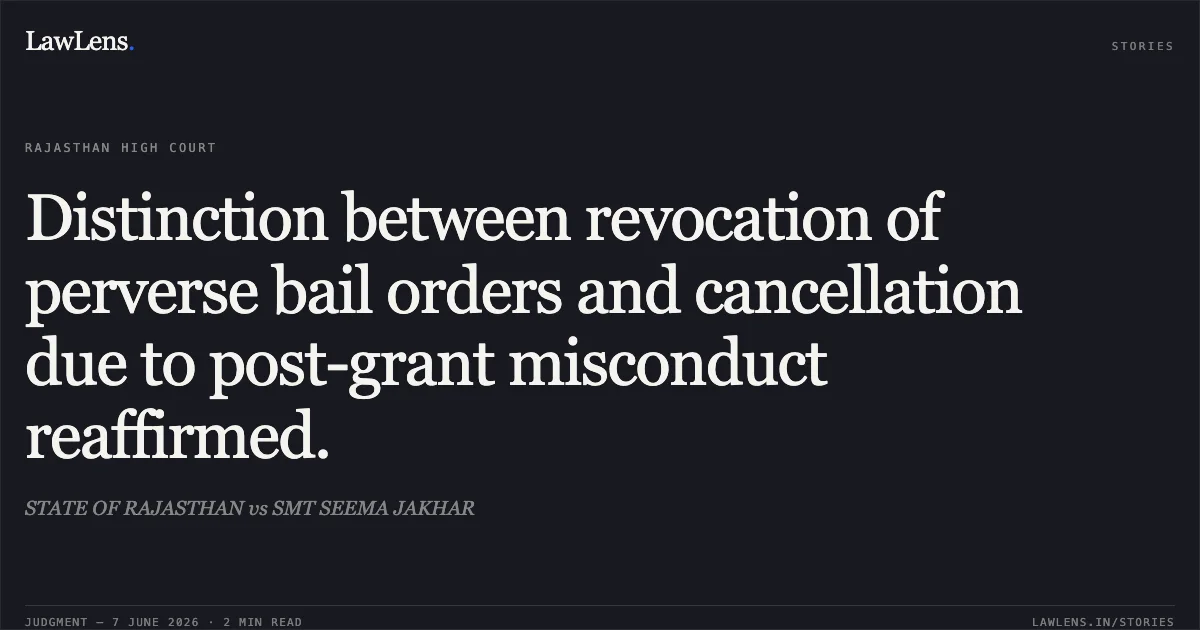
The court reasoned that there is a sharp distinction between an appellate challenge to a bail order and an application for cancellation under Section 439(2).
Source reference: p. 6, para. 11It observed that the State’s primary grievance was an alleged error by the Co-ordinate Bench in evaluating the severity of the charges; however, the court clarified that it does not sit as an "Appellate Court" over a Bench of concurrent jurisdiction.
Source reference: p. 6-7, para. 12The court noted that the original bail order was passed in 2022, and nearly four years had elapsed without any evidence that the respondent misused her liberty, tampered with evidence, or influenced witnesses.
Source reference: p. 2, para. 3; p. 5, para. 8Furthermore, the court emphasized that the respondent's status as a woman entitling her to statutory consideration for bail under Section 437 Cr.P.C. remained a valid factor.
Source reference: p. 7, para. 13-14Holding
The court dismissed the bail cancellation application, holding that the State failed to demonstrate any supervening circumstances or post-bail misconduct.
The court concluded that the application was "misconceived" and lacked merit as it merely sought to re-argue the gravity of the offence rather than proving a violation of bail conditions. The bail granted to Smt. Seema Jakhar remains intact.
Source reference: p. 7, para. 15Acts & Sections Cited
8 provisions across 4 statutes referred to in this judgment. Each provision opens on LawLens.
Code of Criminal Procedure, 19732
Indian Penal Code, 18601
Narcotic Drugs and Psychotropic Substances Act, 19854
Prevention of Money-Laundering Act, 20021
Original Court PDF
STATE OF RAJASTHANvsSMT SEEMA JAKHAR
Click to open original judgment
Original judgment, available to read, download and summarize on LawLens.in