01Facts
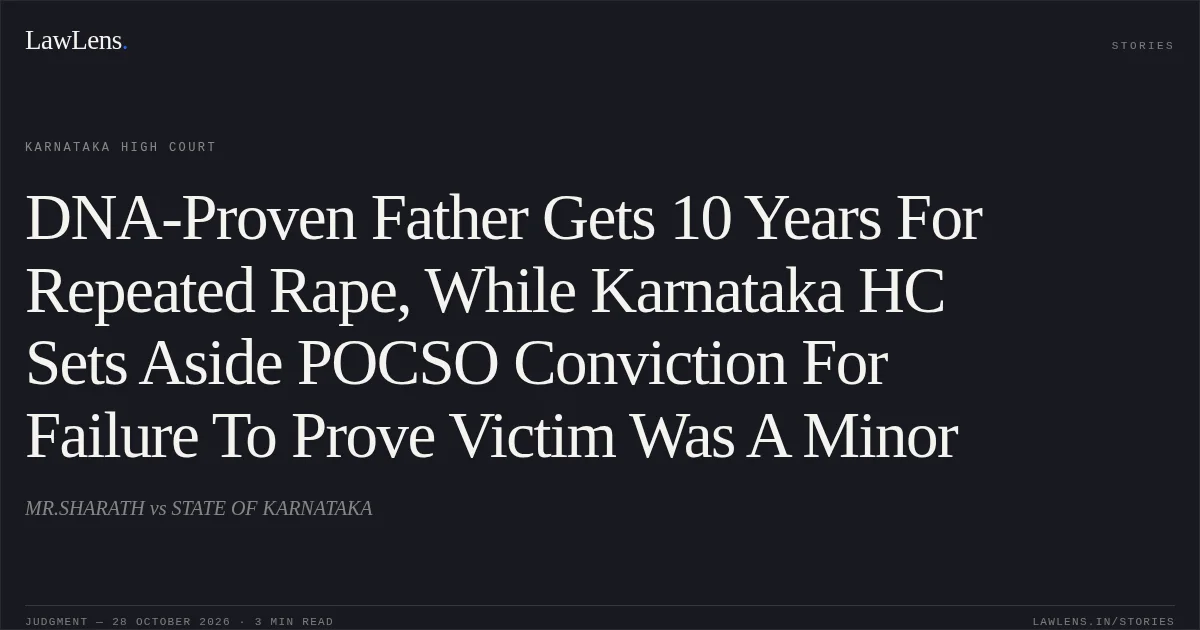
The prosecution alleged that the appellant repeatedly raped the victim, who was said to be under 16, threatened her and caused her pregnancy.
pp. 4–10The victim’s mother lodged the complaint after learning of the pregnancy; DNA testing identified the appellant as the biological father of the child
pp. 4–10The Sessions Court convicted the appellant under Sections 376(2)(n), 376(3) and 506 IPC, and Sections 5(j)(ii) and 5(l), read with Section 6 of the POCSO Act.
pp. 3–4On appeal, the High Court considered whether the victim’s age had been proved and whether the convictions and sentences could be sustained.
pp. 11–1602Issues
i.Whether the prosecution proved beyond reasonable doubt that the victim was below 18 years for the purposes of the POCSO Act and below 16 years for Section 376(3) IPC, on the basis of the study certificate alone
pp. 11–14ii.Whether the evidence, including the victim’s testimony, DNA report and evidence of threats, supported the convictions under Sections 376(2)(n) and 506 IPC despite the failure to prove the victim’s age
pp. 10–11, 14–1603Law Applied
Section 94(2)(iii) of the Juvenile Justice (Care and Protection of Children) Act, 2015, as discussed in P. Yuvaprakash v. State of T.N., provides an evidentiary hierarchy for age determination, with school or matriculation records preferred before other documents or medical age testing.
p. 12The prosecution must prove the victim’s age to establish the relevant age-based elements of the POCSO offences and Section 376(3) IPC.
p. 11The Court also applied the principle that consent given under a life threat is not consent in the eye of law, and considered the victim’s testimony and the DNA evidence in assessing the charges under Sections 376(2)(n) and 506 IPC.
pp. 10, 14–15Provisions in the judgment · 7 · Linked ones open on LawLens
Code of Criminal Procedure, 1973 Section 374Section 164
Indian Penal Code, 1860 Section 376Section 506
Protection of Children from Sexual Offences Act, 2012 Section 5Section 6
Juvenile Justice (Care and Protection of Children) Act, 2015. Section 94
04Reasoning
The Court accepted the DNA report as reliable: the samples were collected on 8 April 2019 and sealed articles were received by the scientific officer the following day, supporting the finding that the appellant fathered the child.
pp. 9–11But paternity did not establish the victim’s age.
pp. 12–14The prosecution relied on a study certificate stating her date of birth, while the underlying school admission register was not produced; the Head Master had not been present when she was admitted and acknowledged that entries could be based on parents’ statements or birth certificates.
pp. 12–14The Court therefore found the certificate insufficient to prove that the victim was under 18 or under 16.
pp. 12–14The age-proof failure defeated the age-dependent convictions under the POCSO Act and Section 376(3) IPC, but not the convictions under Sections 376(2)(n) and 506 IPC: the victim testified to repeated rape and threats, and the Court found no material elicited in cross-examination to disbelieve her account.
pp. 14–1605Holding
The appeal was allowed in part.
pp. 15–16The Court set aside the convictions and sentences under Section 376(3) IPC and Sections 5(j)(ii) and 5(l), read with Section 6 of the POCSO Act, for failure to prove the victim’s age.
pp. 15–16It affirmed the convictions under Sections 376(2)(n) and 506 IPC, sentencing the appellant to ten years’ rigorous imprisonment and a fine of ₹40,000 for Section 376(2)(n), with one year’s simple imprisonment in default, and confirming one year’s simple imprisonment under Section 506; the sentences were to run concurrently, with set-off.
pp. 16–17The fine, if paid, was directed to be paid to the victim as compensation, and the trial court’s remaining compensation order was left undisturbed.
pp. 17–18Original Court PDF
MR.SHARATHvsSTATE OF KARNATAKA
Click to open original judgment
Original judgment, available to read, download and summarize on LawLens.in