Facts
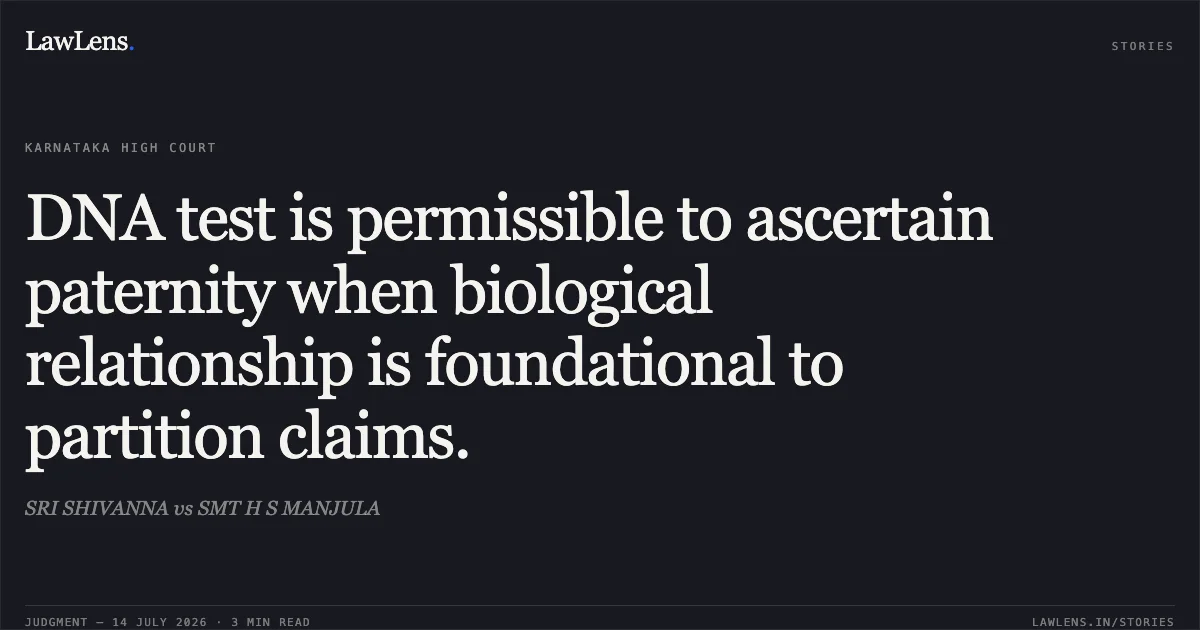
The respondents (plaintiffs) filed a suit for partition and separate possession (O.S. No. 690/2013) claiming to be the children of the petitioner (defendant No. 1) and one Mahadevamma
Source reference: para. 2The petitioner denied the relationship, asserting that the respondents were born of a different father, H.C. Shivanna
Source reference: para. 6Documents such as school records showed the father's name as "H.C. Shivanna," creating a discrepancy with the petitioner's name, "Shivanna"
Source reference: para. 3At the stage of arguments, the respondents filed an application under Order XXVI Rule 10 of the CPC and Section 45 of the Evidence Act for a DNA test to ascertain paternity
Source reference: para. 6The Trial Court allowed the application, citing the petitioner’s own admission in cross-examination that he was willing to undergo the test
Source reference: para. 6The petitioner challenged this order via a Writ Petition under Article 227 of the Constitution
Source reference: p. 2Issues
1. Whether the Trial Court was justified in ordering a DNA test to determine paternity in a suit for partition when other oral and documentary evidence had already been led
Source reference: para. 112. Whether the direction to undergo a DNA test violates the petitioner’s right to privacy under Article 21 of the Constitution
Source reference: para. 11Law Applied
The court applied Order XXVI Rule 10 of the CPC and Section 45 of the Evidence Act regarding scientific investigation
Source reference: para. 2It relied on Chaturbhuj Pradhan v. Amar Pradhan [2026 INSC 600] and Aparna Ajinkya Firodia v. Ajinkya Arun Firodia [2024 7 SCC 773], which mandate that DNA tests should not be ordered routinely but only when such a test is "indispensable" to resolve the controversy and when other evidence is insufficient
Source reference: para. 7It further cited Narayan Dutt Tiwari v. Rohit Shekhar [(2012) 12 SCC 554] to establish that the right of a child to know their biological roots outweighs privacy concerns, and Section 112 of the Evidence Act protects legitimacy, not necessarily paternity
Source reference: para. 9Reasoning
The Court observed that the evidence on record was contradictory; while witnesses for the plaintiffs supported the relationship, cross-examinations and school documents suggested a different father, "H.C. Shivanna," creating a cloud over the respondents' paternity
Source reference: para. 11Since the suit is for partition, the respondents' status as children of the petitioner is a foundational fact that must be resolved to adjudicate the dispute
Source reference: para. 12The court noted that because the respondents (the children) were the ones seeking the test, the risk of "stigmatizing" them or branding the mother as unchaste was absent
Source reference: para. 11Crucially, the Court highlighted that the petitioner had explicitly consented to the DNA test during his cross-examination, thereby waiving any claim to a violation of privacy
Source reference: para. 11The court concluded that scientific investigation was necessary as the existing oral evidence was insufficient to reach a definitive finding
Source reference: para. 11-12Holding
The High Court upheld the Trial Court's order allowing the DNA test, ruling that the results were essential for the partition suit and did not violate privacy due to the petitioner’s prior consent
The Court modified the order to include a safeguard: the Court Commissioner must submit the DNA test report to the Trial Court in a "sealed cover" to maintain confidentiality. The Writ Petition was disposed of with directions to ensure the biological relationship is ascertained through this scientific process
Source reference: para. 13-14Acts & Sections Cited
3 provisions across 3 statutes referred to in this judgment. Each provision opens on LawLens.
Code of Civil Procedure, 19081
Code of Criminal Procedure, 19731
Indian Succession Act, 19251
Original Court PDF
SRI SHIVANNAvsSMT H S MANJULA
Click to open original judgment
Original judgment, available to read, download and summarize on LawLens.in