Facts
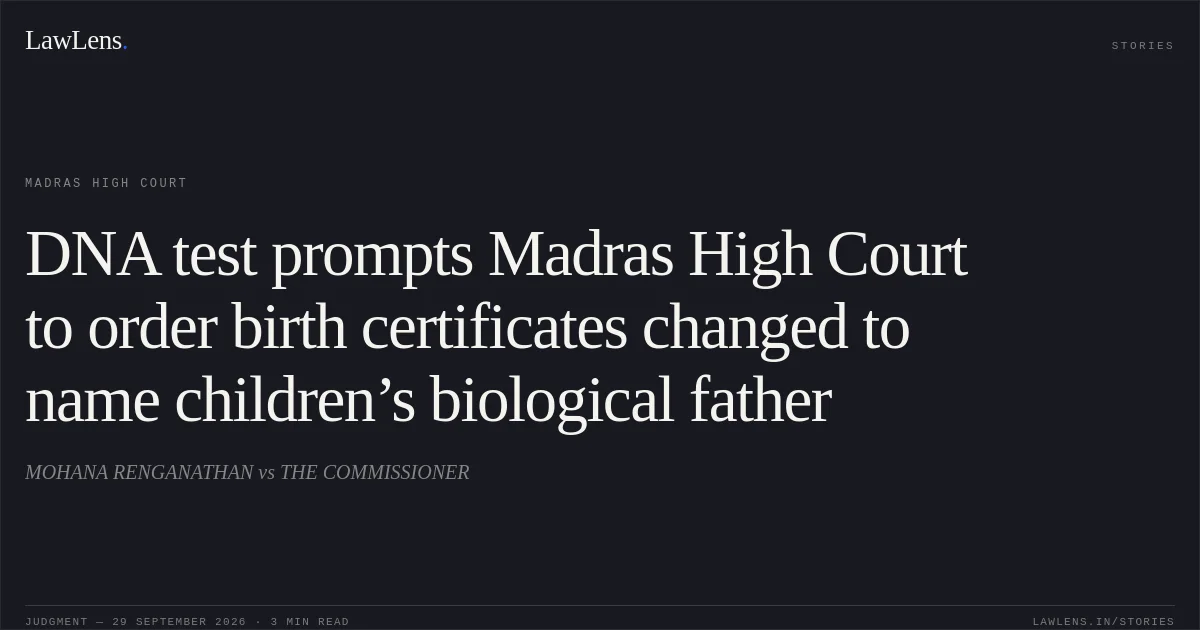
The petitioner’s two daughters were born while she was still legally married to the fifth respondent, K. Dasarathan.
Source reference: p. 3–5Their birth certificates accordingly recorded him as their father.
Source reference: p. 3–5The petitioner later obtained a divorce and married the fourth respondent, P. Renganathan, whom she claimed was the children’s biological father.
Source reference: p. 3–5A DNA report, based on samples voluntarily provided by the petitioner, the fourth respondent and the children, identified the fourth respondent as their biological father.
Source reference: p. 3–5After the authorities did not amend the certificates, the petitioner sought writs directing correction of the recorded father’s name and the related initials.
Source reference: p. 3–5The fifth respondent did not appear; the Court recorded that notice had been returned marked “left without instructions”.
Source reference: p. 8Issues
1. Whether Section 15 of the Registration of Births and Deaths Act, 1969 permits correction of a birth-record entry to substitute the recorded father’s name with the biological father’s name, where DNA evidence establishes paternity.
Source reference: pp. 6–8, 232. Whether the High Court should exercise its jurisdiction under Article 226 to direct the correction, notwithstanding the presumption concerning legitimacy under Section 112 of the Indian Evidence Act, 1872.
Source reference: pp. 11–13, 19–23Law Applied
Section 15 of the Registration of Births and Deaths Act, 1969 authorises correction of errors in birth records; the Court construed that power to extend to substantive errors, including an incorrect entry of a parent’s name.
Source reference: p. 23Section 112 of the Indian Evidence Act, 1872 (now pari materia with Section 116 of the Bharatiya Sakshya Adhiniyam, 2023) provides a presumption of legitimacy for a child born during a valid marriage, subject to its statutory exception.
Source reference: pp. 11–13, 18–19Relying on Nandlal Wasudeo Badwaik v. Lata Nandlal Badwaik, (2014) 2 SCC 576, the Court stated that where reliable scientific evidence conflicts with that presumption, the presumption must yield to proof.
Source reference: pp. 11–13, 18–19The Court also relied on Bhabani Prasad Jena v. Orissa State Commission for Women, (2010) 8 SCC 633, and Narayan Dutt Tiwari v. Rohit Shekhar, (2012) 12 SCC 554, concerning the evidentiary value of DNA testing and the use of scientific evidence in determining paternity.
Source reference: pp. 10–11, 14, 20–23Article 226 confers discretionary and equitable jurisdiction, which the Court may use to protect a child’s dignity and interests under Article 21.
Source reference: pp. 19–22Reasoning
The Court treated the DNA report as genuine and undisputed, noting that the test had been undertaken voluntarily by the petitioner, the fourth respondent and the children; accordingly, the usual concerns about compelling a person to undergo DNA testing did not arise.
Source reference: pp. 19–20, 22–23It held that the children’s birth during the petitioner’s subsisting marriage did not prevent recognition of the biological father where scientific evidence established paternity.
Source reference: pp. 11–13, 19–23The Court construed Section 15 broadly enough to permit correction of the parentage entry and considered that leaving the certificates unchanged would prolong the children’s difficulty in having their paternity legally recognised.
Source reference: pp. 11–13, 19–23Holding
The Court answered both issues in the petitioner’s favour.
It directed the competent respondent to correct the birth certificates by recording the fourth respondent, P. Renganathan, as the father of both children and to make the corresponding changes to the initials of the children and the petitioner.
Source reference: pp. 23–24Both writ petitions were disposed of, the connected miscellaneous petitions were closed, and no order as to costs was made.
Source reference: p. 24Acts & Sections Cited
5 provisions across 4 statutes referred to in this judgment. Each provision opens on LawLens.
Registration of Births and Deaths Act, 19691
Bharatiya Sakshya Adhiniyam, 20231
Code of Civil Procedure, 19082
General Clauses Act, 18971
Original Court PDF
MOHANA RENGANATHANvsTHE COMMISSIONER
Click to open original judgment
Original judgment, available to read, download and summarize on LawLens.in