01Facts
The appellant was prosecuted for offences under Sections 363 and 376(f) of the Indian Penal Code (IPC) concerning the alleged kidnapping and sexual assault of a 12-year-old girl on 9 January 2007. The prosecution case was that the appellant enticed the victim away from near the Government Girls High School, Tripunithura, took her on his motorcycle to his residence at Thammanam, and subjected her to sexual intercourse twice on the same day
pp. 2–3The victim was examined as PW1 and her foster mother, foster father, relatives, school authorities, investigating officers, and the examining doctor were also examined. The prosecution relied, among other evidence, on the victim’s testimony, the birth certificate, the school admission register, and the medical certificate. The Additional Sessions Court convicted the appellant under Sections 363 and 376(f) IPC and sentenced him to five years’ rigorous imprisonment and fine under Section 363, and ten years’ rigorous imprisonment and fine under Section 376(f), with the substantive sentences to run concurrently. The appellant challenged the conviction principally on the ground that the prosecution had failed to prove that the victim was below the relevant age
pp. 3–602Issues
i.Whether the prosecution proved that the appellant kidnapped the victim, a minor girl, thereby committing an offence under Section 363 IPC?
¶ 9 · p. 7ii.Whether the prosecution proved that the appellant committed the offence punishable under Section 376(f) IPC against the victim?
¶ 9 · p. 7iii.Whether the victim’s age, stated to be 12 years at the time of occurrence, was sufficiently established through oral and documentary evidence?
¶ 7, 21 · pp. 4–5, 13iv.Whether the conviction and sentence imposed by the Sessions Court required interference in appeal?
¶ 9, 23–24 · pp. 7, 15–1603Law Applied
The Court applied Sections 363 and 376(f) IPC, relating respectively to kidnapping from lawful guardianship and aggravated rape of a minor girl.
It held that the victim’s age may be established through reliable documentary evidence, including a birth certificate and school admission records, supported by the testimony of persons competent to prove those records.
¶ 21 · p. 13The Court further applied the principle that the credible and trustworthy testimony of a prosecutrix or victim of sexual assault can, by itself, form the basis of conviction without independent corroboration; corroborative medical evidence, however, strengthened the prosecution case.
¶ 22 · pp. 14–15The Court also relied on Joseph @ Sabu v. State of Kerala, 2026 KHC OnLine 331, concerning proof of a victim’s minority and the effect of an accused’s failure to effectively challenge the victim’s asserted age.
¶ 8 · pp. 5–6Provisions in the judgment · 4 · Linked ones open on LawLens
Indian Penal Code, 1860 Section 363Section 376Section 354
Code of Criminal Procedure, 1973 Section 357
04Reasoning
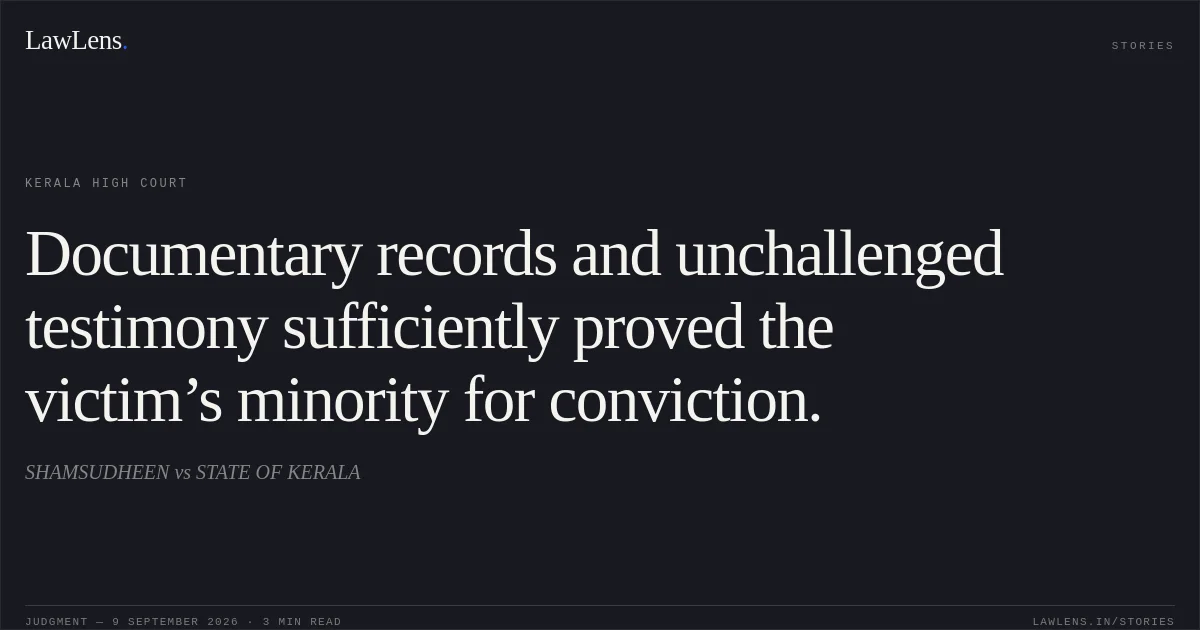
The Court found that the prosecution had satisfactorily established the victim’s age as 12 years on the date of occurrence through the birth certificate, the school admission register, and the evidence of PW2 and PW21, supported by the victim’s testimony. Significantly, although PW1 stated that she was 17 years old at the time of her examination, that evidence was not challenged in cross-examination; the Court therefore accepted the prosecution’s calculation that she was approximately 12 years old when the offence occurred.
¶ 21 · p. 13The victim gave a consistent account of being taken by the appellant to his residence and subjected to sexual intercourse twice. The Court found nothing material in cross-examination to discredit her testimony. Her account was corroborated by the evidence of the examining doctor, who found that penetration had occurred, that the hymen was not intact, and that the swab contained blood stains consistent with injury caused by penetration. The evidence regarding the victim’s absence from school, her immediate disclosure to her foster mother, the prompt registration of the complaint, and the appellant’s connection with the relevant locations further supported the prosecution case. Accordingly, the Court held that the ingredients of Sections 363 and 376(f) IPC were proved beyond reasonable doubt.
¶ 22 · pp. 7–1505Holding
The Kerala High Court answered the issues against the appellant and held that the prosecution had proved both the victim’s minority and the commission of the offences under Sections 363 and 376(f) IPC beyond reasonable doubt.
¶ 22–23 · p. 15The conviction and sentence imposed by the Additional Sessions Court were affirmed. The appeal was dismissed, the order suspending the sentence and granting bail was cancelled, and the appellant was directed to surrender before the Sessions Court forthwith to undergo the sentence; failing surrender, the Sessions Court was directed to execute the sentence.
¶ 24 · p. 16Original Court PDF
SHAMSUDHEENvsSTATE OF KERALA
Click to open original judgment
Original judgment, available to read, download and summarize on LawLens.in