Facts
The plaintiff (Respondent No. 1) filed a civil suit for declaration of title, demolition of a house constructed on the suit land, recovery of vacant possession, and permanent injunction
Source reference: para 3(a)The plaintiff claimed title over Khasra No. 589/1/1 and an abadi plot (Khasra No. 589/1/ग) based on a patta granted by the Nayab Tahsildar in 1991 and an allotment by the Gram Panchayat in 1989
Source reference: para 3(a)He further alleged that his brother, Laxmidas, transferred his adjoining plot to him, totaling 10 decimals, which the defendants forcibly encroached upon in 2007 to construct a house
Source reference: para 3(b)-(c)The defendants contended they had been in peaceful possession for 30–40 years and that the suit was bad for non-joinder of the plaintiff’s brother
Source reference: para 3(d)The Trial Court dismissed the suit, holding that the plaintiff failed to prove title and encroachment without a formal demarcation
Source reference: para 4The First Appellate Court reversed this decision, decreeing the suit in favor of the plaintiff based on the patta and revenue records
Source reference: para 5The defendants then approached the High Court in a Second Appeal
Source reference: para 5Issues
1. Whether the First Appellate Court committed a legal error by reversing the Trial Court’s findings without proper appreciation of evidence regarding title and encroachment
Source reference: para 62. Whether the suit was maintainable despite the alleged non-joinder of a necessary party and improper valuation
Source reference: para 6 & 113. Whether a substantial question of law arises for consideration under Section 100 of the CPC
Source reference: para 12-13Law Applied
The court primarily applied Section 100 of the Code of Civil Procedure (CPC), 1908, which restricts the scope of a Second Appeal to "substantial questions of law"
Source reference: para 1 & 8It relied on the principle that interference with findings of fact by the First Appellate Court is only warranted if such findings are perverse, based on no evidence, or suffer from a substantial error of law
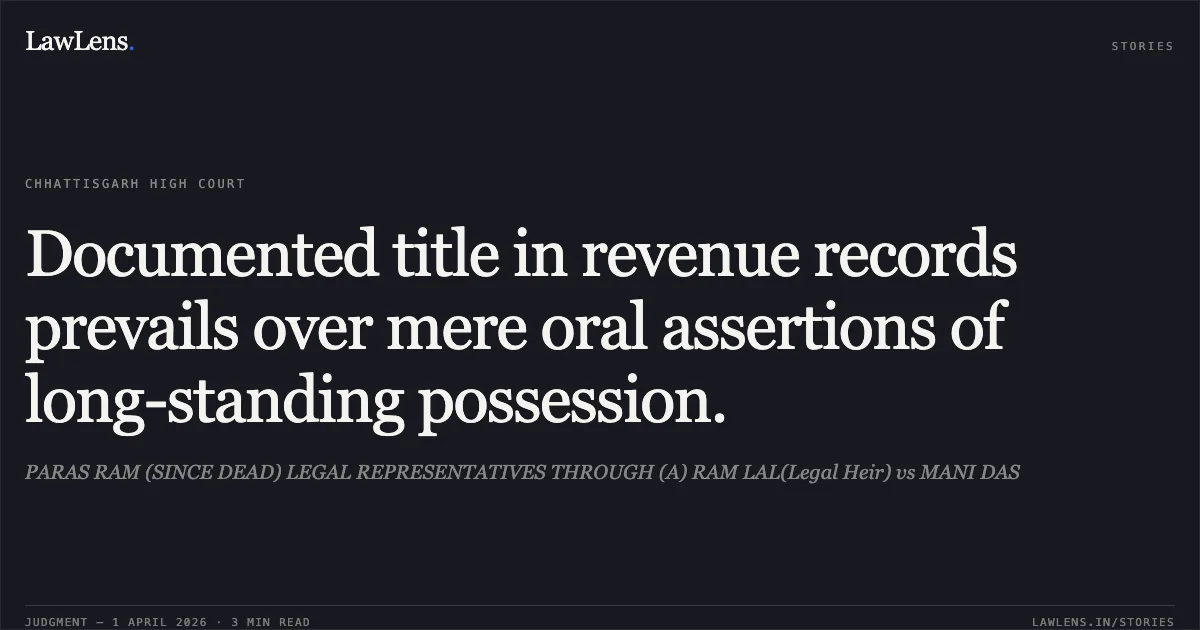
Source reference: para 8Additionally, the court applied the evidentiary principle that documented title (via revenue records/patta) prevails over mere oral assertions of long-standing possession
Source reference: para 9-10Reasoning
The High Court observed that the First Appellate Court correctly identified the plaintiff as the Bhumiswami based on competent revenue grants and records
Source reference: para 9It reasoned that the defendants failed to provide any documentary evidence to support their claim of 30–40 years of possession; thus, their oral testimony could not override the plaintiff's established legal title
Source reference: para 10Regarding the identity of the land and the lack of demarcation, the court noted that the defendants had not raised the issue of "different land identity" in the lower courts, making it an impermissible "afterthought" at the Second Appeal stage
Source reference: para 11The court found that the First Appellate Court had duly considered the technical objections regarding non-joinder and valuation, finding no material illegality therein
Source reference: para 11Consequently, since the findings of the lower appellate court were based on a sound appreciation of evidence, no substantial question of law was triggered
Source reference: para 12Holding
The High Court held that no substantial question of law arose for consideration and that the findings of the First Appellate Court were neither perverse nor illegal
The Second Appeal was dismissed at the admission stage, and the judgment of the First Appellate Court, which decreed the plaintiff's suit for declaration and possession, was upheld
Source reference: para 13No order as to costs was made
Source reference: para 13Acts & Sections Cited
1 provisions across 1 statute referred to in this judgment. Each provision opens on LawLens.
Code of Civil Procedure, 19081
Original Court PDF
PARAS RAM (SINCE DEAD) LEGAL REPRESENTATIVES THROUGH (A) RAM LAL(Legal Heir)vsMANI DAS
Click to open original judgment
Original judgment, available to read, download and summarize on LawLens.in


