Facts
The Petitioner (husband) filed a petition for matrimonial relief under the Hindu Marriage Act (HMA No. 1777/2023).
Source reference: p. 2During the proceedings, the Petitioner filed a Replication along with additional documents which were initially taken on record on 12.05.2026, following which issues were framed.
Source reference: p. 2The Respondent (wife) subsequently moved an application seeking permission to file a sur-rejoinder and challenged the inclusion of the Petitioner’s additional documents.
Source reference: p. 2On 11.07.2026, the Family Court, Rohini, dismissed the request for a sur-rejoinder but ordered that the documents filed with the Replication be "taken off the record" because they were filed without the court's leave.
Source reference: para. 12The Petitioner assailed this order under Article 227 of the Constitution.
Source reference: p. 1Issues
1. Whether the Family Court could validly order documents to be taken off the record after they had already been accepted and issues had been framed.
Source reference: p. 2, 42. Whether the Court exceeded its jurisdiction by granting a relief (removal of documents) that was allegedly not specifically sought in the prayers of the application.
Source reference: p. 2, 43. Whether the statutory embargo under Order VII Rule 14(3) of the CPC applies to documents filed along with a Replication.
Source reference: p. 3-4Law Applied
Order VII Rule 14(3) of the Code of Civil Procedure (CPC), 1908, which stipulates that any document which ought to have been produced with the plaint, but was not, shall not be received in evidence without the leave of the Court.
Source reference: p. 3-4The legal principle established in Polyflor Limited v. A. Goenka & Ors. (2016:DHC:2990), reinforcing that there is a statutory embargo against placing additional documents on record without prior judicial permission.
Source reference: p. 4Reasoning
The High Court reasoned that Order VII Rule 14(3) CPC creates a mandatory procedural requirement: a plaintiff must obtain explicit leave from the court to introduce documents not filed with the original plaint.
Source reference: p. 4The Court found that the Petitioner admittedly failed to file an application for leave when submitting documents with the Replication.
Source reference: para. 10The Court rejected the Petitioner's argument that the prior "taking on record" of the Replication or the framing of issues waived this requirement, holding that these procedural milestones do not dilute the statutory mandate of the CPC.
Source reference: para. 11The Court clarified that a trial judge is not denuded of jurisdiction to enforce statutory procedures simply because a specific prayer for removal was absent in the opponent's application; the court has an independent duty to ensure documents are placed on record according to law.
Source reference: para. 12Holding
The High Court dismissed the petition, holding that the Family Court acted within its jurisdiction and committed no patent illegality.
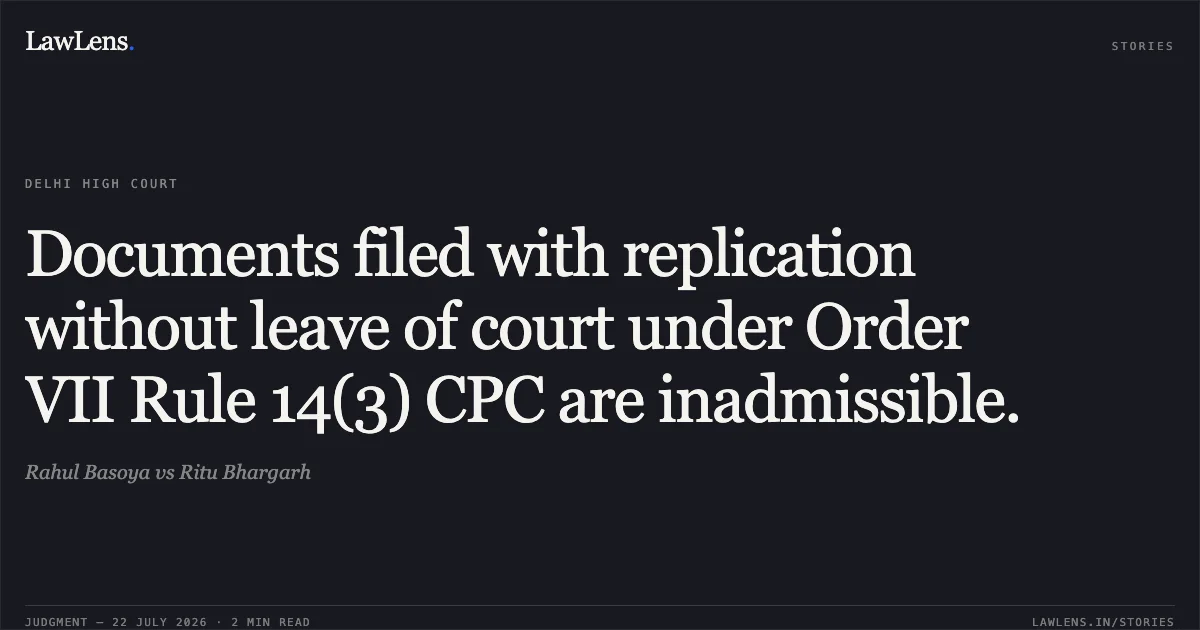
The court affirmed that documents filed with a Replication without leave of the court under Order VII Rule 14(3) CPC cannot remain part of the record or be used in evidence.
Source reference: para. 10, 12All pending applications were dismissed.
Source reference: para. 14Acts & Sections Cited
1 provisions across 1 statute referred to in this judgment. Each provision opens on LawLens.
Code of Civil Procedure, 19081
Original Court PDF
Rahul BasoyavsRitu Bhargarh
Click to open original judgment
Original judgment, available to read, download and summarize on LawLens.in


