Facts
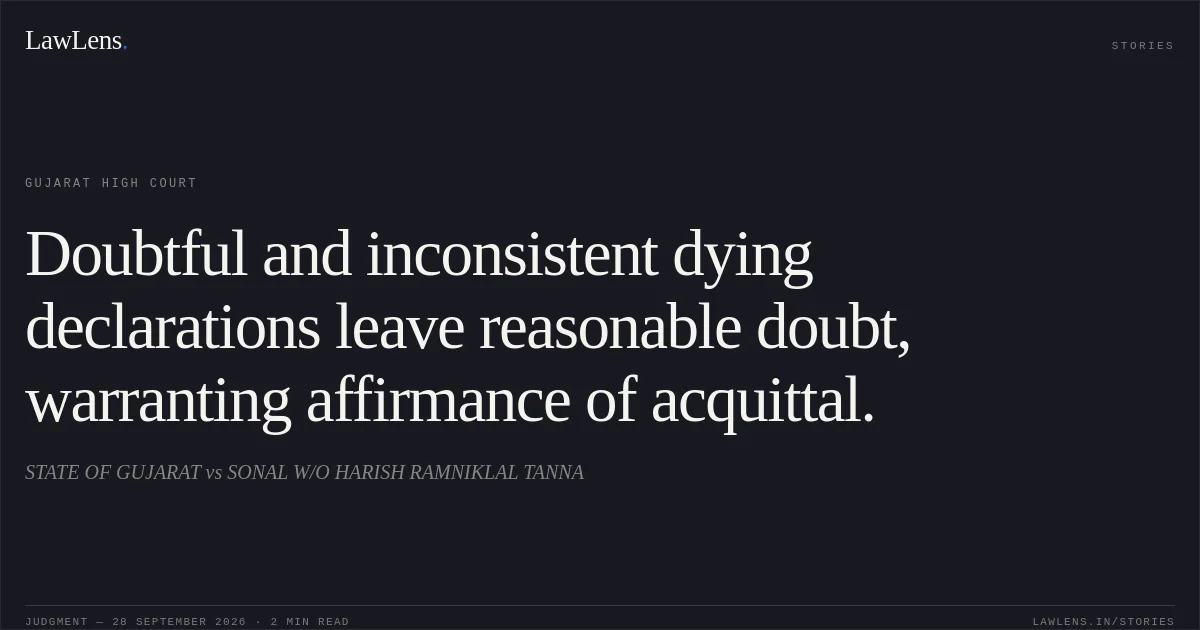
The State appealed the acquittal of the deceased’s wife and mother-in-law, who had been charged under Sections 302 read with 114 of the Indian Penal Code (IPC).
Source reference: para. 1–7, 13The prosecution alleged that the accused poured kerosene on the deceased and set him on fire.
Source reference: para. 1–7, 13Its case relied principally on a dying declaration recorded by an Executive Magistrate, a complaint recorded by a police officer, and alleged oral dying declarations.
Source reference: para. 1–7, 13The Sessions Court acquitted both accused; the State challenged that decision under Section 378 of the Code of Criminal Procedure, 1973 (CrPC).
Source reference: para. 1–7, 13The High Court considered inconsistencies between the statements and other evidence, including evidence that the mother-in-law attempted to extinguish the fire and that the deceased’s wife was not implicated in some contemporaneous accounts.
Source reference: para. 29–33Issues
1. Whether the dying declaration, complaint, and alleged oral dying declarations were sufficiently reliable to establish the accused’s guilt beyond reasonable doubt
Source reference: para. 27–332. Whether the trial court’s acquittal disclosed an error warranting appellate interference under Section 378 CrPC
Source reference: para. 37–41Law Applied
Section 302 IPC concerns murder, and Section 114 IPC addresses liability for abetment where the abettor is present; Section 378 CrPC provides for an appeal against acquittal.
Source reference: para. 1, 3A conviction may rest solely on a dying declaration if the court is satisfied that it is truthful, voluntary, and reliable; a suspicious or materially infirm declaration requires corroboration or cannot safely support conviction (Paniben v. State of Gujarat).
Source reference: para. 35In assessing a dying declaration, the court considers its consistency, voluntariness, the possibility of tutoring, the circumstances of recording, and the declarant’s fitness (Irfan @ Naka v. State of Uttar Pradesh).
Source reference: para. 36An appellate court may review the evidence in an acquittal appeal, but the acquittal strengthens the presumption of innocence; where two reasonable views are possible, the acquittal should not be disturbed (Chandrappa v. State of Karnataka).
Source reference: para. 37–39The court also referred to the principles governing appraisal of oral evidence in Balu Sudam Khalde v. State of Maharashtra.
Source reference: para. 13Reasoning
The Court found material inconsistencies between the Magistrate-recorded declaration and the police-recorded complaint concerning the alleged morning quarrel and the deceased’s fall into a ditch.
Source reference: para. 29The first responder did not testify that the deceased identified the accused while seeking help, and the alleged oral declarations were weakened by other witnesses’ evidence, including that the mother-in-law poured water on the deceased.
Source reference: para. 30–33The medical records and testimony also raised doubt about the wife’s alleged involvement and the reliability of the recorded history.
Source reference: para. 29, 33Applying the principles governing dying declarations and appeals against acquittal, the Court held that the evidence did not establish guilt beyond reasonable doubt and that the trial court’s view was a reasonable one.
Source reference: para. 34–41Holding
The High Court held that the prosecution had not proved the accused’s guilt beyond reasonable doubt and found no basis to interfere with the acquittal.
It dismissed the State’s appeal, confirmed the trial court’s judgment and order of acquittal, discharged any bail bonds, and directed that the record be returned to the trial court.
Source reference: para. 42Acts & Sections Cited
5 provisions across 2 statutes referred to in this judgment. Each provision opens on LawLens.
Code of Criminal Procedure, 19733
Indian Penal Code, 18602
Original Court PDF
STATE OF GUJARATvsSONAL W/O HARISH RAMNIKLAL TANNA
Click to open original judgment
Original judgment, available to read, download and summarize on LawLens.in