Facts
The petitioners were engaged by various District Rural Development Agencies (DRDAs) between 1986 and 2003 and claimed continuous service as Data Entry Operators, Computer Operators, and Computer Programmers.
Source reference: para. 8They sought regularisation/absorption in the post of Computer Programmer/Computer Operator, payment of salary in the applicable regular pay scale, or, alternatively, regularisation as Statistical Assistant/Clerk in the DRDAs.
Source reference: para. 2They also challenged Government orders dated 3 February 2009 and 20 May 2010, by which similar claims for regularisation had been rejected.
Source reference: paras. 10–11During the proceedings, three petitioners withdrew from the case after leaving employment; six had superannuated and one had died, rendering their claims infructuous.
Source reference: paras. 3–6The surviving petitioners relied on Government Orders dated 13 August 2015 and 9 December 2021 concerning regularisation.
Source reference: paras. 12–13Issues
1. Whether the surviving petitioners, being engaged by DRDAs, were entitled to regularisation or absorption as Computer Programmers/Computer Operators, or alternatively as Statistical Assistants/Clerks.
Source reference: paras. 8–9, 162. Whether the petitioners could claim the benefit of the Government Order dated 13 August 2015 concerning regularisation in Government departments and other specified bodies.
Source reference: para. 123. Whether the U.P. Regularisation of Persons Working on Daily Wages or on Work Charge or on Contract in Government Departments on Group ‘C’ and Group ‘D’ Posts (Outside the Purview of the U.P. Public Service Commission) Rules, 2016 applied to the petitioners.
Source reference: paras. 13–154. Whether the petitioners could challenge the rejection orders dated 3 February 2009 and 20 May 2010, although they were not parties to the proceedings or representations decided by those orders.
Source reference: para. 11Law Applied
The Court applied the principle that regularisation cannot be claimed as an automatic right contrary to the applicable statutory or administrative framework, consistently with the principles governing regularisation recognised in State of Karnataka v. Umadevi (3), (2006) 4 SCC 1.
Source reference: para. 10It held that the Government Order dated 13 August 2015 applied only to Government departments, autonomous bodies, public enterprises and corporations, local bodies, development authorities, and district panchayats, and not to DRDAs, which are societies registered under the Societies Registration Act and function under Government of India schemes.
Source reference: para. 12Rule 2(3) of the 2016 Regularisation Rules excludes persons engaged on consolidated pay, fixed honorarium, or in schemes/projects of the State Government or Government of India-sponsored programmes.
Source reference: para. 14A person who was not a party to a decision or representation generally cannot seek quashing of the resulting order at his or her instance.
Source reference: para. 11Reasoning
The Court found that the petitioners’ engagement was by DRDAs, which are registered societies operating under Government of India schemes rather than Government departments or bodies covered by the 2015 Government Order.
Source reference: paras. 8, 12Consequently, that Government Order could not support their claim.
Source reference: para. 12The Court further held that Rule 2(3) of the 2016 Rules expressly excluded persons engaged in schemes or projects on consolidated pay, fixed honorarium, or similar arrangements; the petitioners therefore fell outside the Rules’ scope.
Source reference: paras. 13–15Their reliance on the absorption of allegedly similarly situated DRDA employees in Uttarakhand did not establish an enforceable right to regularisation in Uttar Pradesh.
Source reference: para. 9As the petitioners were not parties to the proceedings or representations resulting in the orders dated 3 February 2009 and 20 May 2010, they had no basis to seek their quashing.
Source reference: para. 11The Court accordingly found no legal foundation for regularisation or absorption.
Source reference: para. 16Holding
The applications for amendment and impleadment were dismissed as not pressed.
The petition was dismissed as not pressed with respect to petitioners nos. 7, 28, and 30, and the claims of petitioners nos. 10, 14, 15, 17, 21, 25, and 29 were dismissed as infructuous due to death or superannuation.
Source reference: paras. 1–6The challenge to the orders dated 3 February 2009 and 20 May 2010 was rejected.
Source reference: para. 11The surviving petitioners were held not entitled to the benefit of the 2015 Government Order or the 2016 Regularisation Rules, and their claims for regularisation/absorption were dismissed for lack of merit.
Source reference: paras. 12–16Original Court PDF
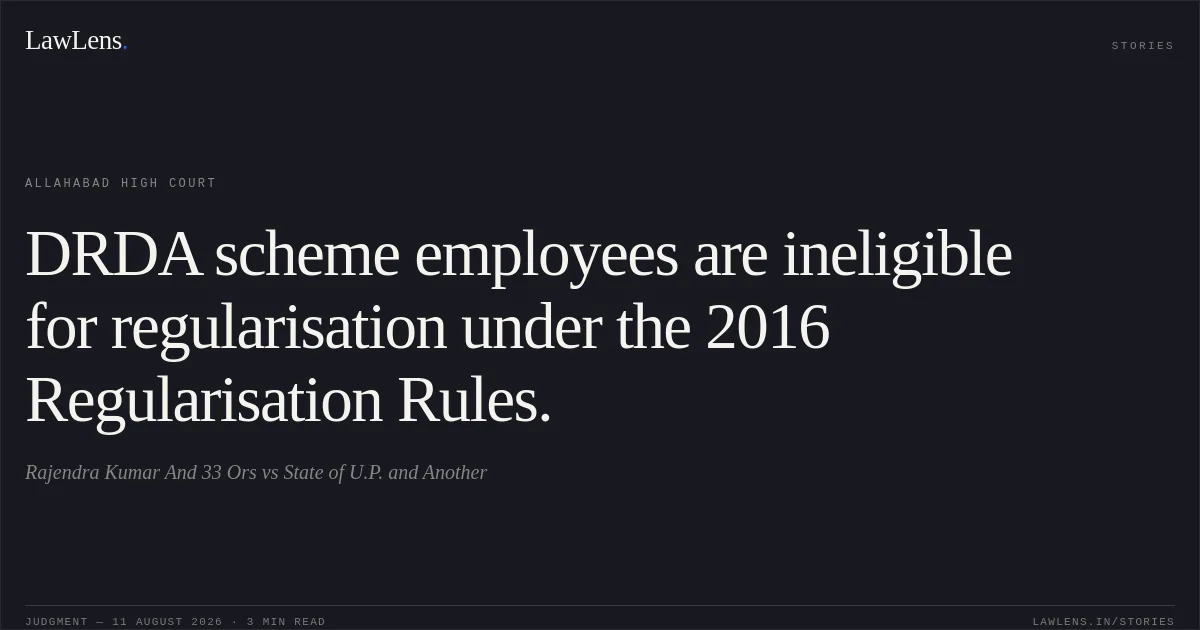
Rajendra Kumar And 33 OrsvsState of U.P. and Another
Click to open original judgment
Original judgment, available to read, download and summarize on LawLens.in