Facts
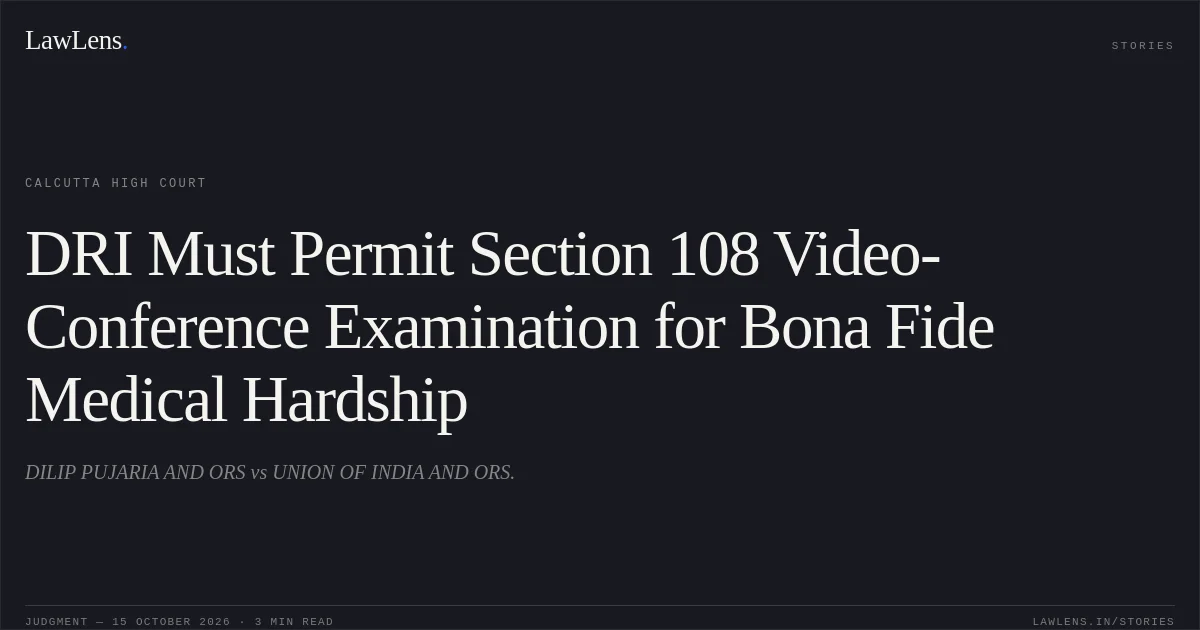
The petitioner sought permission to appear and tender his statement by video conference in response to a summons issued under Section 108 of the Customs Act, 1962 by the Directorate of Revenue Intelligence (DRI), Indore Zonal Unit.
Source reference: para. 1He asserted that knee injuries made long-distance travel from Kolkata to Indore medically hazardous, while affirming his willingness to cooperate with the investigation.
Source reference: paras. 3–5The DRI opposed the request, arguing that physical presence was needed for effective interrogation and document verification, and to guard against coaching; it also relied on the investigating officer’s discretion over the manner of examination and the caution against judicial interference in ongoing investigations.
Source reference: paras. 6–9The petitioner’s application was considered as CAN 1 of 2026.
Source reference: paras. 1, 14Issues
Whether the DRI could reject the petitioner’s request to give a statement by video conference under Section 108 of the Customs Act despite the medical hardship asserted.
Source reference: paras. 2, 10–13Whether virtual examination could be permitted subject to safeguards addressing the DRI’s concerns about coaching and the requirements of the investigation.
Source reference: paras. 7, 13–14Law Applied
Section 108 of the Customs Act authorises the summoning and examination of persons in an inquiry, and the investigating agency has discretion over the mode, place and manner of examination; that discretion must nevertheless be exercised reasonably, proportionately and non-arbitrarily.
Source reference: paras. 8, 10The Court stated that video-conference examination can serve the statutory purpose while protecting rights under Articles 14 and 21 of the Constitution, and that a request for virtual examination should not be rejected as a matter of course; medical evidence is relevant but not an indispensable prerequisite.
Source reference: paras. 11–12The DRI relied on Neeharika Infrastructure Pvt. Ltd. v. State of Maharashtra & Ors., (2021) 19 SCC 401, for the principle that courts should ordinarily not obstruct an ongoing investigation; the Court’s order, however, permitted a limited accommodation without staying the investigation.
Source reference: paras. 9–10, 16The directions also referred to Birendra Kumar Pandey and Paramvir Singh Saini in connection with the advocate’s presence and preservation of CCTV footage.
Source reference: para. 14(c)Reasoning
The Court weighed the petitioner’s stated willingness to cooperate and the medical documents indicating knee injuries against the DRI’s concerns about the reliability of remote examination.
Source reference: paras. 10, 12–13It concluded that secure video conferencing could meet the purpose of the Section 108 inquiry without unduly impairing the investigation, while safeguards could address the risk of coaching or interference.
Source reference: paras. 11–14The accommodation was limited to this applicant, left the investigation unobstructed, and preserved the DRI’s ability to require physical attendance if it considered that necessary, provided it gave reasons and advance notice.
Source reference: paras. 14(e), 16Holding
The Court allowed and disposed of CAN 1 of 2026, directing the DRI to permit the petitioner to appear by video conference and provide a secure link at least 24 hours before examination.
The petitioner’s advocate may remain visible but non-audible; the petitioner must provide verified electronic identification documents and display original credentials on camera.
Source reference: para. 14(c)–(d)If physical attendance becomes imperative, the investigating officer must issue a reasoned order and give at least seven days’ notice; the arrangement is in personam and is not a precedent for other cases.
Source reference: para. 14(e)The petitioner must cooperate, the interrogation is to be videographed, and the DRI may take lawful steps if he fails to cooperate; any necessary spot verification or further inquiry may be conducted in Kolkata.
Source reference: paras. 15–18Acts & Sections Cited
3 provisions across 2 statutes referred to in this judgment. Each provision opens on LawLens.
Customs Act,19621
Code of Criminal Procedure, 19732
Original Court PDF
DILIP PUJARIA AND ORSvsUNION OF INDIA AND ORS.
Click to open original judgment
Original judgment, available to read, download and summarize on LawLens.in