01Facts
On 28 May 2014, Satish Chandra Gupta was travelling in the rear seat of a company-owned Mercedes driven by Sanjay Bhati.
p. 2The driver stated that a dog suddenly crossed the road and that, while swerving to avoid it, the car struck a divider. Gupta suffered grievous injuries and remained in a coma until his death on 22 August 2020.
p. 3 · pp. 10–12The Motor Accident Claims Tribunal awarded compensation of ₹1,70,86,530 with 12% interest. ICICI Lombard appealed, disputing who was driving, the driver’s negligence, insurance coverage, and aspects of the compensation award.
pp. 2–702Issues
i.1. Whether Gupta was an occupant of the vehicle or was driving it at the time of the accident.
pp. 8–12 · ¶ 23–35ii.2. Whether, as an occupant and director of the vehicle-owning company, Gupta was covered by the package policy, including whether he was an employee requiring IMT 29 cover.
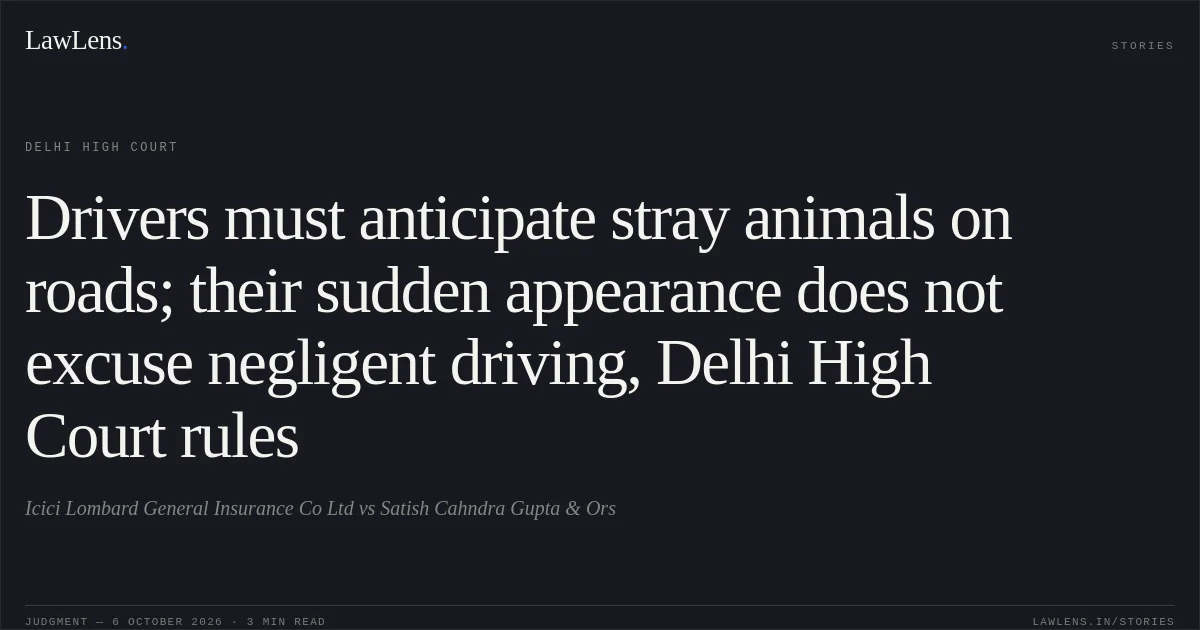
pp. 12–17 · ¶ 36–46iii.3. Whether the driver was negligent where the accident occurred while he swerved to avoid a dog, or whether the “agony of the moment” excused his conduct.
pp. 17–33 · ¶ 47–64iv.4. Whether the Tribunal erred in its assessment of attendant charges, future medical expenses, and medical expenses incurred.
pp. 33–35 · ¶ 65–7103Law Applied
A claim under Section 166 of the Motor Vehicles Act, 1988 is determined on the civil standard of preponderance of probabilities.
pp. 5–6 · ¶ 14 · p. 12 · ¶ 34Negligence is the failure to exercise the degree of care and vigilance required by the circumstances; drivers must anticipate reasonably foreseeable road hazards and maintain control of their vehicles.
pp. 24–25 · ¶ 51(iv) · pp. 31–32 · ¶ 59–62The “agony of the moment” principle may protect a person compelled to react to sudden danger, but the court distinguished danger caused by another person’s conduct from a hazard such as a stray animal, which a driver must reasonably anticipate.
pp. 18–21, 27–28 · ¶ 49–54A comprehensive/package policy covers occupants of a private car, unlike an Act Only policy; the Supreme Court’s decisions in National Insurance Co. Ltd. v. Balakrishnan (2013) 1 SCC 731 and National Insurance Co. v. Smt. Thungala Dhana Laxmi 2026:INSC:793 support that distinction.
pp. 14–17 · ¶ 42–45IMT 29 provides additional cover for an insured’s employees travelling in or driving the vehicle.
pp. 12–13 · ¶ 37Rule 7 of the Delhi Motor Accident Claims Tribunal Rules, 2008 was also relied on in relation to the DAR.
p. 14 · ¶ 41Provisions in the judgment · 2 · Linked ones open on LawLens
Motor Vehicles Act, 1988 Section 166Section 146
04Reasoning
The Court accepted the evidence of the ambulance driver, the vehicle’s driver, the DAR and the MLC as establishing, on a balance of probabilities, that Gupta was in the rear seat and Bhati was driving; the hospital summary’s contrary entry and discrepancy in the recorded phone number were insufficient to displace that evidence.
pp. 10–12 · ¶ 28–35The insurer did not establish that Gupta was an employee of the owner company: his directorship and the evidence that he was being driven home did not prove an employment relationship requiring IMT 29 cover. As an occupant, he was covered by the package policy.
pp. 13–17 · ¶ 38–46On negligence, the Court held that a driver must account for the foreseeable presence of animals on the road and exercise adequate care and control. The driver’s attempt to avoid the dog therefore did not, without more, absolve him of negligence.
pp. 27–33 · ¶ 53–64The Court also found no basis to disturb the Tribunal’s compensation assessment, given the evidence of the claimant’s continuing need for nursing care and the documented medical expenses; the six-month refund condition for future medical expenses did not apply because the claimant died years later.
pp. 33–35 · ¶ 66–7105Holding
The High Court dismissed the insurer’s appeal and upheld the Tribunal’s award.
p. 35 · ¶ 72It directed that the remaining 50% of the compensation, with accrued interest, be deposited before the Registrar General and released as a lump sum, noting that Gupta had since died; any statutory deposit was to be refunded only if the deposit order had been complied with.
p. 36 · ¶ 74–75Original Court PDF
Icici Lombard General Insurance Co LtdvsSatish Cahndra Gupta & Ors
Click to open original judgment
Original judgment, available to read, download and summarize on LawLens.in