Facts
On 23 April 2019, at approximately 3:30 a.m., a bus bearing registration no. HR 69 C 5953, owned by the appellant, collided with a scooter near the Oberoi Maidens Hotel. Ravi was driving the scooter, while his mother Lilawati and sister Shashi were travelling as pillion riders.
Source reference: para. 1Three claim petitions were filed under the Motor Vehicles Act, 1988. The MACT awarded ₹54,234 to Ravi, ₹14,10,589 to Shashi and ₹2,36,404 to Lilawati, with interest at 9% per annum.
Source reference: para. 2The appellant’s owner and driver did not lead evidence before the Tribunal, and the driver was proceeded ex parte.
Source reference: para. 14In the connected criminal proceedings, the owner had pleaded guilty, although he contended before the High Court that the plea had been entered to avoid further complications.
Source reference: paras. 3–5The appellant challenged the findings of negligence and contended that the scooter driver’s lack of a driving licence and the fact of triple riding constituted contributory negligence.
Source reference: paras. 8, 11Issues
1. Whether the MACT could rely upon the circumstances of the accident and the appellant’s criminal conviction to uphold a finding of negligence against the bus driver and owner?
Source reference: paras. 5–7, 15–172. Whether the scooter driver’s absence of a valid driving licence, or the fact that three persons were riding on the scooter, established contributory negligence?
Source reference: paras. 11–213. Whether the nominal amounts awarded towards medical expenses, despite the absence of documentary proof, warranted interference?
Source reference: paras. 23–24Law Applied
The Court applied the principle that negligence in a motor accident claim is determined on the touchstone of preponderance of probabilities, and that criminal proceedings and their outcome are not conclusive of civil liability, though they may be relevant circumstances.
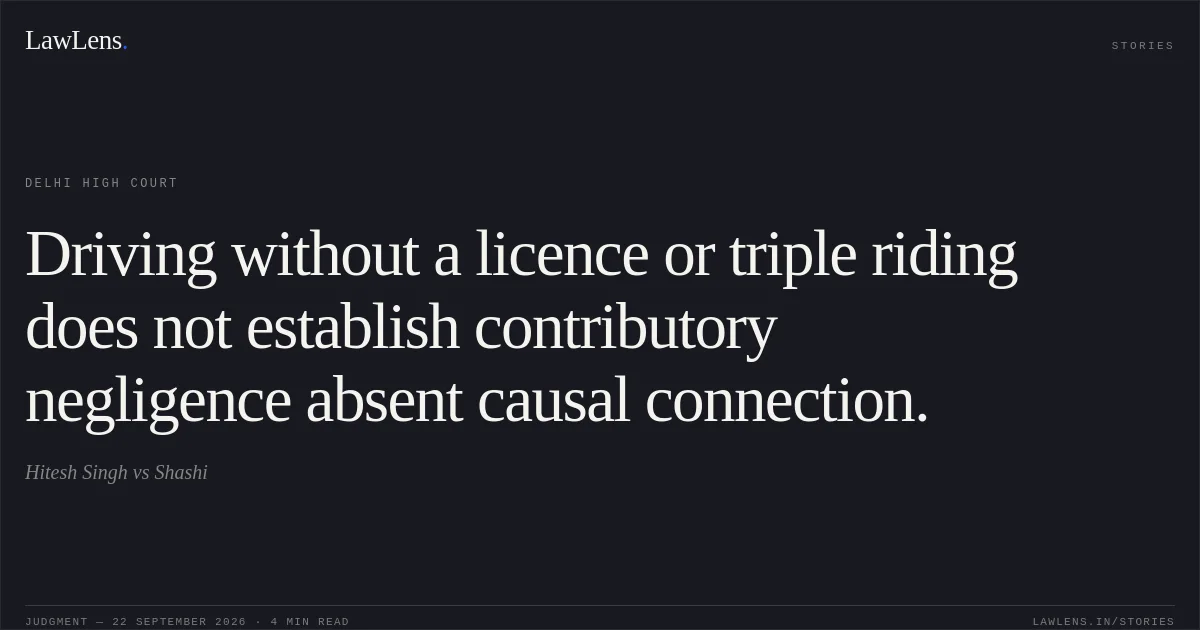
Source reference: paras. 5–7, 17Under the principles governing contributory negligence, a statutory violation by the victim—such as driving without a licence or carrying more than one pillion rider—does not, by itself, establish contributory negligence; there must be cogent evidence of a causal connection between the violation and either the accident or the injuries suffered.
Source reference: paras. 13, 18–21The Court relied on N.K.V. Bros. (P) Ltd. v. M. Karumai Ammal, (1980) 3 SCC 457; Bimla Devi v. Himachal RTC, (2009) 13 SCC 530; Sudhir Kumar Rana v. Surinder Singh, (2008) 12 SCC 436; Saraswati Palariya v. New India Assurance Co. Ltd., 2018 SCC OnLine SC 3988; Dinesh Kumar v. National Insurance Co. Ltd., (2018) 1 SCC 750; Mohd. Siddique v. National Insurance Co. Ltd., (2020) 3 SCC 57; and Srikrishna Kanta Singh v. The Oriental Insurance Co. Ltd., 2025 INSC 394.
Source reference: paras. 7, 13, 18, 20–21The burden of proving contributory negligence lies on the party alleging it.
Source reference: paras. 19–21Reasoning
The Court found that the accident site plan placed the point of collision on the extreme left side of the road, indicating that the scooter was being driven in the proper lane and not on the wrong side or in the middle of the road.
Source reference: para. 16The mechanical inspection reports showed damage to the right side of the scooter and the left side of the bus, supporting the conclusion that the bus had collided with the scooter from its right side.
Source reference: para. 17These circumstances, coupled with the bus driver’s failure to explain the accident and the absence of any defence evidence, established negligence on the part of the bus driver on a balance of probabilities.
Source reference: paras. 14–17The appellant’s guilty plea in the criminal case was not treated as independently conclusive, but it was a relevant supporting circumstance.
Source reference: para. 17The Court rejected the plea of contributory negligence because no evidence showed that the scooter driver’s lack of a licence or the triple riding caused the collision or aggravated the injuries. Mere statutory violations could not justify a deduction from compensation.
Source reference: paras. 18–22Finally, the nominal medical-expense awards were upheld as reasonable estimates, having regard to the injuries, even though medical bills had not been produced.
Source reference: paras. 23–24Holding
The High Court dismissed all three appeals and upheld the MACT awards of ₹54,234 to Ravi, ₹14,10,589 to Shashi and ₹2,36,404 to Lilawati, together with interest at 9% per annum.
It held that the bus driver’s negligence was established and that no deduction could be made for the scooter driver’s lack of a driving licence or for triple riding in the absence of proof of causal contribution.
Source reference: paras. 16–22The appellant was directed to deposit the awarded compensation and accrued interest before the MACT within four weeks, after which the amounts were to be released to the claimants in accordance with the Tribunal’s scheme.
Source reference: para. 25Pending applications were rendered infructuous, and the statutory deposit was directed to be refunded subject to compliance with the deposit order.
Source reference: paras. 27–29Acts & Sections Cited
3 provisions across 1 statute referred to in this judgment. Each provision opens on LawLens.
Motor Vehicles Act, 19883
Original Court PDF
Hitesh SinghvsShashi
Click to open original judgment
Original judgment, available to read, download and summarize on LawLens.in