Facts
The petitioner claimed to have purchased the disputed property under a registered sale deed dated 16 October 2017.
Source reference: p. 1The Bank’s mortgage over the property, however, was recorded as having been created on 14 September 2015.
Source reference: p. 1After receiving a possession notice, the petitioner—who denied being a borrower, co-borrower, guarantor, or creator of the mortgage—challenged the Bank’s measures under Section 17 of the SARFAESI Act.
Source reference: pp. 1–3The DRT dismissed his application because the mortgage preceded his purchase; the DRAT affirmed that decision.
Source reference: pp. 1–3The petitioner then sought relief under Article 227 of the Constitution.
Source reference: p. 7Issues
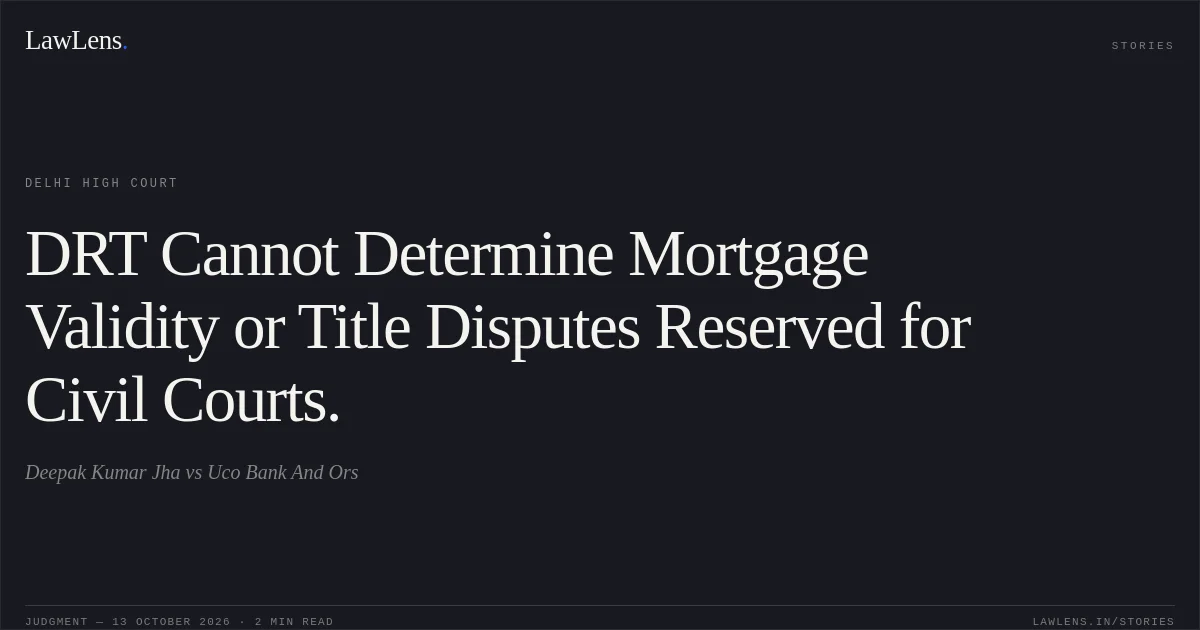
Whether the DRT, in proceedings under Section 17 of the SARFAESI Act, could determine the validity of the mortgage or grant a declaration concerning the petitioner’s title to the property.
Source reference: pp. 5–6Whether the High Court should interfere under Article 227 with the DRAT’s decision affirming dismissal of the petitioner’s Section 17 application.
Source reference: pp. 7–8Law Applied
Section 17 of the SARFAESI Act empowers the DRT to examine the legality of measures taken under Section 13(4), but does not confer jurisdiction to finally determine title or declare a sale deed or mortgage deed invalid.
Source reference: pp. 5–6Under Section 9 of the Code of Civil Procedure, 1908, the Civil Court may adjudicate such questions, and Section 34 of the SARFAESI Act does not oust that jurisdiction in this regard.
Source reference: pp. 5–6Relying on Central Bank of India v. Prabha Jain, 2025 SCC OnLine SC 121, the Court held that challenges requiring a declaration on the validity of title documents or a mortgage must be brought before the Civil Court.
Source reference: pp. 5–6The DRT, as a statutory tribunal, cannot exceed the jurisdiction conferred on it by the governing statutes.
Source reference: pp. 5–6Reasoning
The petitioner’s own case was that he acquired the property in 2017, after the Bank’s mortgage was created in 2015.
Source reference: pp. 4–7Establishing that the mortgage was fraudulent or based on forged documents would require determining the predecessor’s title, the identity and authority of the person who created the mortgage, and the petitioner’s ownership free of encumbrances.
Source reference: pp. 4–7Those issues go beyond the DRT’s power under Section 17 and could not be resolved by the High Court while reviewing the DRAT’s order under Article 227.
Source reference: pp. 4–7The registered sale deed and the authorities cited by the petitioner did not establish that the earlier mortgage was invalid.
Source reference: pp. 4–7Holding
The Court found no basis to interfere with the DRAT’s order affirming dismissal of the Section 17 application.
It dismissed the writ petition and pending applications, while leaving the petitioner at liberty to pursue remedies in accordance with law, including proceedings before the Civil Court.
Source reference: p. 8Acts & Sections Cited
5 provisions across 3 statutes referred to in this judgment. Each provision opens on LawLens.
Securitisation and Reconstruction of Financial Assets and Enforcement of Security Interest Act, 20023
Code of Civil Procedure, 19081
Unified Waqf Management, Empowerment, Efficiency and Development Act, 19951
Original Court PDF
Deepak Kumar JhavsUco Bank And Ors
Click to open original judgment
Original judgment, available to read, download and summarize on LawLens.in