01Facts
Twenty-five petitioners challenged eviction orders dated January 23, 2025, issued by the Estate Officer of Western Railway.
¶ 3The petitioners occupy various structures (averaging 6–16 sqm) on Railway land at Malad (East), Mumbai, asserting continuous occupation since approximately 1980.
¶ 4-5On August 29, 2022, the Railways issued show-cause notices under Section 5A(2) of the Public Premises (Eviction of Unauthorised Occupants) Act, 1971, regarding unauthorized structures.
¶ 6The petitioners contended they were "Project Affected Persons" (PAP) entitled to rehabilitation under the Government Resolution (GR) dated December 12, 2000, and Phase I/II of the Mumbai Urban Transport Project (MUTP).
¶ 11-12The City Civil Court previously dismissed their appeals as non-maintainable on May 6, 2025, leading to these Writ Petitions.
¶ 902Issues
i.1. Whether the petitioners qualify as Project Affected Persons (PAP) entitled to Rehabilitation and Resettlement (R&R) benefits under the Government Resolution dated December 12, 2000.
¶ 12, 20ii.2. Whether the Estate Officer followed due process of law under the Public Premises (Eviction of Unauthorised Occupants) Act, 1971, in issuing the eviction orders.
¶ 21, 2403Law Applied
Sections 2(e), 2(g), and 5A of the Public Premises (Eviction of Unauthorised Occupants) Act, 1971, which define "public premises" and "unauthorised occupation" and empower Estate Officers to remove unauthorized structures after providing notice and an opportunity to show cause.
¶ 16-17Government Resolution dated December 12, 2000, which defines PAP eligibility based on baseline surveys and proximity to MUTP sub-projects.
¶ 11Precedent from Utran Se Besthan Railway Jhopadpatti Vikas Mandal v. Government of India regarding the obligation of Railways to follow statutory procedures for eviction.
¶ 23Precedent from Ahmedabad Municipal Corporation v. Nawab Khan Gulab Khan [(1997) 11 SCC 121] regarding the humane manner of removing encroachments and the obligation to record occupant data.
¶ 2704Reasoning
The Court found that the petitioners admitted the structures were unauthorized and situated on Railway land.
¶ 5Regarding the claim for rehabilitation, the Court noted that the petitioners failed to produce any evidence proving their structures were affected by a specific MUTP project or situated within 10 meters of the 6th Railway Line; in fact, their own representations stated they were located beyond that limit.
¶ 18-19Consequently, they did not meet the criteria for PAP status under the 2000 GR.
¶ 20Regarding procedural fairness, the Court distinguished this case from Utran Se Besthan, noting that the Railways here did invoke the Act of 1971, issued statutory notices, and provided a hearing before passing orders, thus fulfilling the mandate of due process.
¶ 24However, citing the Railways' "public trust obligation" and long-standing occupation, the Court held the authorities still carry a responsibility to document the displaced persons for potential future eligibility under existing State/Railway schemes.
¶ 26-2705Holding
The Court dismissed the Writ Petitions, holding that the petitioners failed to establish eligibility for automatic rehabilitation.
¶ 25The Court ordered the petitioners to vacate the premises within 60 days.
¶ 27(a)Directions were issued to the Collector (Respondent No. 5) to record the identities and profiles of all occupants before demolition to preserve their right to apply for any existing rehabilitation schemes for which they might be independently eligible.
¶ 27(d)-(e)The Court clarified it expressed no view on the ultimate grant of such benefits, leaving it to the authorities' discretion.
¶ 27(h)Rule discharged.
¶ 28Original Court PDF
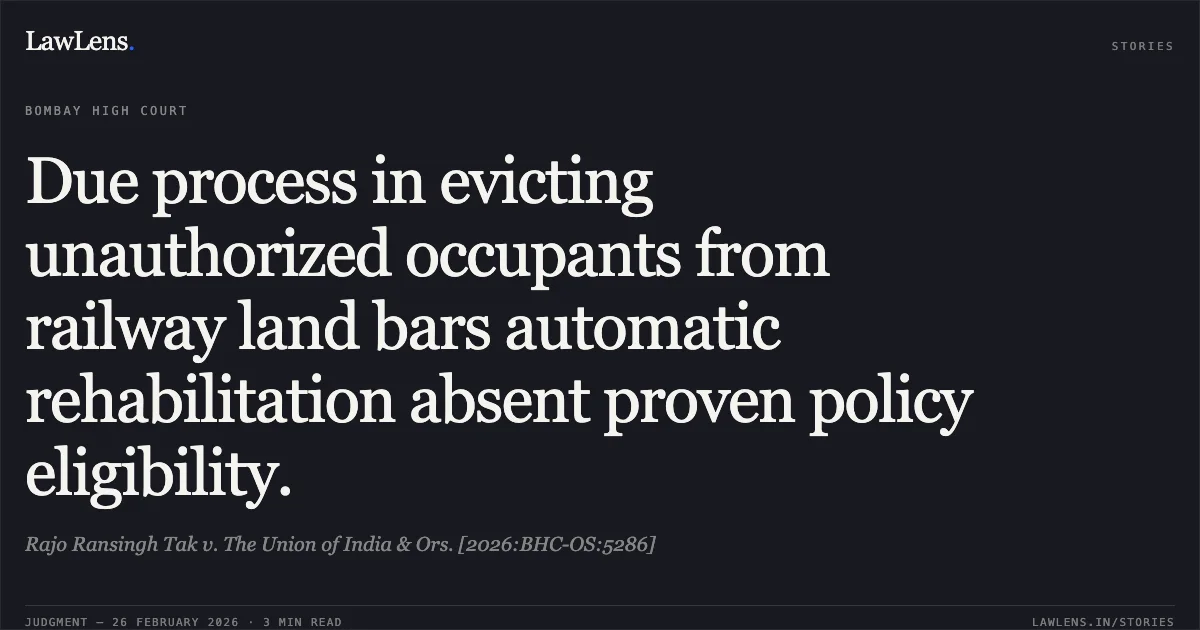
Rajo Ransingh Tak v. The Union of India & Ors. [2026:BHC-OS:5286]
Click to open original judgment
Original judgment, available to read, download and summarize on LawLens.in