Facts
The appellant, Pawan Kumar, was accused of entering the complainant’s house on April 2, 2008, through a neighbor’s roof, scuffling with the victim (Kanchan, aged 16), and setting her ablaze using kerosene
Source reference: p. 2The victim was admitted to District Hospital, Etawah, where her dying declaration was recorded by a Tehsildar
Source reference: p. 2-3She was later transferred to Kanpur, where she died of septicemia resulting from burn injuries seven days after the incident
Source reference: p. 3The Trial Court convicted the appellant under Sections 302 (murder), 452 (house-trespass), and 354 (outraging modesty) of the IPC
Source reference: p. 1-2The appellant challenged the conviction, arguing that the death due to septicemia after seven days should not be classified as murder and that the outraging modesty charge was unproven
Source reference: p. 5-6Issues
1. Whether the dying declaration of the deceased was reliable and could form the sole basis of conviction?
Source reference: para. 16(i)2. Whether the prosecution proved the charges of house-trespass and outraging modesty beyond reasonable doubt?
Source reference: para. 16(ii)3. Whether the case should be categorized as murder (S. 302) or culpable homicide not amounting to murder (S. 304 Part-II) given the death occurred due to septicemia after seven days?
Source reference: para. 16(iii)Law Applied
The court applied Section 32 of the Indian Evidence Act regarding the admissibility of dying declarations, relying on Laxman v. State of Maharashtra to establish that a certificate of mental fitness is a rule of prudence, not an absolute necessity if the statement is otherwise reliable
Source reference: para. 33For the distinction between murder and culpable homicide, the court applied Sections 299 and 300 of the IPC, using the framework from Anbazhagan v. State to determine if "intention" or "knowledge" of death was present
Source reference: para. 53Section 304 Part-II was applied for acts done with the knowledge that death is likely but without the specific premeditated intention to murder
Source reference: para. 57Reasoning
The court found the dying declaration (Ex. Ka-10) highly reliable as it was recorded within 2.5 hours of the incident after a medical fitness certification
Source reference: para. 46However, it found the testimony of P.W.2 (the brother) doubtful, as the victim's own declaration did not mention his presence during the act or the fire-extinguishing efforts
Source reference: para. 48Crucially, the court noted that the dying declaration mentioned a "scuffle" rather than "molestation," leading to the acquittal under Section 354
Source reference: para. 52, 56Regarding the nature of the offense, the court observed there was no evidence of prior enmity or premeditation and that the death resulted from septicemia seven days post-incident
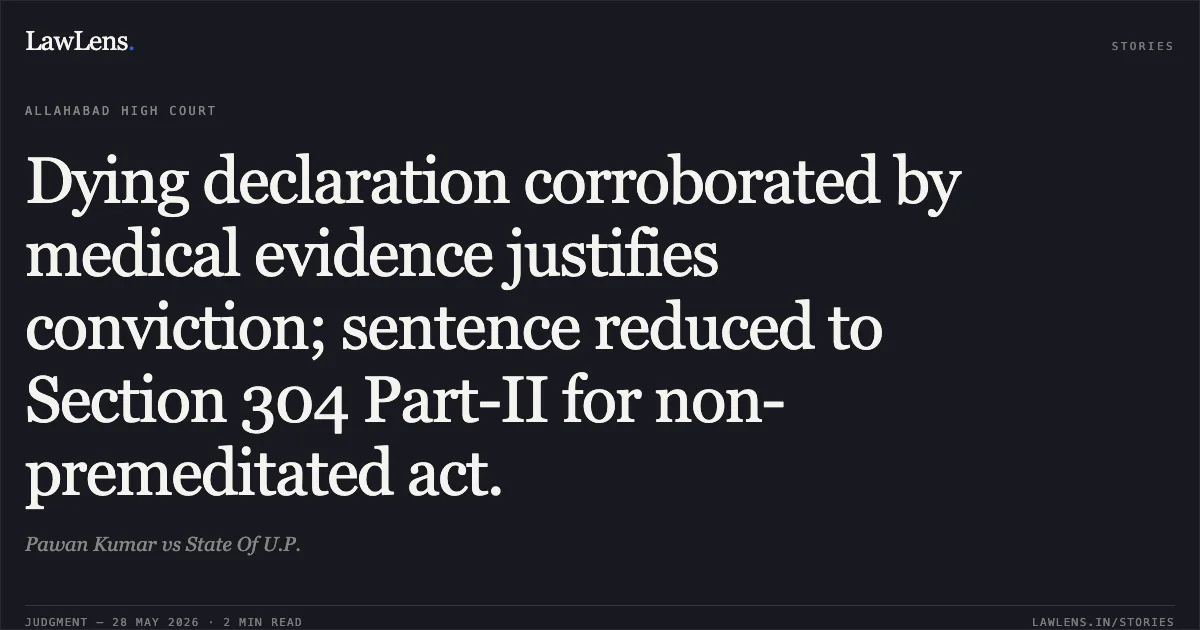
Source reference: para. 54, 57Applying the principle that the act was a result of a sudden scuffle where the appellant had "knowledge" but not "premeditated intention" to kill, the court determined the offense fell under Section 304 Part-II IPC rather than Section 302
Source reference: para. 57Holding
The High Court partly allowed the appeal. It set aside the conviction under Section 302 IPC, converting it to Section 304 Part-II IPC with a sentence of 10 years rigorous imprisonment
The appellant was acquitted of the charge under Section 354 IPC
Source reference: para. 58-59The conviction under Section 452 IPC (7 years) was affirmed. Given that the appellant had already served over 18 years in jail—exceeding the modified sentence and default imprisonment—the court ordered his immediate release
Source reference: para. 59Acts & Sections Cited
8 provisions across 2 statutes referred to in this judgment. Each provision opens on LawLens.
Indian Penal Code, 18607
Code of Criminal Procedure, 19731
Original Court PDF
Pawan KumarvsState Of U.P.
Click to open original judgment
Original judgment, available to read, download and summarize on LawLens.in


