Facts
The deceased, Ranjnaben, died on September 20, 2001, after sustaining severe burn injuries at her matrimonial home.
Source reference: p. 1-2It was alleged that she set herself ablaze with kerosene due to persistent physical and mental harassment regarding dowry and household faults by her husband, mother-in-law, brother-in-law, and sister-in-law.
Source reference: p. 1-2Two dying declarations were recorded: one at C.H.C. Nizar and allegedly another at a hospital in Dhule, Maharashtra.
Source reference: p. 7-9The primary family members (father and brother) turned hostile during the trial, stating relations were cordial.
Source reference: p. 13-14The Sessions Court, Tapi, acquitted the accused on February 28, 2014, leading to this State appeal.
Source reference: p. 1-4Issues
1. Whether the prosecution proved the mental fitness of the deceased to give a valid dying declaration in the absence of medical testimony from the certifying doctors.
Source reference: p. 7-8 / para. 8.2-8.32. Whether the non-production of the second dying declaration recorded at Dhule is fatal to the prosecution's case.
Source reference: p. 9 / para. 8.43. Whether the conduct of the accused amounted to "abetment" under Section 306 of the IPC, establishing a clear proximity and causal link to the suicide.
Source reference: p. 17-19 / para. 9.1-9.6Law Applied
The court primarily applied Section 306 (Abetment of suicide) and Section 107 (Definition of abetment) of the Indian Penal Code.
Source reference: p. 18A dying declaration must inspire full confidence and requires proof of a fit state of mind, as per Sham Shankar Kankaria v. State of Maharashtra.
Source reference: p. 11Mere harassment is insufficient for a conviction under Section 306 IPC; there must be a positive act of instigation proximate to the time of death, as held in Amalendu Pal v. State of West Bengal and Mahendra Awase v. State of MP.
Source reference: p. 21-22The principle regarding the double presumption of innocence in acquittal appeals from Chandrappa v. State of Karnataka.
Source reference: p. 26-27Reasoning
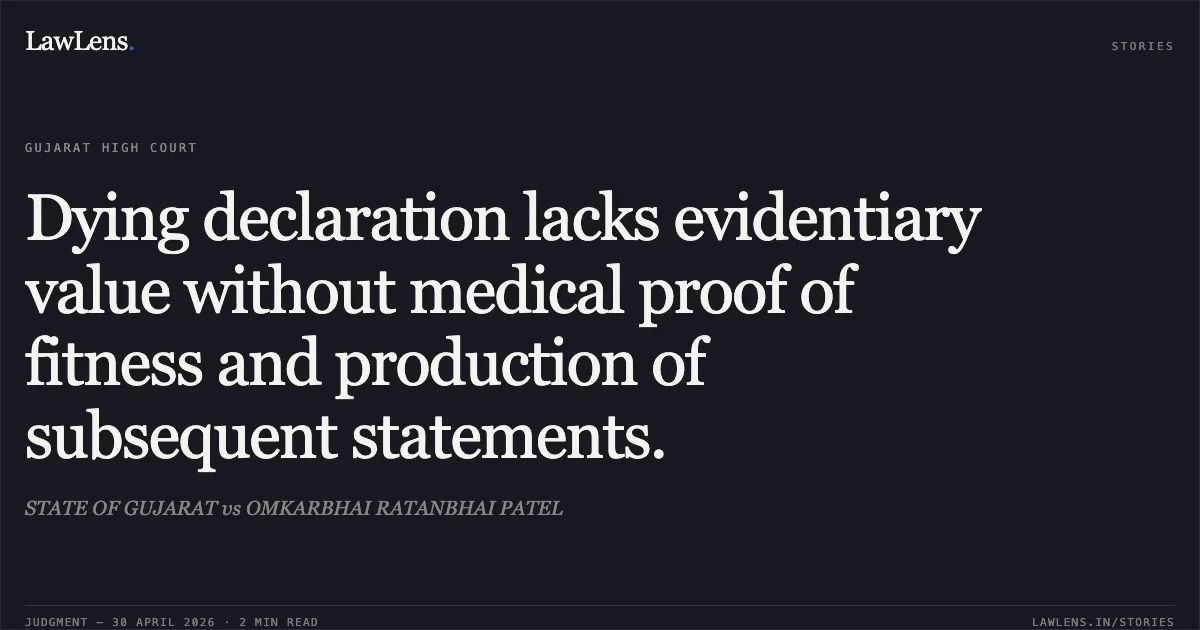
The High Court observed that the prosecution failed to examine the medical officers who certified the deceased’s fitness at Nizar or Dhule, leaving the validity of the dying declaration unproven.
Source reference: p. 8, 15The court highlighted a critical gap: while the prosecution claimed a second dying declaration existed in Dhule, they failed to produce it or examine the magistrate who recorded it, creating an adverse inference.
Source reference: p. 16Regarding Section 306 IPC, the court found no evidence of "instigation" as defined by law. The hostility of the deceased’s father and brother negated the allegations of a "continued course of conduct" that would leave the deceased with no option but suicide.
Source reference: p. 13, 21The court reasoned that routine domestic friction does not constitute abetment without a "live nexus" and a clear mens rea to provoke suicide.
Source reference: p. 19Holding
The High Court dismissed the State’s appeal and upheld the acquittal.
It held that the prosecution failed to prove the case beyond reasonable doubt due to the lack of medical evidence regarding the deceased's mental state and the failure to establish an immediate act of incitement by the accused.
Source reference: p. 28-29The court concluded that the trial court's view was a possible and reasonable one, warranting no interference under Section 378 of the Cr.P.C.
Source reference: p. 29Acts & Sections Cited
5 provisions across 2 statutes referred to in this judgment. Each provision opens on LawLens.
Indian Penal Code, 18603
Original Court PDF
STATE OF GUJARATvsOMKARBHAI RATANBHAI PATEL
Click to open original judgment
Original judgment, available to read, download and summarize on LawLens.in


![Subsequent exoneration does not retrospectively invalidate a finalized promotion select list.. UNNIKRISHNAN M vs M/o Environment And Forests. CAT - ['Ernakulam']. LawLens](/stories/thumbnails/subsequent-exoneration-does-not-retrospectively-invalidate-a-finalized-promotion-select-li-ce80a0e84f2f4887857271e8b4341c42.webp)