Facts
The petitioners (Accused Nos. 1 and 4) were arrested on 30.12.2025 for alleged possession of 4.22 grams of MDMA under Sections 22(b) and 29 of the NDPS Act.
Source reference: p.3They were remanded to judicial custody on the same day.
Source reference: p.3The investigating agency electronically filed (e-filed) the final report on 28.02.2026 at 6:02 p.m., which was the 60th day of custody.
Source reference: p.12The physical copy reached the court on 02.03.2026.
Source reference: p.12The petitioners sought default bail, arguing the final report was filed beyond the prescribed 60-day limit.
Source reference: p.3-4Issues
1. Whether the 90-day period for filing a charge sheet under Section 187(3)(i) of the BNSS applies to offences punishable with imprisonment up to 10 years but without a minimum sentence.
Source reference: p.5-62. Whether an electronic filing made after court hours (5:00 p.m.) can be reckoned as being filed on the same day for the purpose of computing the limitation for default bail.
Source reference: p.11-12Law Applied
The court applied Section 187(3) of the Bharatiya Nagarik Suraksha Sanhita (BNSS), 2023, which replaces Section 167(2) of the Cr.P.C.
Source reference: p.5It relied on the Supreme Court’s interpretation in Rakesh Kumar Paul v. State of Assam, holding that the 90-day limit applies only to offences with a minimum threshold of 10 years' imprisonment.
Source reference: p.6The court further applied Rule 13 of the Electronic Filing Rules for Courts (Kerala), 2021, and Rules 4 & 5 of the Criminal Rules of Practice, Kerala, 1982, which establish that filings after 5:00 p.m. are deemed instituted on the next working day.
Source reference: p.11-12Reasoning
Regarding the first issue, the court observed that while Section 187(3)(i) of the BNSS uses the phrase "ten years or more" (replacing "not less than ten years"), the legislative intent remains aligned with the Rakesh Kumar Paul dictum: the 90-day period is reserved for graver offences involving death, life imprisonment, or a minimum 10-year term.
Source reference: p.9-10Since Section 22(b) of the NDPS Act prescribes a maximum of 10 years without a minimum, the 60-day limit applies.
Source reference: p.10-11Regarding the second issue, the court analyzed Rule 13 of the Electronic Filing Rules. It held that since the Registry closes at 5:00 p.m. per the Criminal Rules of Practice, any e-filing received at 6:02 p.m. is legally recorded as filed on the 61st day.
Source reference: p.12Therefore, the prosecution failed to complete the investigation within the "indefeasible" statutory period.
Source reference: p.5Holding
The court held that the petitioners were entitled to statutory/default bail as the final report was filed after the 60-day period.
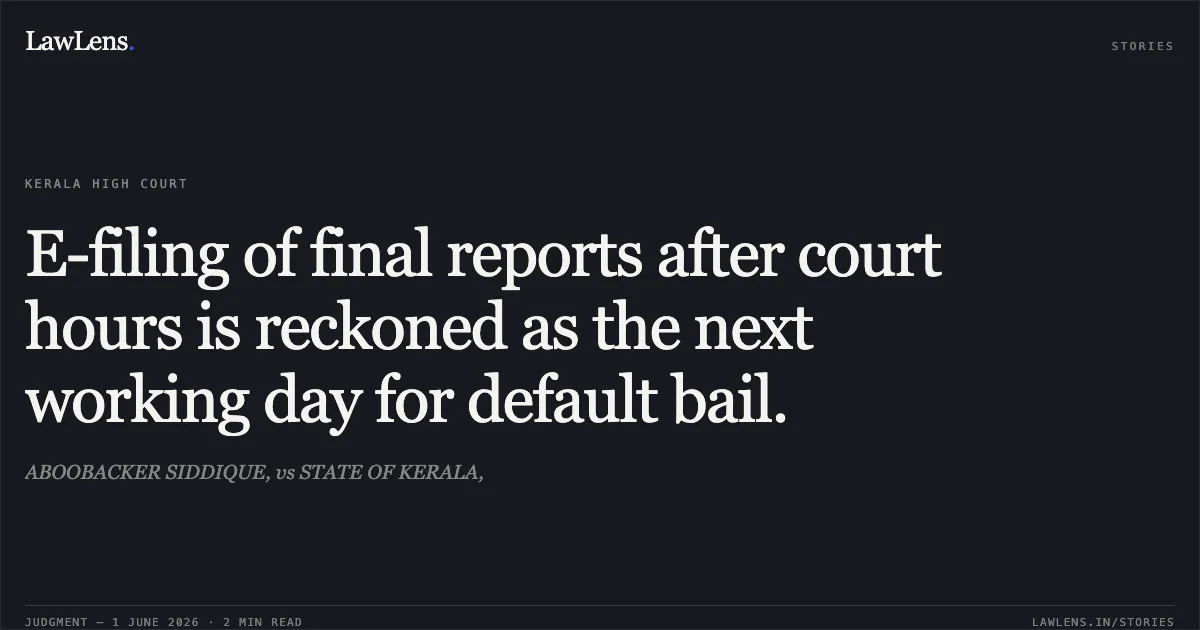
The court clarified that for the purpose of default bail, e-filings after 5:00 p.m. are reckoned as instituted on the next working day.
Source reference: p.12The bail was granted subject to a bond of Rs. 1,00,000/- with two solvent sureties and specific conditions regarding non-tampering of evidence and restricted travel.
Source reference: p.13Acts & Sections Cited
8 provisions across 5 statutes referred to in this judgment. Each provision opens on LawLens.
Bharatiya Nagarik Suraksha Sanhita, 20233
Narcotic Drugs and Psychotropic Substances Act, 19852
Code of Criminal Procedure, 19731
Prevention of Corruption Act, 19881
Bharatiya Nyaya Sanhita, 20231
Original Court PDF
ABOOBACKER SIDDIQUE,vsSTATE OF KERALA,
Click to open original judgment
Original judgment, available to read, download and summarize on LawLens.in


