Facts
The Applicant and Respondent executed a Work Order dated 9 February 2022 for the installation, testing, commissioning and handing over of 338 double-stack parking units at the Respondent’s Beaumonte project.
Source reference: paras. 2–3, 15–18; pp. 1–2, 9–11The Work Order contained Clause 56, providing for arbitration of “any and all disputes” arising out of or connected with the agreement, while Clause 3 stated that “no arbitration is allowed” and made the decision of designated representatives final.
Source reference: paras. 2–3, 15–18; pp. 1–2, 9–11The Respondent subsequently issued a revised Purchase Order dated 8 September 2022, described as a “Purchase Order Amendment”, reducing the quantity from 338 to 288 units and fixing the revised order value at Rs. 3,97,61,280.
Source reference: paras. 3, 8, 21–22; pp. 2, 5, 12–13According to the Applicant, only 212 units could ultimately be installed due to site constraints. It claimed Rs. 27,59,165 as outstanding principal, together with interest of Rs. 13,07,343, totalling Rs. 40,66,508.
Source reference: paras. 4–5, 21; pp. 3–4, 12The Applicant therefore filed the present application under Section 11 of the Arbitration and Conciliation Act, 1996, seeking appointment of a sole arbitrator.
Source reference: paras. 6–13; pp. 4–8The Respondent opposed the application, contending that the claim arose under the subsequent Purchase Order, which contained no arbitration clause, and that the Applicant’s claim was disputed on account of alleged defects and deductions.
Source reference: paras. 6–13; pp. 4–8Issues
Whether Clause 56 of the Work Order constituted a valid and subsisting arbitration agreement despite the contrary language in Clause 3 stating that no arbitration was permitted?
Source reference: paras. 16–19, 25; pp. 9–11, 14Whether the Applicant’s monetary claim relating to 212 parking systems arose under the Work Order and was therefore covered by its arbitration clause?
Source reference: paras. 20–30; pp. 11–18Whether the subsequent Purchase Order, containing only a Mumbai High Court jurisdiction clause and no arbitration clause, superseded or otherwise displaced the arbitration agreement in the Work Order?
Source reference: paras. 21–24, 30–34; pp. 12–19Law Applied
The Court applied Section 11 of the Arbitration and Conciliation Act, 1996, under which the Court must determine at the referral stage whether an arbitration agreement exists and whether the dispute is covered by it.
Source reference: paras. 1, 19, 33; pp. 1, 11, 19It relied on the principle stated in Ajay Madhusudan Patel v. Jyotrindra S. Patel, 2024 INSC 710, that the Court should not conduct a detailed trial or mini-trial at the Section 11 stage, particularly where issues concerning the existence or validity of the arbitration agreement may be determined by the arbitral tribunal under Section 16.
Source reference: para. 19; p. 11The Court also applied the principle that an arbitration clause must cover the particular dispute sought to be referred; a broad clause referring to disputes arising out of “this agreement” does not automatically extend to claims arising under a distinct subsequent contract.
Source reference: paras. 26–27; pp. 15–16A jurisdiction clause conferring jurisdiction on a particular court is not, by itself, an arbitration agreement.
Source reference: paras. 23–24, 31; pp. 14, 18Reasoning
The Court held that the Work Order was a binding contractual document and that Clause 56 contained an express arbitration agreement, notwithstanding the inconsistency created by Clause 3.
Source reference: paras. 15–18, 25, 27; pp. 9–11, 14–16However, the existence of Clause 56 did not conclude the Section 11 inquiry; the Applicant had to establish that its particular claim arose under the Work Order.
Source reference: paras. 15–18, 25, 27; pp. 9–11, 14–16The Court noted that the Work Order concerned installation labour charges for 338 units and had an approximate value of Rs. 39,88,400, whereas the Applicant’s claim was based on the subsequent Purchase Order, which concerned 288 units, detailed technical specifications, revised commercial terms and a value of Rs. 3,97,61,280.
Source reference: paras. 20–22, 26–28; pp. 11–17Although the later Purchase Order did not expressly cancel or replace the Work Order, it materially governed the transaction forming the basis of the Applicant’s monetary claim.
Source reference: paras. 22–24, 30–31; pp. 13–18Its clause stating that it was subject to the jurisdiction of the Mumbai High Court only did not amount to an arbitration agreement and could not extend Clause 56 to claims arising under the Purchase Order.
Source reference: paras. 22–24, 30–31; pp. 13–18The Respondent’s allegations concerning defects and deductions were not finally adjudicated, since those matters related to the merits of the monetary claim and not to the existence or scope of the arbitration agreement.
Source reference: paras. 28–29, 32–35; pp. 16–20Holding
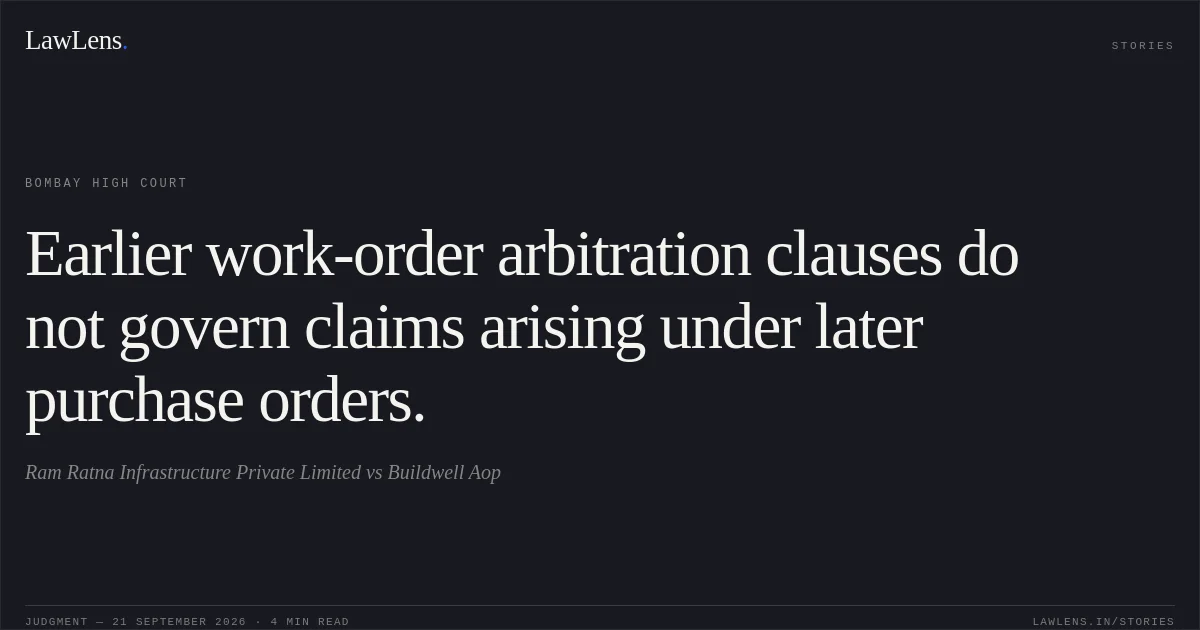
The Court held that Clause 56 of the Work Order contained a valid arbitration agreement, but the Applicant’s claim for payment relating to 212 parking systems was based on the subsequent Purchase Order and was not shown to arise under, or be covered by, Clause 56.
The subsequent Purchase Order contained no arbitration agreement; its Mumbai High Court jurisdiction clause could not be treated as one.
Source reference: paras. 31, 34The Section 11 application seeking appointment of an arbitrator was therefore dismissed, without any final determination on the Applicant’s entitlement, alleged defects, deductions, interest or the amount payable.
Source reference: paras. 35–37; p. 20There was no order as to costs.
Source reference: paras. 35–37; p. 20Acts & Sections Cited
2 provisions across 1 statute referred to in this judgment. Each provision opens on LawLens.
Arbitration and Conciliation Act, 19962
Original Court PDF
Ram Ratna Infrastructure Private LimitedvsBuildwell Aop
Click to open original judgment
Original judgment, available to read, download and summarize on LawLens.in