Facts
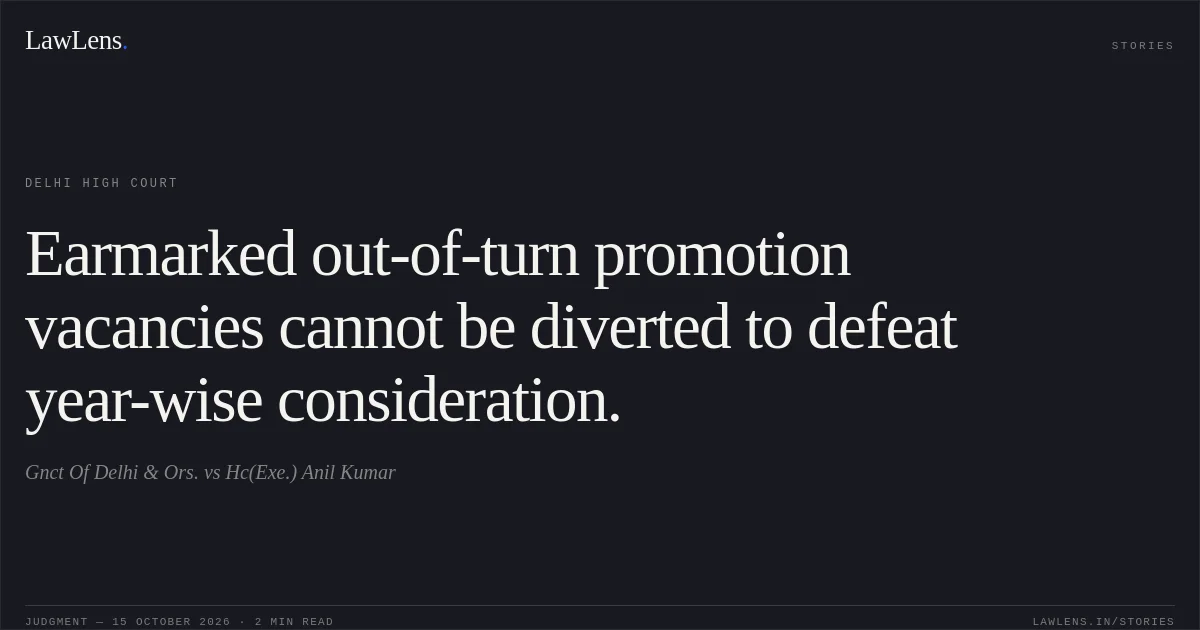
Under the applicable arrangement, 5% of annual promotional vacancies were reserved for OTP, and candidates were to be considered by an Incentive Committee.
Source reference: p.3, para. 2The Committee did not meet in 2022; when it met in 2023, it clubbed the vacancies and recommended candidates from both years together.
Source reference: p.3, para. 3The Central Administrative Tribunal directed separate, year-wise consideration of candidates for 2022 and 2023. The Union of India challenged those directions.
Source reference: p.4, para. 4The High Court noted that 32 vacancies earmarked for OTP in 2022 had been diverted to regular promotion eight days before the Committee meeting scheduled for 27 December 2022; the petitioners acknowledged an administrative lapse in that diversion.
Source reference: pp.5–6, paras. 8–10Issues
1. Whether candidates recommended for OTP were entitled to separate, year-wise consideration against the vacancies earmarked for 2022 and 2023, notwithstanding the Committee’s decision to club the vacancies.
Source reference: pp.3–4, paras. 2–42. Whether the diversion of 32 vacancies earmarked for 2022 to regular promotion could defeat the candidates’ opportunity for consideration against the OTP vacancies.
Source reference: pp.5–6, paras. 8–153. Whether the Tribunal’s directions warranted interference under Article 226 of the Constitution.
Source reference: p.6, para. 16; p.7, para. 17Law Applied
The Court applied the OTP arrangement described in the judgment: 5% of available promotional vacancies were earmarked for OTP each year, with candidates selected by an Incentive Committee against that year’s vacancies.
Source reference: p.3, para. 2It invoked the principle ubi jus ibi remedium—where there is a right, there is a remedy.
Source reference: p.4, para. 7The Court observed that no provision had been shown permitting the diversion of OTP vacancies to regular promotion.
Source reference: p.6, para. 13The Court considered the matter under Article 226 of the Constitution.
Source reference: p.6, para. 17Reasoning
The Court held that clubbing the annual OTP vacancies was inconsistent with the year-wise scheme and the Tribunal had therefore correctly directed separate consideration.
Source reference: pp.3–4, paras. 2–4, 16The diversion of the 32 vacancies occurred after citations for 2022 had been received and shortly before the scheduled Committee meeting; the Court found the act highly irregular and unsupported by any identified enabling provision.
Source reference: pp.5–6, paras. 9–14The Police could not rely on the subsequent inability to identify regular-promotees who may have occupied the diverted vacancies to extinguish the respondents’ opportunity for consideration.
Source reference: pp.4–6, paras. 5–7, 15The respondents had to retain their chance of consideration against the 2022 and 2023 vacancies independently, subject to any vacancies already filled by candidates recommended for OTP.
Source reference: pp.4–6, paras. 5–7, 15Holding
The Court declined to interfere under Article 226 and upheld the Tribunal’s directions for independent, year-wise consideration of the respondents against the OTP vacancies for 2022 and 2023.
The writ petitions were dismissed, applying mutatis mutandis the order in Union of India and Ors. v. Banty Yadav and Ors., W.P.(C) 10054/2026.
Source reference: p.7, paras. 18–19The connected contempt petition was also dismissed, with no separate order passed in light of the decision on the writ petitions.
Source reference: p.7, paras. 21–22Original Court PDF
Gnct Of Delhi & Ors.vsHc(Exe.) Anil Kumar
Click to open original judgment
Original judgment, available to read, download and summarize on LawLens.in