Facts
The petitioner, a farmer, claims to be the lawful owner and cultivator of specific land parcels in Village Revti.
Source reference: para. 4On November 7, 2025, he received information that private respondents (Nos. 7, 8, and 9) were illegally collecting his harvested paddy.
Source reference: para. 4Although the police intervened, the Chowki In-charge (respondent No. 6) recorded a Non-Cognizable (NC) report on November 8, 2025, citing an incorrect Khasra number, which the petitioner alleges was a deliberate attempt to treat a criminal offence as a civil dispute.
Source reference: para. 4Despite subsequent written complaints to the Station House Officer and the Superintendent of Police, no FIR was registered.
Source reference: para. 5The petitioner approached the High Court via a writ petition seeking a direction to register an FIR and to set aside the NC report.
Source reference: para. 3Issues
Whether the High Court should exercise its extraordinary writ jurisdiction to direct the registration of an FIR when the petitioner has not exhausted alternative statutory remedies.
Source reference: para. 7Law Applied
The court applied the principle of "efficacious alternative remedy," noting that grievances regarding the non-registration of an FIR are governed by the Bharatiya Nagarik Suraksha Sanhita, 2023 (BNSS).
Source reference: para. 6, 7Specifically, the court highlighted Section 175(3) (formerly Section 156(3) of the Cr.P.C.) and Section 223 (formerly Section 200 of the Cr.P.C.), which empower a competent Magistrate to direct an investigation or take cognizance of a complaint.
Source reference: para. 6, 7The court further relied on judicial precedents, including Waseem Haider vs. State of U.P. (2020) and Akhilesh Agrawal vs. State of Chhattisgarh (2023), which establish that writ petitions are generally not maintainable for FIR registration if statutory remedies remain unexhausted.
Source reference: para. 6Reasoning
The court examined the petitioner's prayers for FIR registration and the quashing of the NC report in light of the available legal framework.
Source reference: para. 4-5It observed that the petitioner’s allegations—concerning the theft of crops and the police's failure to act impartially—fall within the domain of criminal procedure.
Source reference: para. 4-5The court reasoned that the BNSS provides a robust mechanism for citizens to seek judicial intervention via a Magistrate if the police refuse to register an FIR.
Source reference: para. 7By citing Akhilesh Agrawal, the court emphasized that it would not bypass the specialized hierarchy of the criminal justice system when an "efficacious alternative remedy" is readily available to the petitioner.
Source reference: para. 6-7Holding
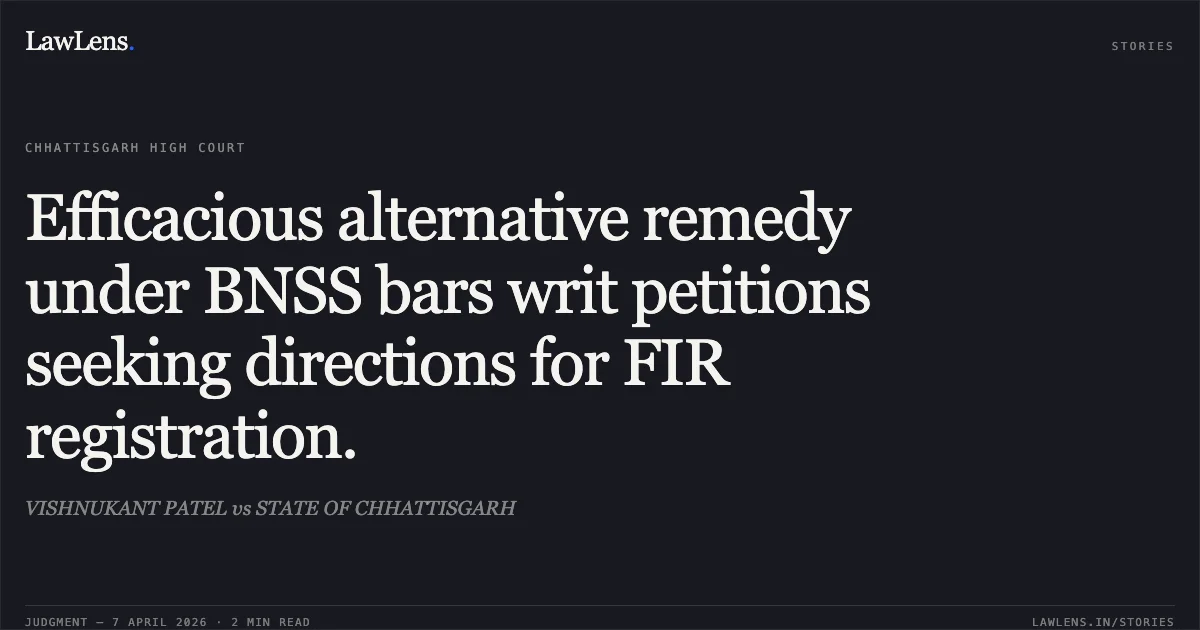
The High Court dismissed the writ petition, holding that it would not interfere as the petitioner has an adequate alternative remedy before the competent lower court under the BNSS.
The court granted the petitioner liberty to approach the appropriate forum/Magistrate to seek redressal for his grievances.
Source reference: para. 8Acts & Sections Cited
4 provisions across 2 statutes referred to in this judgment. Each provision opens on LawLens.
Code of Criminal Procedure, 19732
Bharatiya Nagarik Suraksha Sanhita, 20232
Original Court PDF
VISHNUKANT PATELvsSTATE OF CHHATTISGARH
Click to open original judgment
Original judgment, available to read, download and summarize on LawLens.in


![Subsequent exoneration does not retrospectively invalidate a finalized promotion select list.. UNNIKRISHNAN M vs M/o Environment And Forests. CAT - ['Ernakulam']. LawLens](/stories/thumbnails/subsequent-exoneration-does-not-retrospectively-invalidate-a-finalized-promotion-select-li-ce80a0e84f2f4887857271e8b4341c42.webp)