Facts
The Bar Council of Delhi (BCD) conducted elections for 23 posts in February 2026 under a preferential voting system.
Source reference: para 2During the elimination-based counting stage on 15.04.2026, a member of the counting staff (Mr. Nikhil Kumar) was caught manipulating voter preferences on 18 ballot papers to benefit a candidate who was his relative.
Source reference: paras 3, 35-37An FIR was registered, and counting was halted.
Source reference: para 37The High-Powered Election Supervisory Committee (HPESC), appointed by the Supreme Court, rejected the petitioners' demand for a re-poll, instead directing that counting resume from the elimination stage after re-checking affected tables.
Source reference: para 5Petitioners approached the Supreme Court, which transferred the matters to the Delhi High Court for final adjudication while staying the counting process.
Source reference: paras 6, 55Issues
1. Whether the writ petitions are maintainable given the bar on judicial interference in an ongoing election.
Source reference: para 692. Whether the admitted criminal tampering of ballot papers vitiated the entire election process, necessitating a re-poll.
Source reference: para 693. Whether the first-preference counting was compromised by the presence of the accused staff member.
Source reference: para 694. Whether the reconciliation of votes must occur before or after the final counting.
Source reference: para 69Law Applied
Article 226 of the Constitution regarding writ jurisdiction, noting that while power is broad, it is sparingly used to interdict ongoing elections.
Source reference: para 80The doctrine that "election" encompasses the entire process from notification to declaration and should not be stalled by courts, as established in N.P. Ponnuswami v. Returning Officer [1952] and Mohinder Singh Gill v. CEC [1978].
Source reference: paras 65.1-65.2Rules 23(2) and 23(3) of the BCD Rules, 1963, which dictate that defaced or altered ballot papers are to be decided upon by the Additional Solicitor General.
Source reference: para 127The Bar Council of India Guidelines (2026), which provide for the segregation and recording of "doubtful" ballots.
Source reference: para 128Reasoning
The Court held the petitions maintainable because they were transferred by the Supreme Court specifically for adjudication on merits.
Source reference: para 87The Court found that the tampering was detected at the elimination stage, and first-preference counting had been conducted under high transparency (CCTV and live-streaming).
Source reference: paras 138-140The Court reasoned that a re-poll is an extreme remedy; the integrity of the process could be preserved by applying BCD Rule 23, where the Additional Solicitor General (ASG) acts as a final arbiter for "doubtful" or tampered ballots.
Source reference: paras 130-131Since the identity of the beneficiary and the method of tampering (changing '2' to '12') were known, forensic re-evaluation of the 27 identified ballots by the ASG would suffice to honor voter intent without scrapping the entire election.
Source reference: paras 132, 152The Court dismissed concerns about the 79 suspended candidates, noting the Election Committee had the authority to revoke suspensions upon receiving explanations.
Source reference: para 105Holding
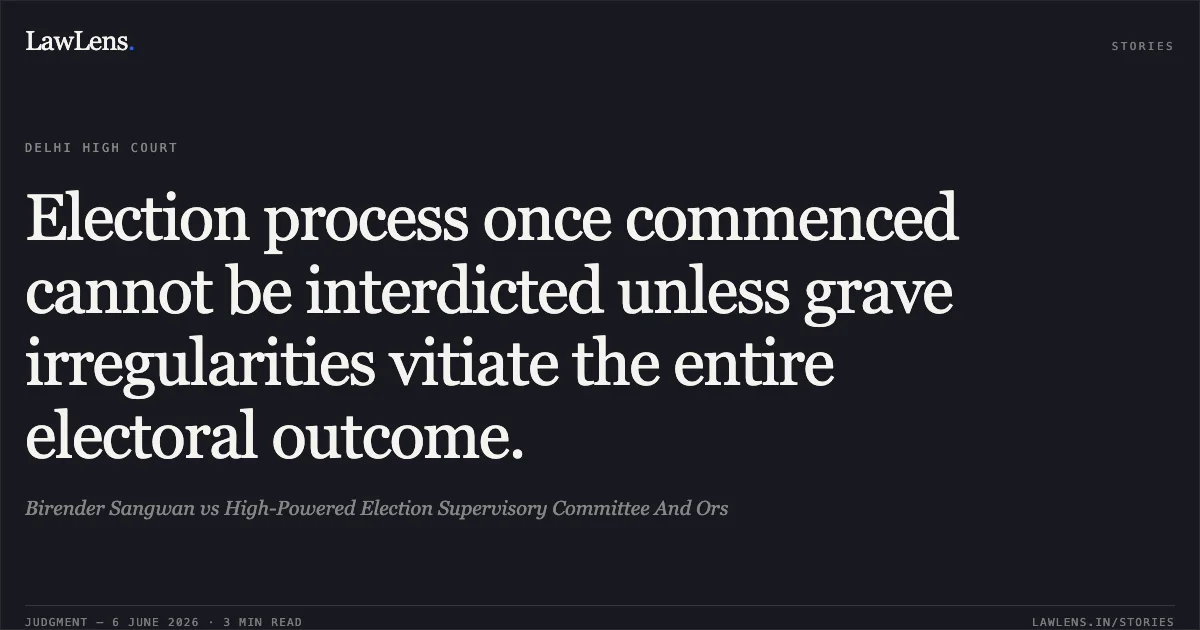
Admitted tampering of a limited number of ballots does not vitiate the entire election if statutory mechanisms (Rule 23) exist to rectify the count.
The Court dismissed the prayers for a re-poll and upheld the HPESC’s order to resume counting.
Source reference: para 152Directions: (1) Counting must recommence from the stage it stopped; (2) 27 manipulated ballots plus any other "doubtful" ballots must be placed before the ASG for a final decision on how they are counted; (3) High-resolution overhead cameras must be installed for transparent live-streaming; (4) No staff from the previous outsourced agency shall be used; (5) Petitioners retain the right to file an Election Petition after the declaration of results.
Source reference: para 152(i), (vii), (iii), (v), (x)Acts & Sections Cited
3 provisions across 1 statute referred to in this judgment. Each provision opens on LawLens.
Advocates Act, 19613
Original Court PDF
Birender SangwanvsHigh-Powered Election Supervisory Committee And Ors
Click to open original judgment
Original judgment, available to read, download and summarize on LawLens.in


![Subsequent exoneration does not retrospectively invalidate a finalized promotion select list.. UNNIKRISHNAN M vs M/o Environment And Forests. CAT - ['Ernakulam']. LawLens](/stories/thumbnails/subsequent-exoneration-does-not-retrospectively-invalidate-a-finalized-promotion-select-li-ce80a0e84f2f4887857271e8b4341c42.webp)