Facts
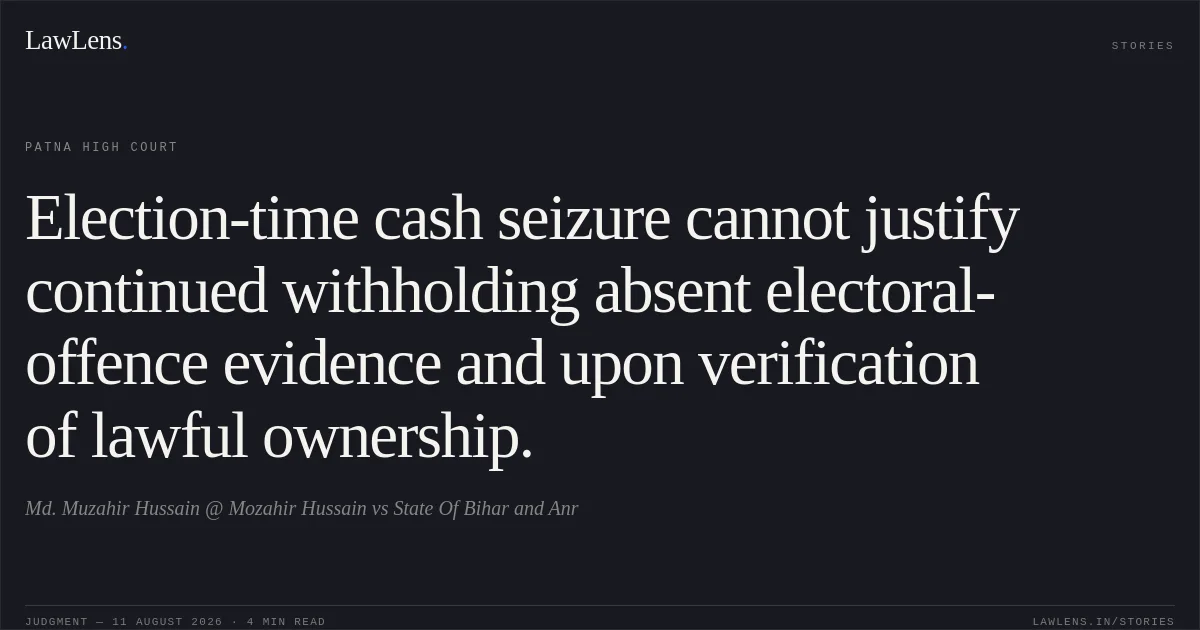
During the 2015 Bihar Legislative Assembly elections, a Flying Squad Magistrate intercepted a Scorpio vehicle at Vaishali on 22 September 2015. A sum of ₹5,04,000 was recovered from a school bag kept in the vehicle, in which the petitioner and two others were travelling. The petitioner allegedly could not satisfactorily explain the source and purpose of the cash. The amount was deposited in the District Treasury, and an FIR was registered under Sections 414, 171-B and 171-C of the IPC and Section 123 of the Representation of the People Act, 1951.
Source reference: paras. 2–3, p. 2The petitioner claimed that the money belonged to him and had been withdrawn from his Canara Bank account in Delhi for attending his nephew’s marriage. He relied on his bank statement, marriage invitation card and income-tax return.
Source reference: paras. 4–8, pp. 2–4His application for release of the money was rejected by the Chief Judicial Magistrate on the grounds that his address had not been verified and that certain conditions connected with his provisional bail and intimation to the Income Tax Department remained incomplete.
Source reference: para. 9, p. 5The Sessions Judge dismissed his revision, observing that the amount had been recovered from his possession, no sufficient explanation had been furnished, and his address remained unverified.
Source reference: para. 10, pp. 5–6The petitioner thereafter invoked the High Court’s jurisdiction under Section 482 of the Code of Criminal Procedure.
Source reference: para. 11, p. 6Issues
1. Whether the orders refusing release of ₹5,04,000 to the petitioner were legally sustainable when the lower courts relied principally on non-verification of his address and bail-related conditions?
Source reference: paras. 9–11, pp. 5–62. Whether the materials collected during investigation disclosed a prima facie connection between the petitioner or the seized money and offences under Sections 414, 171-B and 171-C of the IPC and Section 123 of the Representation of the People Act, 1951?
Source reference: paras. 17–20, pp. 9–113. Whether the petitioner was entitled to consideration of his claim for release after verification of his identity and the alleged withdrawal of the money from his bank account?
Source reference: paras. 19–22, pp. 10–12Law Applied
The Court exercised its inherent jurisdiction under Section 482 CrPC to examine whether the impugned orders resulted in legal or procedural injustice.
Source reference: para. 11, p. 6It considered Section 414 IPC, which concerns assisting in the concealment or disposal of stolen property; Sections 171-B and 171-C IPC, relating respectively to bribery and undue influence at elections; and Section 123 of the Representation of the People Act, 1951, concerning corrupt electoral practices.
Source reference: paras. 17–18, pp. 9–10The Court applied the principle that mere possession of cash during an election period, without material connecting the person or the money to bribery, undue influence, stolen property or another electoral offence, is insufficient by itself to establish the alleged offences or justify indefinite withholding of the property.
Source reference: paras. 17–20, pp. 9–11It further held that a claim for release of seized property must be determined on the basis of relevant verification of the claimant’s identity, ownership and source of the money, rather than on unrelated or incomplete conditions.
Source reference: paras. 19–22, pp. 10–12Reasoning
The Court found that the investigation had produced no evidence linking the petitioner to any political party, bribery of voters or officials, undue influence, or concealment of stolen property.
Source reference: paras. 17–18, pp. 9–10There was also no complaint or FIR alleging that the seized ₹5,04,000 had been stolen from another person; consequently, the ingredients of Sections 414, 171-B and 171-C IPC were not prima facie established merely because the petitioner was carrying cash during the election period.
Source reference: paras. 17–18, pp. 9–10The Court further noted that the police had not verified either the petitioner’s identity or his asserted withdrawal of ₹5,50,000 and ₹4,00,000 from his Canara Bank account, despite the bank statement and other documents placed on record.
Source reference: paras. 16, 19–20, pp. 8–11The lower courts therefore erred in refusing release solely because the petitioner’s address had not been verified and because conditions relating to provisional bail or Income Tax Department intimation had not been completed.
Source reference: paras. 9–10, 19, pp. 5–6, 10However, instead of directing immediate release, the High Court ordered a proper verification-based determination by the Chief Judicial Magistrate.
Source reference: no citationHolding
The High Court allowed the petition and quashed the orders dated 14 March 2016 and 4 July 2016 passed by the Chief Judicial Magistrate and the Sessions Judge, respectively.
It directed the petitioner to file a fresh application before the Chief Judicial Magistrate with documents proving his entitlement to the money, along with his Aadhaar Card, PAN Card and other relevant identity documents.
Source reference: paras. 21–23, pp. 11–12The Chief Judicial Magistrate was directed to verify the petitioner’s identity and the alleged bank withdrawal and pass a reasoned order within eight weeks.
Source reference: paras. 21–23, pp. 11–12If the identity and withdrawal were corroborated, the amount was to be released in the petitioner’s favour; if contrary facts emerged, appropriate orders were to be passed in accordance with law.
Source reference: para. 22, p. 12Acts & Sections Cited
3 provisions across 3 statutes referred to in this judgment. Each provision opens on LawLens.
Indian Penal Code, 18601
Representation of the People Act, 19511
Code of Criminal Procedure, 19731
Original Court PDF
Md. Muzahir Hussain @ Mozahir HussainvsState Of Bihar and Anr
Click to open original judgment
Original judgment, available to read, download and summarize on LawLens.in