Facts
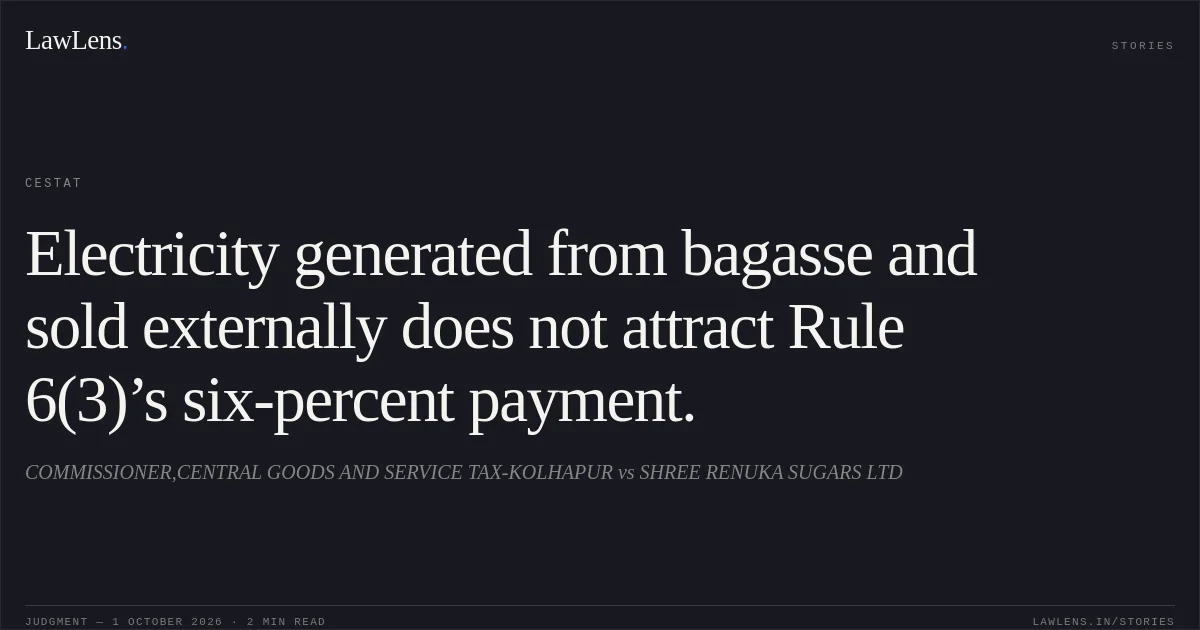
The respondent, a sugar manufacturer, generated electricity by burning bagasse, a by-product of sugarcane crushing. It used some electricity captively and sold surplus electricity to the Maharashtra State Electricity Distribution Company Ltd.
Source reference: pp. 2–3The Department treated the electricity sold as exempted and demanded an amount equal to 6% of its value under Rule 6(3) of the CENVAT Credit Rules, 2004, along with interest and penalties. The adjudicating authority confirmed the demand; the Commissioner (Appeals) set it aside, relying on *Jawahar SSK Ltd.* The Revenue appealed to the Tribunal
Source reference: pp. 2–3Issues
Whether the respondent was required to pay an amount under Rule 6(3) of the CENVAT Credit Rules, 2004, on electricity generated from bagasse and sold outside the factory
Source reference: p. 4Whether the Commissioner (Appeals) was justified in setting aside the demand confirmed by the adjudicating authority
Source reference: pp. 3–4Law Applied
Rule 6(3) of the CENVAT Credit Rules, 2004 concerns an amount payable in respect of exempted goods or services where common inputs or input services are used.
Source reference: pp. 5–6In *Union of India v. DSCL Sugar Ltd.*, the Supreme Court held that bagasse, as agricultural waste and residue not resulting from a manufacturing process, is not excisable; consequently, Rule 6 of the CENVAT Credit Rules does not apply on that basis.
Source reference: pp. 5–6The Tribunal also relied on its consistent decisions that electricity generated from bagasse and sold to a State electricity authority is not subject to the 6% amount under Rule 6(3).
Source reference: pp. 4–6Reasoning
The Tribunal found that the dispute was covered by a consistent line of Tribunal decisions concerning electricity generated from bagasse and sold to electricity authorities.
Source reference: pp. 4–6It relied on *DSCL Sugar Ltd.* for the principle that bagasse is waste and is not the result of manufacture, and on decisions involving the respondent and other sugar manufacturers applying that principle to Rule 6(3).
Source reference: pp. 4–6As the issue had been resolved in favour of sugar manufacturers and the Revenue showed no basis for a different outcome, the Tribunal held that the Commissioner (Appeals)’ order required no interference.
Source reference: p. 6Holding
The Tribunal held that the respondent was not liable to pay an amount equal to 6% of the value of electricity generated from bagasse and sold outside the factory under Rule 6(3) of the CENVAT Credit Rules, 2004.
It sustained the Commissioner (Appeals)’ order and dismissed the Revenue’s appeal.
Source reference: pp. 6–7Acts & Sections Cited
2 provisions across 1 statute referred to in this judgment. Each provision opens on LawLens.
Central Excise Act, 19442
Original Court PDF
COMMISSIONER,CENTRAL GOODS AND SERVICE TAX-KOLHAPURvsSHREE RENUKA SUGARS LTD
Click to open original judgment
Original judgment, available to read, download and summarize on LawLens.in