Facts
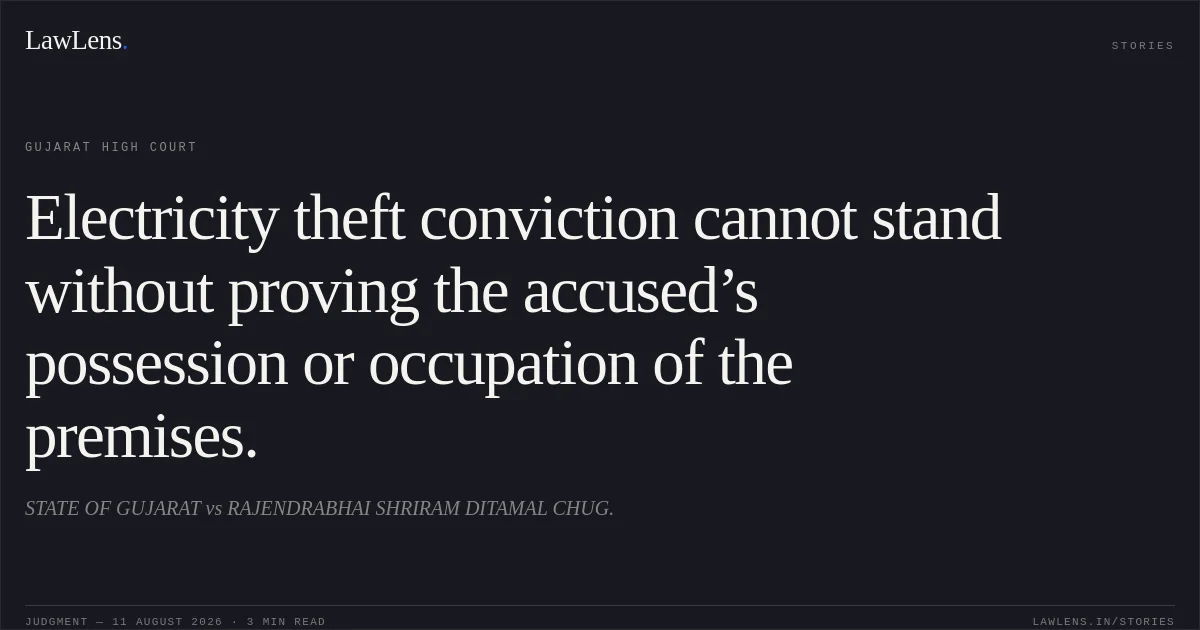
The prosecution alleged that, on 1 February 2006, the respondent had illegally connected a wire to the low-voltage electricity line and abstracted electricity for his residential premises, causing alleged theft valued at ₹8,41,202.01, thereby committing an offence under Section 135(1)(a) of the Electricity Act, 2003.
Source reference: p.1Following investigation, a charge-sheet was filed and the matter was committed to the Special Court, where the respondent pleaded not guilty and claimed trial.
Source reference: pp.1–2The prosecution examined seven witnesses and produced documents including the complaint, inspection and seizure panchnamas, supplementary bills, calculation sheets, checking sheet, FIR and related records.
Source reference: pp.2–3The trial Court acquitted the respondent, holding that the prosecution failed to establish his occupation or possession of the premises and failed to prove the alleged seizure and the complainant’s authority to institute the prosecution.
Source reference: pp.6–9The State preferred an appeal against the acquittal under Section 378(1)(3) of the Code of Criminal Procedure, 1973.
Source reference: p.1Issues
1. Whether the trial Court was justified in acquitting the respondent of the offence under Section 135(1)(a) of the Electricity Act, 2003?
Source reference: para. 11; p.52. Whether the trial Court properly appreciated the oral and documentary evidence, and whether its judgment suffered from illegality, irregularity or perversity warranting appellate interference?
Source reference: para. 11; p.5Law Applied
The Court applied Section 135(1)(a) of the Electricity Act, 2003, which criminalises dishonest abstraction or consumption of electricity through illegal connections, wires, artificial means or apparatus.
Source reference: pp.1, 6The State’s appeal against acquittal was considered under Section 378(1)(3) of the Code of Criminal Procedure, 1973.
Source reference: p.1Relying on Chandrappa v. State of Karnataka, as reaffirmed in Rajesh Prasad v. State of Bihar, Babu Sahebagouda Rudragoudar v. State of Karnataka, and Ramesh v. State of Karnataka, the Court held that an appellate court may fully reappreciate the evidence in an appeal against acquittal, but the accused enjoys a double presumption of innocence.
Source reference: pp.9–12Where two reasonable views are possible, the acquittal should not be disturbed; interference is warranted only where the trial Court’s view is manifestly illegal, perverse or unreasonable.
Source reference: pp.9–12Reasoning
The prosecution failed to prove the foundational link between the respondent and the inspected premises.
Source reference: pp.7–8Although the inspection allegedly covered 40 rooms and two shops, the checking officers admitted that they did not ascertain who occupied the rooms, who owned the shops, or whether the respondent was in possession of the premises.
Source reference: pp.7–8The respondent’s wife was allegedly present and had signed the checking sheet, but she was neither examined nor cited as a witness.
Source reference: pp.6–7The alleged seizure of the cable was also not reliably established: a panch witness admitted that he was associated with the complainant company and that the panchnama was prepared at the company’s office rather than at the place of inspection.
Source reference: pp.7–9Further, the complaint was lodged approximately six weeks after the inspection, and the complainant had not personally visited the premises or examined the occupants.
Source reference: pp.6–7The complainant also failed to produce the authorization required under the company’s delegation framework to register the prosecution.
Source reference: p.8In these circumstances, the evidence did not prove beyond reasonable doubt either the respondent’s possession of the premises or his dishonest abstraction of electricity.
Source reference: pp.8–12The trial Court’s view was therefore a reasonable one and did not meet the threshold for appellate interference.
Source reference: pp.8–12Holding
The High Court answered the issues in favour of the respondent.
It held that the prosecution had failed to establish the essential facts connecting him with the alleged electricity theft and that the trial Court had correctly appreciated the evidence.
Source reference: paras. 20–21; p.12Finding no illegality, perversity or infirmity in the acquittal, the Court dismissed the State’s appeal and confirmed the trial Court’s judgment and order of acquittal.
Source reference: para. 22; p.13The respondent’s bail bond was cancelled, and the record and proceedings were directed to be returned to the trial Court.
Source reference: para. 22; p.13Acts & Sections Cited
3 provisions across 2 statutes referred to in this judgment. Each provision opens on LawLens.
Code of Criminal Procedure, 19732
Electricity Act, 20031
Original Court PDF
STATE OF GUJARATvsRAJENDRABHAI SHRIRAM DITAMAL CHUG.
Click to open original judgment
Original judgment, available to read, download and summarize on LawLens.in