Facts
The prosecution alleged that on 5 April 2010 the appellant had tapped electricity directly from a nearby pole using an aluminium wire to supply a 5 HP pump at his house, causing BESCOM a loss of ₹1,64,140.
Source reference: p.2–4The trial court convicted him under Section 135 of the Electricity Act, 2003, sentenced him to two years’ simple imprisonment and a fine of ₹50,000, and permitted recovery of the alleged loss.
Source reference: p.2–4The appellant challenged the conviction, including on the ground that the prosecution had not established his connection to the premises or the equipment
Source reference: p.2–4The High Court considered the evidence of four prosecution witnesses and Exhibits P1–P5
Source reference: p.5–7Issues
1. Whether the prosecution proved beyond reasonable doubt that the appellant committed electricity theft punishable under Section 135 of the Electricity Act, 2003
Source reference: p.5–72. Whether the trial court’s conviction and sentence were sustainable on the evidence presented
Source reference: p.7–8Law Applied
Section 135 of the Electricity Act, 2003, was the statutory basis for the charge.
Source reference: no citationThe Court applied the criminal-law principle that the prosecution must prove the accused’s guilt beyond reasonable doubt.
Source reference: p.7The judgment cited no judicial precedent.
Source reference: no citationReasoning
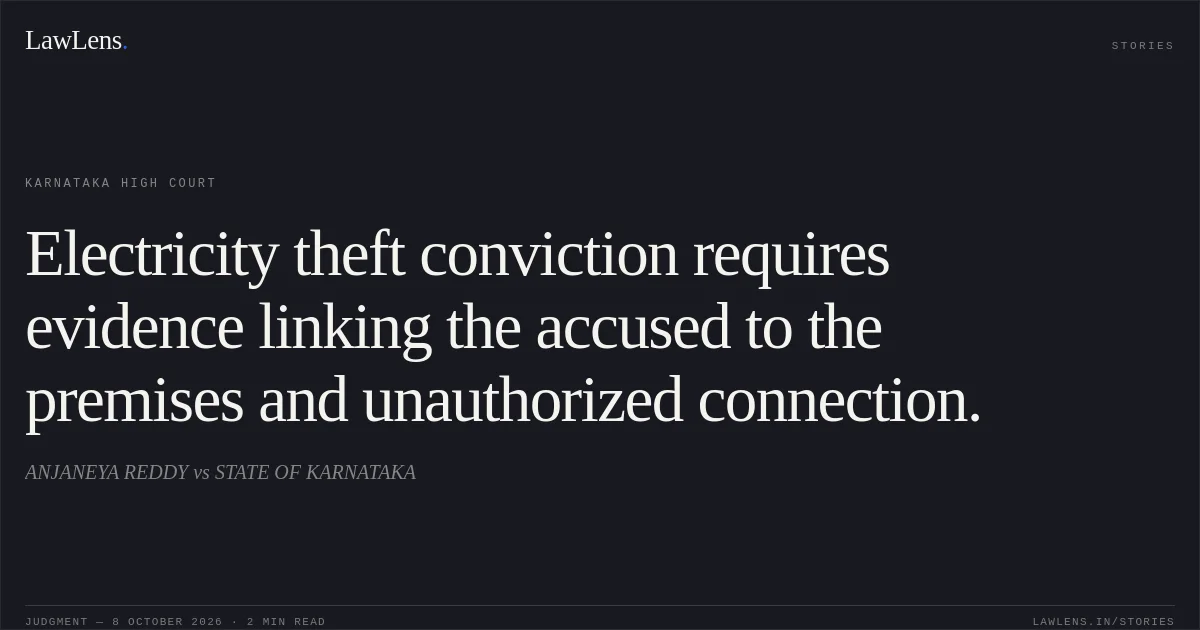
The prosecution evidence described an unauthorised connection from an electricity pole and the seizure of wire, but the record did not establish that the appellant owned or occupied the premises, or that he had the alleged 5 HP motor to which the connection was made.
Source reference: p.5–7The inspection report did not identify the house by door number, and the investigating officer had not obtained the house’s khata extract or explained the absence of that evidence.
Source reference: p.7In the Court’s view, the resulting evidentiary gaps meant that the prosecution had not proved the appellant’s guilt beyond reasonable doubt; the trial court had therefore convicted him on assumptions and presumptions.
Source reference: p.7Holding
The High Court allowed the appeal and set aside the conviction and sentence.
It acquitted the appellant of the offence under Section 135, cancelled his bail bond, and directed the trial court to refund any fine deposited.
Source reference: p.8Acts & Sections Cited
3 provisions across 2 statutes referred to in this judgment. Each provision opens on LawLens.
Code of Criminal Procedure, 19732
Electricity Act, 20031
Original Court PDF
ANJANEYA REDDYvsSTATE OF KARNATAKA
Click to open original judgment
Original judgment, available to read, download and summarize on LawLens.in