Facts
The respondents (original plaintiffs) filed a suit for specific performance of an oral agreement regarding the sale of a bungalow
Source reference: para 2The plaintiffs claimed to have recorded telephonic conversations with the defendants to prove a concluded contract and produced a transcript and an audio cassette (tape)
Source reference: para 2.2The plaintiffs moved application Exh.119 seeking the appointment of the Forensic Science Laboratory (FSL) to record the defendants' voice samples for comparison with the cassette
Source reference: para 2.4The trial court allowed the application, ordering the audio tape to be sent to FSL and directing the defendants to provide voice samples
Source reference: para 2.9The petitioners (defendants) challenged this order, arguing it forced them to provide evidence for the plaintiffs' case and ignored the legal requirements for electronic evidence
Source reference: para 3.3Issues
1. Whether the trial court could admit and act upon electronic evidence (audio tape) without verifying its status as primary or secondary evidence and ensuring compliance with certification requirements under Section 65B(4) of the Evidence Act.
Source reference: para 7-112. Whether the trial court exceeded its jurisdiction in directing the defendants to provide voice samples before the plaintiffs proved the authenticity and admissibility of the audio recording.
Source reference: para 3.3 / 14Law Applied
Section 65B(4) of the Indian Evidence Act (now Section 63(4) of the Bharatiya Sakshya Adhiniyam, 2023), which makes a certificate mandatory for the admissibility of secondary electronic evidence
Source reference: para 8-10Anvar P.V. v. P.K. Basheer and Arjun Panditrao Khotkar v. Kailash Kushanrao Gorantyal, which established that such certification is a condition precedent to admissibility
Source reference: para 33-35Safeguards for voice identification and tape recordings established in Ziyauddin Burhanuddin Bukhari v. Brijmohan Ramdass Mehra
Source reference: para 32Tukaram S. Dighole v. Manikrao Shivaji Kokate, which mandate rigorous proof of authenticity and accuracy for tape records
Source reference: para 13/23Reasoning
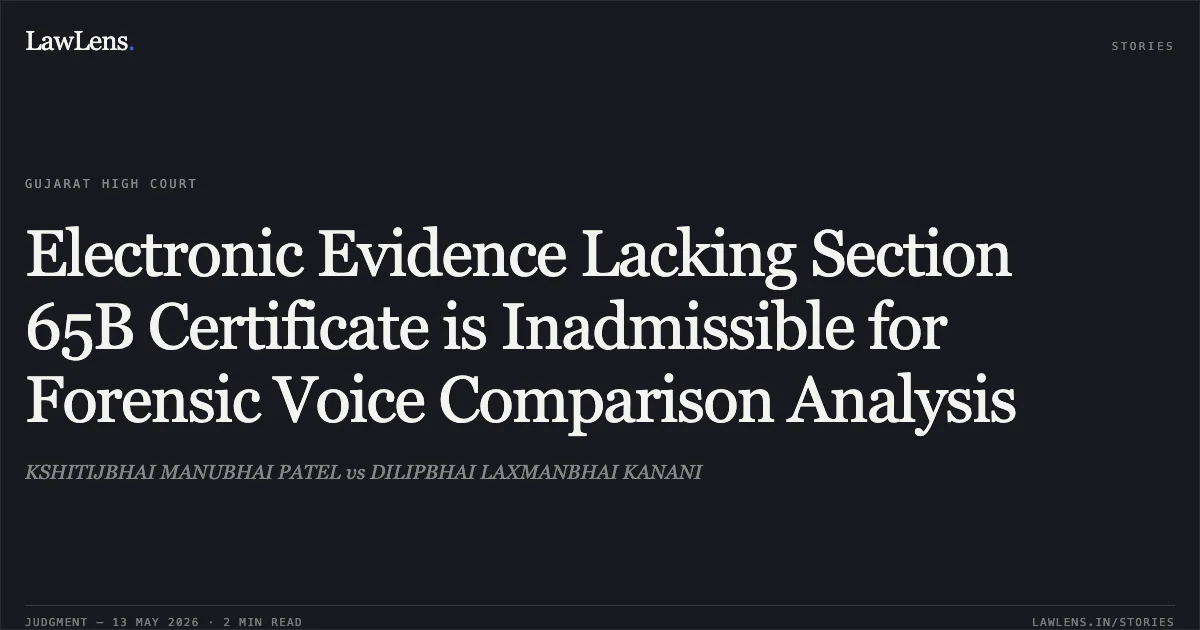
The High Court found that the trial court committed a patent illegality by ignoring whether the tape record was primary or secondary evidence
Source reference: para 7Since the original telephone instrument was not produced, the tape was secondary evidence, requiring a mandatory certificate under Section 65B(4) (or Section 63(4) of BSA) before admission
Source reference: para 7-9The court noted that the trial court failed to follow binding precedents that require strict proof of accuracy and identification of voices before basing a decision on electronic recordings
Source reference: para 12-13Moving straight to FSL examination and demanding voice samples from the defendants "dehors" the established legal procedure for electronic evidence was held to be an overreach
Source reference: para 14Holding
It held that the trial court cannot bypass the mandatory requirement of Section 65B(4) certification and must strictly adhere to the safeguards for electronic evidence authenticity as laid down by the Supreme Court
The Court allowed the petition and quashed the impugned order dated 30.12.2022. The matter was remanded to the trial court to decide application Exh.119 afresh in light of the cited binding precedents
Source reference: para 16 / 14-16Acts & Sections Cited
1 provisions across 1 statute referred to in this judgment. Each provision opens on LawLens.
Bharatiya Sakshya Adhiniyam, 20231
Original Court PDF
KSHITIJBHAI MANUBHAI PATELvsDILIPBHAI LAXMANBHAI KANANI
Click to open original judgment
Original judgment, available to read, download and summarize on LawLens.in


![Subsequent exoneration does not retrospectively invalidate a finalized promotion select list.. UNNIKRISHNAN M vs M/o Environment And Forests. CAT - ['Ernakulam']. LawLens](/stories/thumbnails/subsequent-exoneration-does-not-retrospectively-invalidate-a-finalized-promotion-select-li-ce80a0e84f2f4887857271e8b4341c42.webp)