Facts
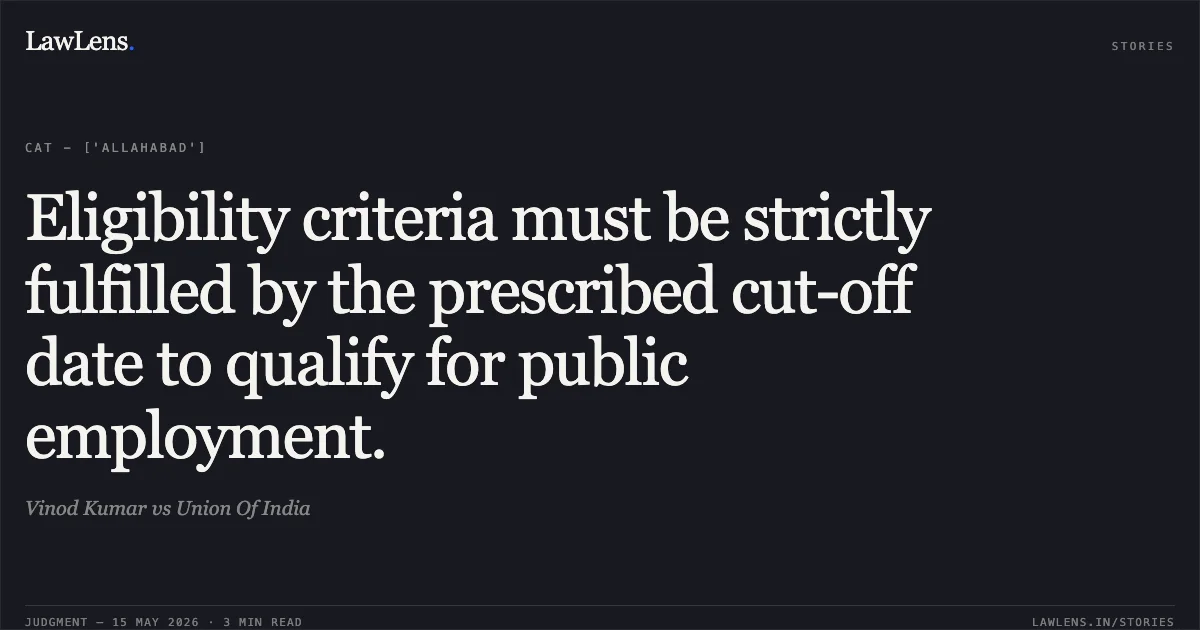
Following a vacancy for the post of Extra Departmental Branch Post Master (EDBPM) at Harbanspur Dharam in 1998, the postal department invited applications from the open market with a cut-off date of 17.11.1998
Source reference: p. 3, 6The applicant, Vinod Kumar, applied but his application was allegedly received on 18.11.1998 and lacked proof of an independent source of income—a mandatory eligibility requirement
Source reference: p. 3, 6Respondent No. 5 (Pawan Kumar) was appointed on 13.08.1999
Source reference: p. 2The applicant alleged that Respondent No. 5 was lower in merit and favored by his uncle (Respondent No. 6), a postal official
Source reference: p. 2, 4After a prior round of litigation (O.A. No. 1338 of 1999), the Tribunal directed the respondents to reconsider the matter, resulting in a speaking order dated 29.03.2010 rejecting the applicant's claim
Source reference: p. 2, 3Issues
1. Whether the applicant fulfilled the mandatory eligibility criteria, specifically the submission of documents and proof of independent income, within the prescribed cut-off date
Source reference: p. 102. Whether the appointment of Respondent No. 5 was vitiated by favoritism, nepotism, or violation of rules regarding the appointment of "near relations"
Source reference: p. 103. Whether the Tribunal should interfere with a selection process and appointment after a lapse of more than two decades
Source reference: p. 10-11Law Applied
The Court primarily applied the principle that eligibility must be determined strictly as of the cut-off date prescribed in the advertisement
Source reference: p. 6, 11State of Uttar Pradesh v. Vijay Kumar Mishra (2003), which establishes that a candidate lacking prescribed qualifications by the cut-off date cannot be considered, and no relaxation is permissible unless provided by rules
Source reference: p. 8Rameshwar Dayal v. Union of India (2014), affirming the employer's right to insist on compliance with recruitment conditions (such as independent income) before appointment
Source reference: p. 8-9Regarding "near relations," it noted the Supreme Court’s decision in Balram Prasad v. Union of India (1996), which struck down certain restrictive departmental instructions on the employment of relatives as arbitrary
Source reference: p. 7Reasoning
The Tribunal found that the applicant failed to meet the mandatory requirements of the notification dated 02.11.1998. His application was received after the 17.11.1998 deadline, and he admitted in subsequent correspondence that his certificates were unavailable at the time of submission
Source reference: p. 6, 9The income certificate provided by the applicant was either in his father’s name or lacked proper authentication, failing the "independent source of income" requirement essential for GDS BPM posts
Source reference: p. 9-10The Tribunal rejected the allegations of nepotism, noting that the applicant provided no evidence that Respondent No. 6 influenced the appointing authority (Superintendent of Post Offices, Bijnor)
Source reference: p. 10Furthermore, Respondent No. 5 had since been promoted to 'Postman' in 2016 via departmental exam, and a third party had already been appointed to the original vacancy in 2021. Under these circumstances, the Tribunal reasoned that unsettling a 25-year-old appointment would cause grave prejudice
Source reference: p. 7, 11Holding
The Tribunal held that the applicant was ineligible for the post due to late submission and failure to prove an independent income by the cut-off date
It further held that the appointment of Respondent No. 5 was made in accordance with the rules as he was the next meritorious eligible candidate
Source reference: p. 5-6The Original Application was dismissed, affirming the impugned order dated 29.03.2010, and no costs were awarded
Source reference: p. 11Acts & Sections Cited
1 provisions across 1 statute referred to in this judgment. Each provision opens on LawLens.
Administrative Tribunals Act, 19851
Original Court PDF
Vinod KumarvsUnion Of India
Click to open original judgment
Original judgment, available to read, download and summarize on LawLens.in