Facts
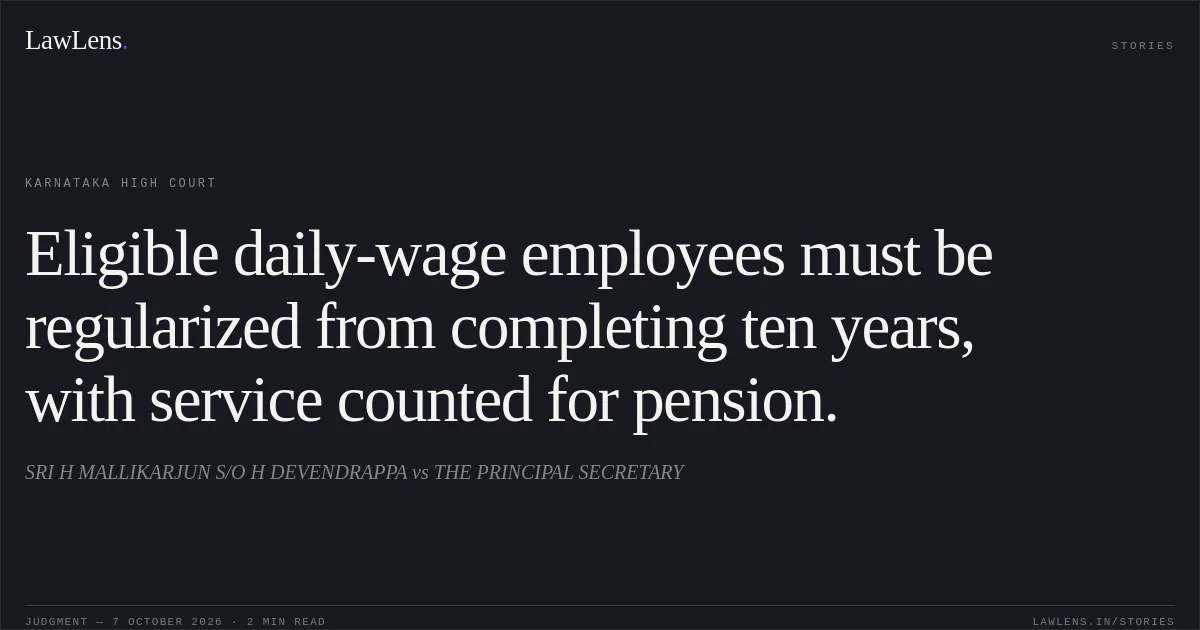
The petitioners entered the respondents’ service as daily wagers on 1 January 1985 and 6 July 1984, respectively.
Source reference: p.3They sought regularisation through representations, asserting that they had completed over 32 years of continuous service; by the time of the petition, both had retired on reaching superannuation, and the representations remained undecided.
Source reference: p.3They sought retrospective regularisation from completion of ten years’ service, financial and retirement benefits, and pension.
Source reference: p.3–4Relying on a coordinate Bench’s decision in W.P. No. 100556 of 2024, the Court treated the dispute as identical and allowed the petition.
Source reference: p.4, 51–52Issues
Whether the petitioners, who had served as daily wagers for more than ten years, were entitled to regularisation from the dates they completed ten years of service.
Source reference: p.3–4, 47–50Whether their service should count towards pay fixation, pension and other terminal benefits, and whether arrears of salary were payable.
Source reference: p.50–53Law Applied
In Secretary, State of Karnataka v. Umadevi (3), the Supreme Court recognised a one-time measure for considering irregularly appointed employees who had worked for ten years or more in duly sanctioned posts, without court or tribunal protection, and who possessed the prescribed qualifications.
Source reference: p.11–13State of Karnataka v. M.L. Kesari explained the distinction between irregular and illegal appointments and identified the relevant conditions for regularisation.
Source reference: p.23–25The Court also relied on subsequent Supreme Court decisions concerning long-serving employees, including Narendra Kumar Tiwari, Sheo Narain Nagar, Prem Singh and Jaggo, and on the principle that similarly situated employees should not be treated arbitrarily or subjected to “pick and choose” treatment.
Source reference: p.14–27, 46–50The Court applied these principles through its jurisdiction under Articles 226 and 227 of the Constitution.
Source reference: p.3Reasoning
The Court considered that the petitioners’ claims fell within the principles applied by the coordinate Bench concerning long-serving daily-wage employees and the Umadevi framework.
Source reference: p.47–50It concluded that the circumstances warranted a direct mandamus rather than a direction merely to reconsider their cases, reasoning that further consideration could generate another round of litigation.
Source reference: p.47–50The Court therefore adopted the coordinate Bench’s decision and granted the same relief, including counting the petitioners’ service for pension and terminal benefits.
Source reference: p.51–53Holding
The writ petition was allowed.
The respondents were directed to regularise the petitioners’ services from the respective dates on which they completed ten years of service.
Source reference: p.52–53The petitioners were entitled to pay fixation at par with permanent employees from those dates, but not arrears of salary; their service was to count for pension and other incidental terminal benefits.
Source reference: p.52–53Compliance was directed within six weeks.
Source reference: p.52–53Acts & Sections Cited
2 provisions across 1 statute referred to in this judgment. Linked provisions open on LawLens.
Himachal Pradesh Compulsory Primary Education Act, 19972
Original Court PDF
SRI H MALLIKARJUN S/O H DEVENDRAPPAvsTHE PRINCIPAL SECRETARY
Click to open original judgment
Original judgment, available to read, download and summarize on LawLens.in