Facts
The Applicant joined the Central Silk Board (CSB) as a Lower Division Clerk on 29.10.1982 and retired as Assistant Director on 28.02.2018
Source reference: p. 3Upon retirement, his gratuity was computed and paid under the Central Civil Services (Pension) Rules, 1972
Source reference: p. 8In December 2024, the Applicant submitted a representation seeking re-computation of his gratuity under the Payment of Gratuity Act, 1972 (PG Act), arguing it offered more beneficial terms, including the consideration of entire continuous service without the 33-year cap
Source reference: p. 3, 5The Respondents rejected this request on 22.01.2025, asserting that CSB employees are governed by the CCS (Pension) Rules via the Central Silk Board Rules, 1955
Source reference: p. 3, 8The Applicant challenged this rejection, contending that the PG Act has an overriding effect under Section 14
Source reference: p. 4Issues
1. Whether an employee of the Central Silk Board, functioning under the administrative control of the Ministry of Textiles, is covered by the provisions of the Payment of Gratuity Act, 1972
Source reference: p. 9, para. 92. Whether the Applicant is barred by the principles of estoppel and limitation from claiming benefits under the PG Act after accepting retirement benefits under the CCS (Pension) Rules without protest in 2018
Source reference: p. 21, para. 27Law Applied
Section 2(e) of the Payment of Gratuity Act, 1972, which defines "employee" but excludes persons holding posts under the Central or State Government who are governed by any other Act or rules providing for gratuity
Source reference: p. 10Supreme Court’s decision in N. Manoharan v. The Administrative Officer (2026 Livelaw (SC) 137), which clarified that the exclusionary limb of Section 2(e) strictly removes such classes from the PG Act’s ambit
Source reference: p. 14Rule 28A of the Central Silk Board Rules, 1955, which mandates that CSB employees be entitled to pension and gratuity at rates prescribed by the Central Government's Liberalised Pension Rules (CCS Pension Rules)
Source reference: p. 17Reasoning
The Tribunal found that the CSB is a statutory body under the strict control of the Union Government per Sections 2 and 11 of the Central Silk Board Act, 1948
Source reference: p. 15-16Under Rule 28A of the CSB Rules, the Board specifically adopted the Central Government's pension and gratuity framework for its staff
Source reference: p. 18Applying the ratio of N. Manoharan, the Tribunal reasoned that since the Applicant is governed by a separate set of statutory rules (CCS Pension Rules) for gratuity, he falls squarely within the "exclusionary limb" of the definition of "employee" under Section 2(e) of the PG Act
Source reference: p. 14, 19Consequently, the overriding effect of Section 14 of the PG Act cannot be invoked because the Act itself does not apply to him
Source reference: p. 9The Tribunal also noted that the Applicant retired in 2018 and accepted his benefits without demur; therefore, the claim filed in 2025 is barred by delay, laches, and Section 21 of the Administrative Tribunals Act, 1985
Source reference: p. 21Holding
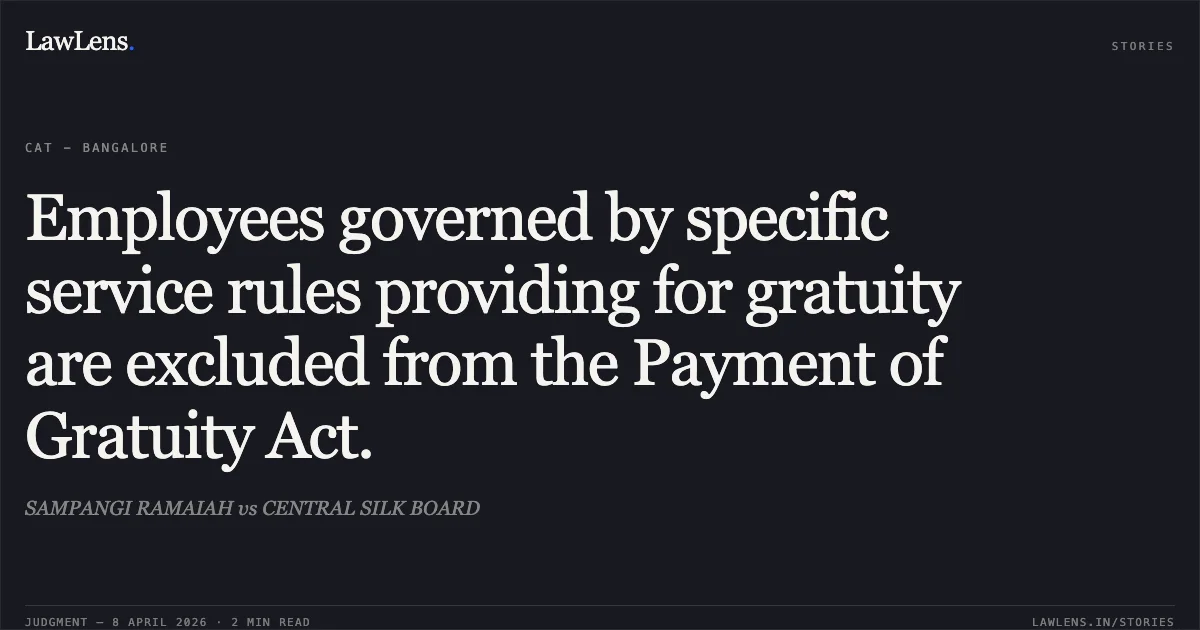
The Tribunal answered the primary issue in the negative, holding that CSB employees are governed exclusively by the CCS (Pension) Rules, 1972, and not the Payment of Gratuity Act, 1972
The Tribunal further held that the application was barred by limitation and the principle of estoppel
Source reference: p. 21The Original Application was dismissed, and no order as to costs was made
Source reference: p. 22Acts & Sections Cited
7 provisions across 2 statutes referred to in this judgment. Each provision opens on LawLens.
Administrative Tribunals Act, 19852
Central Silk Board Act, 19485
Original Court PDF
SAMPANGI RAMAIAHvsCENTRAL SILK BOARD
Click to open original judgment
Original judgment, available to read, download and summarize on LawLens.in


![Authorities must decide pensionary and retiral-benefit claims through a reasoned order within eight weeks.. Habibullah khan vs HOME DEPARTMENT. CAT - ['Srinagar']. LawLens](/stories/thumbnails/authorities-must-decide-pensionary-and-retiral-benefit-claims-through-a-reasoned-order-wit-d0cbe8a8119c48fbabe7df9f2d353488.webp)