01Facts
The 39 petitioners were Junior Engineers employed with the Chhattisgarh State Power Generation Company Limited and related power companies. They challenged the reduction of the promotional quota for appointment to the post of Assistant Engineer from 70% to 40%.
¶ 2(a)–2(c) · pp. 9–11By resolution dated 8 April 2025 and consequential order dated 5 May 2025, the quota was revised to 40% by promotion, 10% through departmental recruitment, and 50% through direct recruitment.
¶ 9 · pp. 16–21The petitioners also challenged the recruitment advertisement dated 7 August 2026 proposing direct recruitment to 60 posts of Assistant Engineer (Generation), contending that it unlawfully curtailed their promotional opportunity.
¶ 1–2(c) · pp. 8–1102Issues
i.Whether the petitioners had a vested or enforceable right to insist upon continuation of the earlier 70% promotional quota for appointment to the post of Assistant Engineer.
¶ 6, 11, 17 · pp. 15–16, 22–24ii.Whether the reduction of the promotional quota from 70% to 40%, with a corresponding increase in the direct-recruitment quota, was arbitrary, unconstitutional, mala fide, or contrary to the applicable service rules.
¶ 7, 10, 17–18 · pp. 15–16, 21–25iii.Whether the consequential recruitment advertisement dated 7 August 2026 was liable to be quashed for allegedly prejudicing the petitioners’ promotional prospects.
¶ 18 · p. 2503Law Applied
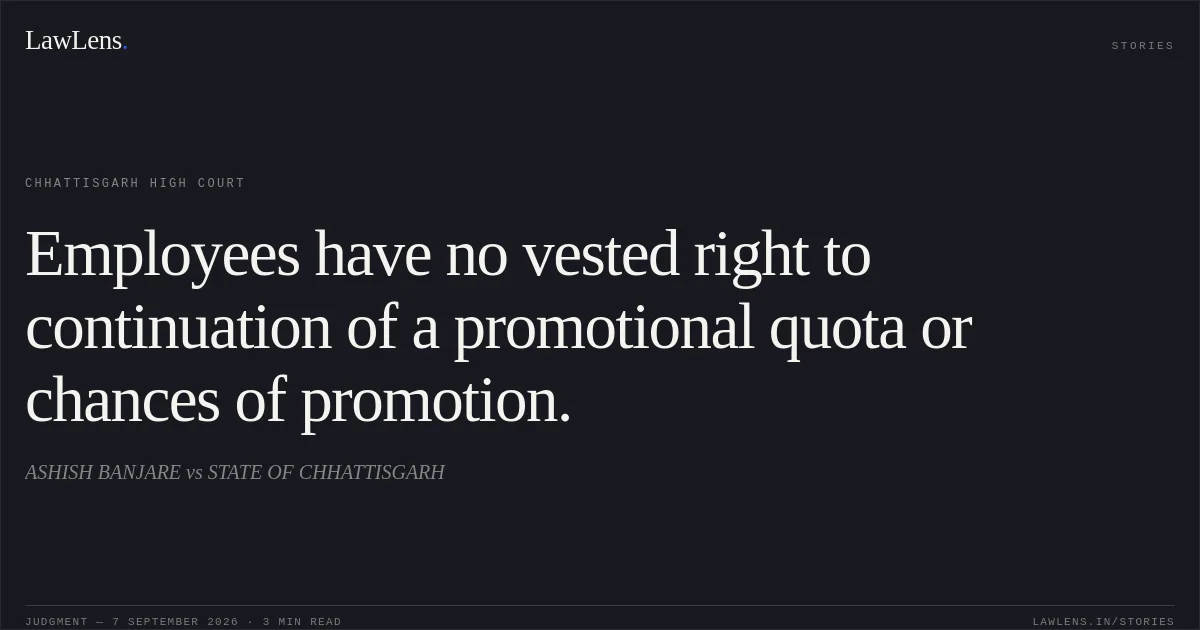
The Court applied the settled principle that an employee has a right to fair consideration for promotion under the rules applicable at the relevant time, but no vested or indefeasible right to promotion or to continuation of a particular promotional quota; reduction in promotional chances alone does not violate Articles 14 or 16.
¶ 6, 11, 13, 16–18 · pp. 15–16, 22–25Relying on State of Maharashtra v. Chandrakant Anant Kulkarni, (1981) 4 SCC 130, and Union of India v. Pushpa Rani, (2008) 9 SCC 242, the Court distinguished the right to consideration for promotion from a mere chance of promotion.
¶ 3(iii), 16 · pp. 12–13, 24Under Dwarka Prasad v. Union of India, (2003) 6 SCC 535, fixation of quotas and promotional channels is primarily within the employer’s policy domain, having regard to cadre strength, suitability, experience, duties, and organisational requirements.
¶ 14 · pp. 22–23The Court also relied on Dilip Kumar Garg v. State of Uttar Pradesh, (2009) 4 SCC 753, and Dr. Jaya Thakur v. Union of India, 2023 SCC OnLine SC 813, for the proposition that courts should not substitute their judgment for that of administrative authorities on policy matters unless the decision is manifestly arbitrary, unconstitutional, mala fide, or contrary to statute.
¶ 15–16 · pp. 23–2404Reasoning
The Court held that the petitioners’ eligibility for promotion did not confer a right to demand that 70% of Assistant Engineer vacancies continue to be filled through promotion. The 70% quota had itself been introduced after the petitioners’ appointment, when the applicable promotional quota was 40%; therefore, it could not be treated as an immutable service condition.
¶ 8 · p. 16The respondents produced a departmental note and Board resolution explaining that the revised 40:10:50 arrangement was adopted to address the need for graduate engineers for upcoming power-generation and pump-storage projects and to maintain operational requirements.
¶ 8–10 · pp. 16–21Since 40% of vacancies remained available for promotion and an additional 10% for departmental recruitment, the promotional avenue was reduced but not eliminated.
¶ 7 · p. 15The Court found no material demonstrating arbitrariness, mala fides, statutory violation, or constitutional infirmity in the decision-making process.
¶ 17–18 · pp. 24–25The earlier promotion of 23 Junior Engineers pursuant to a process initiated before the quota revision did not create an accrued right in favour of the petitioners.
¶ 7 · p. 15Consequently, the direct-recruitment advertisement could not be interdicted merely because it reduced the petitioners’ chances of promotion.
¶ 18 · p. 2505Holding
The Court answered the issues against the petitioners. It held that the petitioners had no vested or accrued right to promotion under the earlier 70% quota and that the reduction to 40% was a permissible administrative and policy decision, not shown to be arbitrary, mala fide, unconstitutional, or contrary to law.
¶ 17–18 · pp. 24–25The challenge to the orders dated 5 May 2025 and 22 July 2026 and to the recruitment advertisement dated 7 August 2026 was rejected. The writ petition was accordingly dismissed as devoid of merit.
¶ 19 · p. 25Original Court PDF
ASHISH BANJAREvsSTATE OF CHHATTISGARH
Click to open original judgment
Original judgment, available to read, download and summarize on LawLens.in