Facts
The petitioner was appointed as a "Data Entry Operator" in the Department of Commercial Taxes, Government of Jharkhand, and has been working in a sanctioned post continuously since April 1, 2009.
Source reference: para. 1, 3Despite her long-term service, the petitioner alleged that her case for regularization had not been considered by the respondent authorities.
Source reference: para. 3Consequently, she filed this writ petition seeking a mandamus for regularization/absorption of her services from the date of her initial appointment, along with all consequential and retiral benefits.
Source reference: para. 1During the proceedings, the respondents suggested that the petitioner should approach the Secretary of the Department of Commercial Taxes for the redressal of her grievances.
Source reference: para. 5Issues
1. Whether the petitioner is entitled to regularization or absorption in her service as a Data Entry Operator based on her continuous employment in a sanctioned post since 2009.
Source reference: para. 1, 32. Whether the respondent authorities are bound to consider the petitioner’s claim in light of established Supreme Court precedents regarding regularization.
Source reference: para. 4, 6Law Applied
The court primarily relied on the principles of service law and regularization established by the Hon’ble Supreme Court.
Source reference: para. 4Specifically, it cited Jaggo v. Union of India Ors. (2024 SCC OnLine SC 3826) and Bhola Nath v. State of Jharkhand Ors. (2026 SCC OnLine SC 129), which govern the criteria and legal framework for the regularization of temporary or contractual employees working against sanctioned posts for extended periods.
Source reference: para. 4Reasoning
The Court did not rule on the merits of the regularization claim but focused on the administrative duty of the respondents to consider the petitioner's long-standing service.
Source reference: para. 3, 6Noting that the petitioner had been discharging her duties for over 16 years in a sanctioned post, the Court observed that her grievance necessitated a formal review by the competent authority.
Source reference: para. 3, 6By directing the petitioner to file a representation, the Court ensured that the executive branch—specifically the Secretary of the Department of Commercial Taxes—exercises its primary jurisdiction to evaluate the petitioner’s eligibility under the cited Supreme Court precedents.
Source reference: para. 6, 6.1To maintain the status quo and prevent administrative prejudice during the deliberation period, the Court invoked its equitable jurisdiction to protect the petitioner from disengagement and ensure the continuity of her salary payments.
Source reference: para. 6.4Holding
The High Court disposed of the writ petition by directing the petitioner to submit a fresh representation to Respondent No. 5 (Secretary, Department of Commercial Taxes) within four weeks.
The Court ordered Respondent No. 5 to take a decision and pass a reasoned order within two months of receipt.
Source reference: para. 6.1, 6.3The Court held that if the petitioner is found entitled to regularization, appropriate orders must be passed.
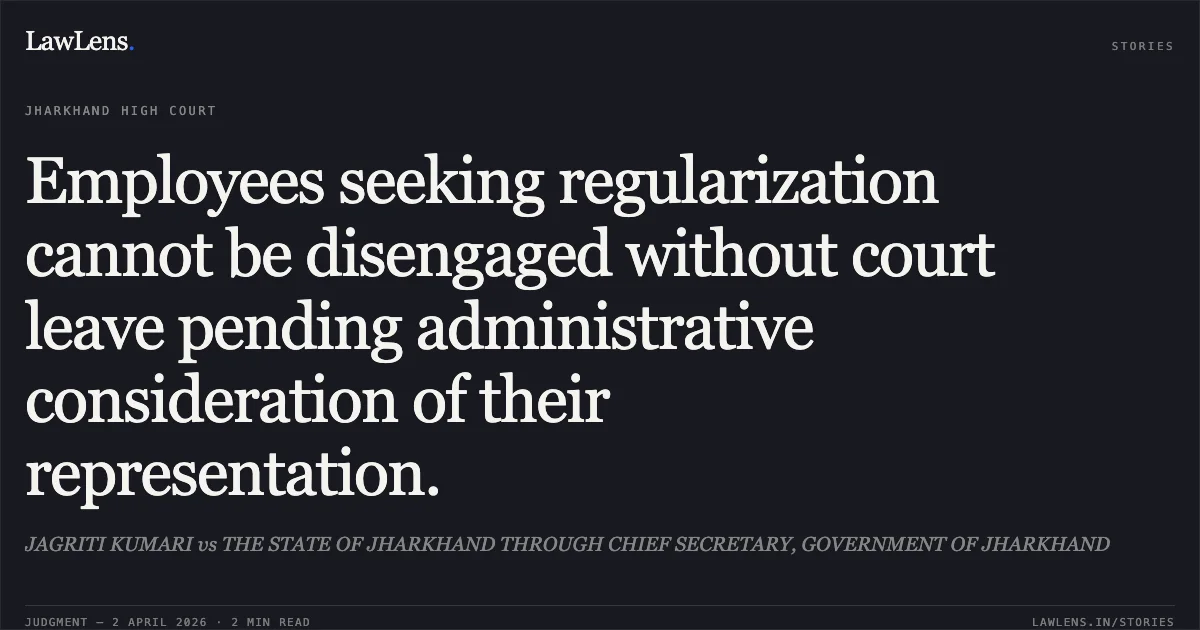
Source reference: para. 6.2Crucially, the Court directed that the petitioner shall not be disengaged during the intervening period without the Court's leave and that the respondents must ensure regular payment of her salary.
Source reference: para. 6.4Original Court PDF
JAGRITI KUMARIvsTHE STATE OF JHARKHAND THROUGH CHIEF SECRETARY, GOVERNMENT OF JHARKHAND
Click to open original judgment
Original judgment, available to read, download and summarize on LawLens.in


![Subsequent exoneration does not retrospectively invalidate a finalized promotion select list.. UNNIKRISHNAN M vs M/o Environment And Forests. CAT - ['Ernakulam']. LawLens](/stories/thumbnails/subsequent-exoneration-does-not-retrospectively-invalidate-a-finalized-promotion-select-li-ce80a0e84f2f4887857271e8b4341c42.webp)