01Facts
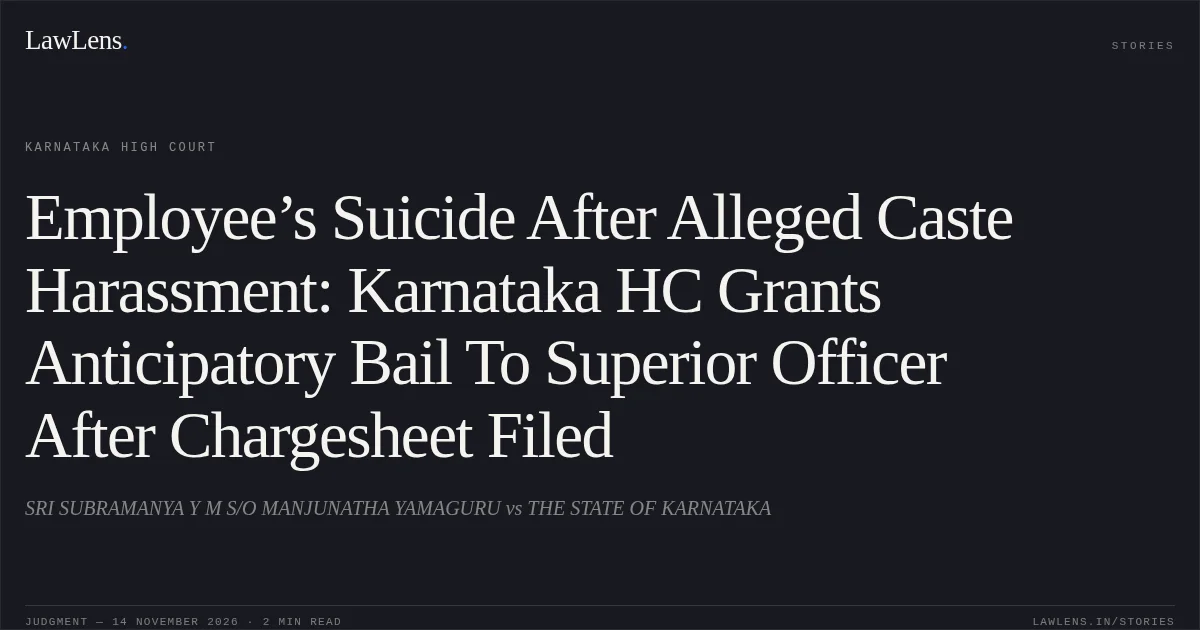
The complainant, the deceased’s wife, alleged that the deceased, a Scheduled Caste employee of SKDRDP, was harassed by the appellant, his superior, including through caste-based abuse and criticism of his work and leave. She alleged that the harassment contributed to her husband’s suicide.
¶ 1–4The FIR registered offences under Sections 108 and 352 read with Section 3(5) of the Bharatiya Nyaya Sanhita, 2023 (BNS), and Sections 3(1)(r), 3(1)(s) and 3(2)(v) of the Scheduled Castes and the Scheduled Tribes (Prevention of Atrocities) Act, 1989 (SC/ST Act).
¶ 1–4The Sessions Court rejected the appellant’s application for anticipatory bail, leading to this appeal under Section 14A(2) of the SC/ST Act.
¶ 1, 702Issues
i.1. Whether the bar on anticipatory bail under Sections 18 and 18A of the SC/ST Act precluded relief to the appellant in the circumstances of the case.
¶ 9–11ii.2. Whether the appellant had established grounds for anticipatory bail, having regard to the allegations, the status of the investigation and the circumstances on record.
¶ 11–1703Law Applied
Section 14A(2) of the SC/ST Act provides for an appeal against an order refusing bail. Sections 18 and 18A of the Act restrict anticipatory bail in cases involving offences under the Act.
¶ 10As the appellant argued, Prathvi Raj Chauhan v. Union of India recognizes that the bar does not apply where the complaint fails to disclose a prima facie case under the Act.
¶ 10The Sessions Court’s reliance on Shajan Skaria v. State of Kerala was noted.
¶ 9The alleged offences were under Sections 108 and 352 read with Section 3(5) BNS, and Sections 3(1)(r), 3(1)(s) and 3(2)(v) of the SC/ST Act.
¶ 1Provisions in the judgment · 6 · Linked ones open on LawLens
Scheduled Castes and the Scheduled Tribes (Prevention of Atrocities) Act, 1989 Section 3Section 18
Bharatiya Nyaya Sanhita, 2023 Section 108Section 352Section 3
Bharatiya Nagarik Suraksha Sanhita, 2023 Section 482
04Reasoning
The Court considered the allegations of caste-based abuse and harassment, as well as the parties’ competing submissions on the statutory bar.
It noted that the deceased and appellant did not work in the same office premises and that SKDRDP was described as an organisation functioning on the basis of a public trust rather than a Government office.
¶ 16Taking account of the nature of the allegations, the material on record, completion of the investigation and filing of the charge sheet, and the appellant’s undertaking to cooperate if required, the Court found that anticipatory bail was warranted subject to stringent conditions.
¶ 15–1705Holding
The High Court allowed the appeal and set aside the Sessions Court’s order rejecting anticipatory bail.
pp. 9–11 · ¶ 17It directed the appellant to appear before the jurisdictional Court within 15 days of receiving a certified copy of the order and execute a personal bond of ₹2,00,000 with two sureties for the like sum.
pp. 9–11 · ¶ 17The relief was subject to conditions, including non-interference with witnesses, cooperation with the investigation, restrictions on leaving the Trial Court’s jurisdiction without permission, and attendance at hearings unless exempted.
pp. 9–11 · ¶ 17Original Court PDF
SRI SUBRAMANYA Y M S/O MANJUNATHA YAMAGURUvsTHE STATE OF KARNATAKA
Click to open original judgment
Original judgment, available to read, download and summarize on LawLens.in