Facts
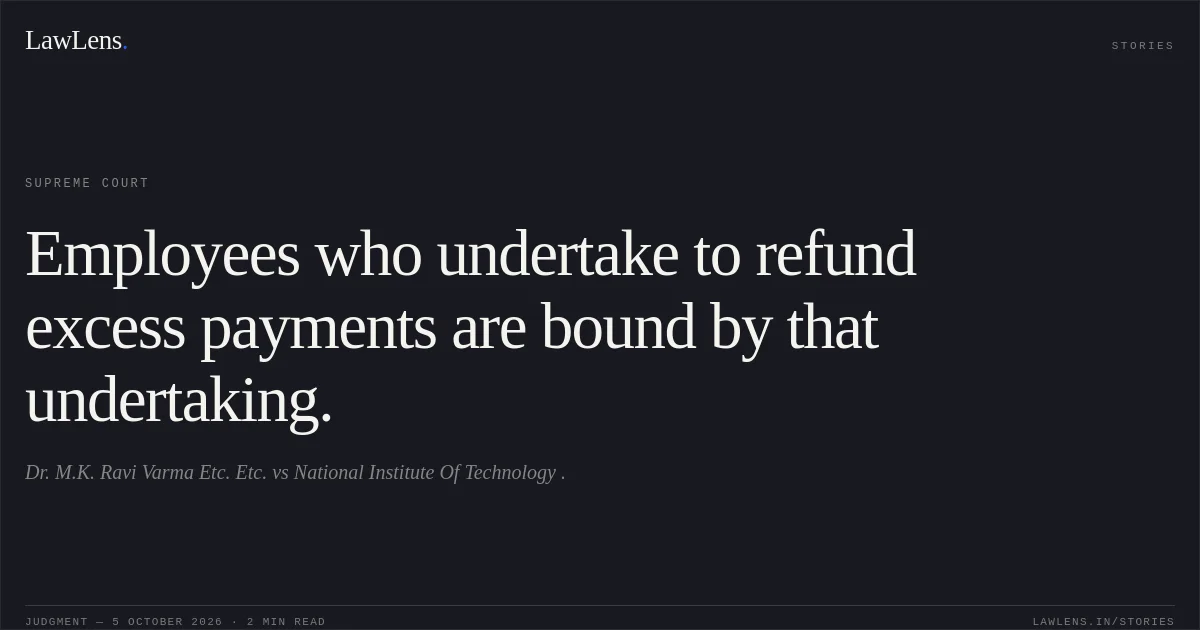
The appellants, Lecturers/Assistant Professors, received financial benefits following the grant of Academic Grade Pay in or about October 2009. The benefits were withdrawn and amounts recovered in January 2010 after the respondents found that the appellants lacked the required years of service. The appellants had given undertakings permitting recovery if their pay fixation was found erroneous.
Source reference: para. 4, 18–20The Single Judge allowed their writ petitions, but the Division Bench reversed that decision. The appellants appealed to the Supreme Court.
Source reference: para. 1, 19–20Issues
1. Whether the respondents could withdraw and recover financial benefits mistakenly paid to the appellants, where the appellants had not misrepresented facts or committed fraud.
Source reference: para. 4–5, 16–202. Whether the appellants’ undertakings and the circumstances of the case permitted recovery notwithstanding the principles in Rafiq Masih.
Source reference: para. 16–20Law Applied
Section 72 of the Indian Contract Act, 1872 requires a person who receives money by mistake to repay it; the Court observed that the reasoning in Chandi Prasad Uniyal v. State of Uttarakhand draws inspiration from this provision.
Source reference: para. 15Chandi Prasad Uniyal establishes that recovery of excess public money does not depend on proof of fraud or misrepresentation, subject to exceptions for extreme hardship.
Source reference: para. 9, 12State of Punjab v. Rafiq Masih (White Washer) identified categories in which recovery would be impermissible, including cases where recovery would be iniquitous, harsh or arbitrary.
Source reference: para. 7Under High Court of Punjab & Haryana v. Jagdev Singh, an employee who gives an undertaking to refund excess payment is bound by it.
Source reference: para. 17Reasoning
The Court found that the benefits had been granted by mistake and promptly withdrawn when the error was detected; the appellants’ undertakings expressly permitted recovery in that event. It therefore considered Jagdev Singh applicable and held that the undertakings supported recovery.
Source reference: para. 18–20The appellants had not pleaded or established that recovery would cause exceptional hardship, and the Court rejected that contention on the record before it.
Source reference: para. 24The later Government instruction against recovery did not assist them because recovery had already occurred before their writ petitions were instituted.
Source reference: para. 21–23The Court accordingly found no basis to interfere with the Division Bench’s decision.
Source reference: para. 20Holding
The Supreme Court dismissed the appeals as without merit, leaving the recovery and the Division Bench’s judgment undisturbed.
The parties were directed to bear their own costs.
Source reference: para. 26, 28Acts & Sections Cited
1 provisions across 1 statute referred to in this judgment. Each provision opens on LawLens.
Indian Contract Act, 18721
Original Court PDF
Dr. M.K. Ravi Varma Etc. Etc.vsNational Institute Of Technology .
Click to open original judgment
Original judgment, available to read, download and summarize on LawLens.in