Facts
The petitioner was appointed as a library attendant by the respondent on 20 January 2007 and regularised on 29 March 2007.
Source reference: p.1Following challenges to appointments made between 1 April 2006 and 11 June 2007, this Court directed an impartial inquiry into their legality.
Source reference: p.1The Inquiry Tribunal found that the appointments were unsupported by sanctioned posts, budgetary provision, proper advertisement, fair scrutiny, or constitutionally compliant procedure, and declared them illegal and void from inception.
Source reference: pp.2–4The respondent accepted the report and, by order dated 11 September 2009, annulled the petitioner’s appointment along with those of similarly situated employees.
Source reference: p.4A challenge to the annulment was dismissed by a Coordinate Bench, which also rejected claims for arrears of salary and subsistence allowance; the decision was affirmed in appeal and the Special Leave Petition was dismissed by the Supreme Court.
Source reference: pp.5–6The petitioner subsequently filed an application under Section 33C(2) of the Industrial Disputes Act, 1947, claiming unpaid wages for the period from 1 April 2007 to 25 September 2009.
Source reference: p.6The Labour Court dismissed the application as not maintainable, holding that the petitioner was bound by the earlier decisions concerning the invalidity of the mass appointments.
Source reference: pp.6–7The petitioner challenged that order under Articles 226 and 227 of the Constitution.
Source reference: p.1Issues
1. Whether the petitioner could maintain a claim under Section 33C(2) of the Industrial Disputes Act for wages arising from an appointment already annulled as illegal and void from inception.
Source reference: pp.6–102. Whether the petitioner could independently claim the benefit of the remedial measures recommended in paragraphs 40 and 41 of the Inquiry Report, notwithstanding the earlier judgments and the compliance report.
Source reference: pp.7–103. Whether the Labour Court’s dismissal of the petitioner’s claim warranted interference under Articles 226 and 227 of the Constitution.
Source reference: p.11Law Applied
The Court applied Articles 226 and 227 of the Constitution, under which writ interference is warranted only where the subordinate court has committed a material error of law or jurisdiction.
Source reference: no citationIt applied Section 33C(2) of the Industrial Disputes Act, 1947, which permits the Labour Court to compute money or benefits already due to a workman but does not create an independent entitlement to wages.
Source reference: no citationThe Court relied on the binding effect of the earlier judgment upholding the annulment of the mass appointments and rejecting claims for arrears of salary.
Source reference: p.9It further considered the principles of quantum meruit reflected in paragraphs 40 and 41 of the Inquiry Report, under which limited compensation could be considered for employees who had actually and sincerely rendered services, subject to identification by the committee and fulfilment of the prescribed conditions.
Source reference: pp.3–4Reasoning
The Court held that the legality of the petitioner’s appointment had already been conclusively determined through the earlier proceedings, which concerned the legality and consequences of all appointments made during the relevant period, rather than merely the individual rights of the litigating employees.
Source reference: pp.8–10Since the petitioner belonged to the same class of employees whose appointments were annulled from inception, he could not use Section 33C(2) to re-agitate a claim for wages that had already been rejected in the prior proceedings.
Source reference: pp.9–10The Court also rejected the petitioner’s reliance on the remedial measures in the Inquiry Report because the respondent had produced the compliance report of the nine-member committee, and the petitioner’s name was not included among those found to have actually and sincerely discharged their duties.
Source reference: p.10In the absence of any challenge or material showing that the compliance report was incorrect, incomplete, or prepared contrary to the Court’s directions, no basis existed to grant the claimed benefit.
Source reference: p.10Holding
The Court answered the issues against the petitioner.
It held that the petitioner’s wage claim under Section 33C(2) was not maintainable because it was founded on an appointment annulled as illegal from inception and sought to revive a claim already rejected in earlier proceedings.
Source reference: pp.9–10The petitioner was also not entitled to the limited quantum meruit benefit under the Inquiry Report, as he was not identified as eligible in the compliance report.
Source reference: p.10Finding no error warranting interference under Articles 226 or 227, the Court dismissed the writ petition and disposed of any pending applications.
Source reference: p.11Original Court PDF
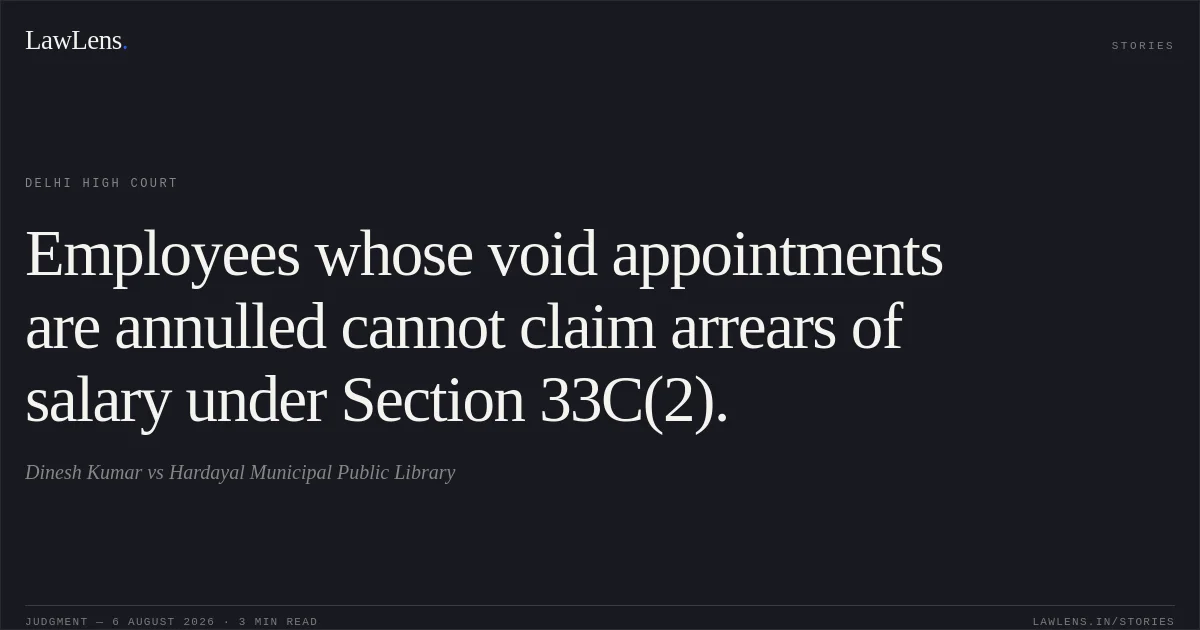
Dinesh KumarvsHardayal Municipal Public Library
Click to open original judgment
Original judgment, available to read, download and summarize on LawLens.in